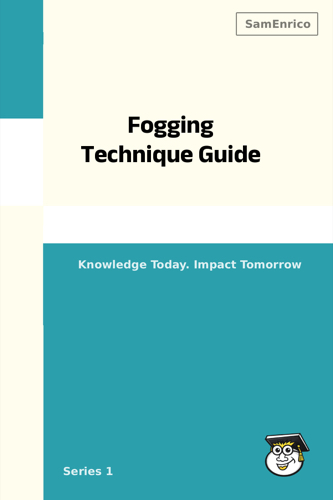
Fogging Technique Guide eBook
Agrees with valid criticism without changing your
by Kenny Melita
Agrees with valid criticism without changing your boundary position.
Formats
Free sample
Chapter 1: Beyond Blind Defense--The call came at 4:47 PM on a Wednesday. Sarah, a senior marketing manager I’ll call her, had just finished a presentation she’d spent eighteen hours preparing. Her boss’s voice was flat. “The client didn’t like the direction. We need to redo the whole deck by Friday.
What happened here?”Sarah felt her stomach drop. Then her jaw tightened. Then the words began pouring out: “Well, the brief was ambiguous, and I didn’t get final approval from legal until Tuesday, and honestly the client changed their requirements three times, and I was working with incomplete data, and if we had more resources this wouldn’t have happened, and…”She stopped because her boss had stopped listening. He was already typing an email. The conversation was over.
She had won nothing except the exhausted satisfaction of having explained herself into oblivion.That night, Sarah told me: “I know I sounded defensive. I couldn’t stop myself. It’s like my mouth just starts running and I’m watching from outside my body.”I told her something that surprised her. “You’re not broken. You’re not weak.
You’re not even unusually defensive. You are a normal human being with a normal nervous system that has been trained by evolution and experience to treat criticism as a survival threat. And that training is ruining your life one conversation at a time.”This chapter is about why that training happened, why it persists, and why the first step to freedom is not learning new techniques but recognizing the cage you’re already in.The Biological Lie Your Brain Tells You Let’s start with something most assertiveness books get dangerously wrong. They assume that defensiveness is a psychological problem—a sign of low self-esteem, inadequate boundaries, or unresolved childhood issues. They tell you to “work on yourself” before you can learn to handle criticism.This is backwards and unhelpful.Your defensive reactions are not primarily psychological.
They are biological. Your brain is doing exactly what it evolved to do. The problem is not your brain. The problem is that your brain cannot tell the difference between a lion and a lecture.Here’s what happens inside you when someone criticizes you. Your sensory thalamus registers the criticism.
Within milliseconds, it sends a signal directly to your amygdala—the brain’s threat detection center. Your amygdala does not stop to analyze whether the threat is physical or verbal, legitimate or illegitimate, fair or unfair. It simply sounds the alarm.Within one second, your sympathetic nervous system activates. Your adrenal glands release epinephrine and norepinephrine. Your heart rate increases by 20 to 30 beats per minute.
Your breathing becomes shallow and rapid. Blood flows away from your digestive system and toward your large muscles. Your pupils dilate. Your non-essential cognitive functions—including creative thinking and long-term planning—shut down. Your brain prioritizes only one thing: survival.This is the fight-or-flight response.
It takes less than two seconds from criticism to full physiological activation. And here is the crucial point: this response is completely automatic. You do not choose it. You cannot reason your way out of it. It is a reflex.Your ancestors needed this reflex.
When a predator appeared, the ones who stopped to analyze whether it was really a threat got eaten. The ones who reacted first survived. You are descended from the reactors, not the philosophers.But here is the problem. Your amygdala cannot distinguish between a predator and a peer. It cannot tell the difference between “that rustling grass might be a tiger” and “that comment about my presentation might be unfair.” Both trigger the same cascade.
Both prepare you for battle.So when your boss says “This needs work,” your body prepares to fight a tiger. Your muscles tense. Your heart pounds. Your higher cognition dims. And you do what your biology demands: you defend yourself.This is not a character flaw.
This is not low self-esteem. This is not weakness. This is your nervous system doing its job. The problem is that its job description is fifty thousand years out of date.The Hidden Cost of Winning Arguments Here is where things get counterintuitive. Defending yourself feels urgent.
It feels necessary. It feels like the only reasonable response to an attack.But feelings are not facts. And in the case of verbal criticism, the defensive reflex is not protecting you. It is trapping you.Every time you defend yourself, you are sending two messages. One is to the critic: “Your words matter enough to require my response.
You have the power to disrupt my nervous system. Please use this power again whenever you wish.”The second message is to yourself: “I am not safe as I am. I must prove my worth in every exchange. My value is contingent on others’ approval.”These messages are not harmless. They accumulate.
Over months and years, they harden into beliefs. And those beliefs become the architecture of your invisible cage.Let me show you what I mean. Consider two people receiving the same criticism: “This report is late.”Person A, who has trained themselves out of the defensive reflex, feels a brief flicker of discomfort. Then their higher brain engages. They think: “The report is late.
That’s a fact. The critic is pointing out a fact. I can agree with the fact without agreeing that I am a bad person.” They say: “You’re right, it’s late. I’ll have it by tomorrow.”The interaction lasts ten seconds. They feel fine afterward.
They do not ruminate. They do not replay the conversation. They do not lose sleep.Person B, who has not yet learned to interrupt the defensive reflex, feels a spike of physiological arousal. Their amygdala hijacks their prefrontal cortex. They think: “This is an attack.
I must defend myself.” They say: “It’s late because legal took two days to approve the compliance section, and IT had a server outage, and I was waiting on data from your team actually.”The interaction lasts three minutes. They feel exhausted afterward. They replay the conversation for the next two hours, refining their counter-arguments. They check their phone repeatedly to see if the critic has responded. They have trouble sleeping.
They wake up still rehearsing.Person B has won the argument. They have provided excellent reasons for the delay. Their explanation is thorough, accurate, and persuasive. And they are miserable.This is the hidden cost of winning. Every justification you offer, every fact you cite, every counter-argument you deploy is a small victory that costs you your peace.
You are winning battles and losing the war for your own mind.The Justification Addiction Let me name something you have probably never admitted aloud: explaining yourself feels good.Not in the moment—in the moment it feels desperate and urgent. But afterward, when you have successfully justified your actions, when you have persuaded the critic (or at least yourself) that you were right, there is a small hit of relief. A tiny dopamine reward. You did it. You survived.
You won.This is the justification addiction. And it is every bit as real as any other behavioral addiction.The cycle works…
This is the end of the free sample. Get the eBook to keep going. Buy now
About this book
Details
- Author
- Kenny Melita
- Publisher
- SamEnrico
- Language
- English
- Genre
- Non-Fiction, Self-Help / Technique
- Released
- 2026-06-06
- Pages (approx.)
- 137
- Available as
- eBook, Audiobook

Read better in the ZLOADR app
Your eBooks on your phone or tablet. Sign in with your SamEnrico account and start reading.
More by Kenny Melita
 Subscription RetentionKenny Melita$11.99
 Ground Search Dog FailuresKenny Melita$11.99
 Twin Identity Low Self WorthKenny Melita$11.99
 The Follow Up Question HandbookKenny Melita$11.99
 Meth and Brain RecoveryKenny Melita$11.99
 Essay Writing For AssignmentsKenny Melita$11.99
 Celebrity Gambling AddictionKenny Melita$11.99
 The Silent Tides of Empire: Portugal's Voyagers and the Birth of the Global AgeKenny Melita$11.99
 The Condottiero: Andrea Doria and the Naval Revolution of the Italian WarsKenny Melita$11.99
 How to Start a Amusement Park Business (Beginners Guide)Kenny Melita$11.99
 Understanding Werdnig-hoffman DiseaseKenny Melita$11.99
 A Collector's Handbook to the Daimler Light Straight 8Kenny Melita$11.99