
Non-FictionHealth & WellnessAlcohol
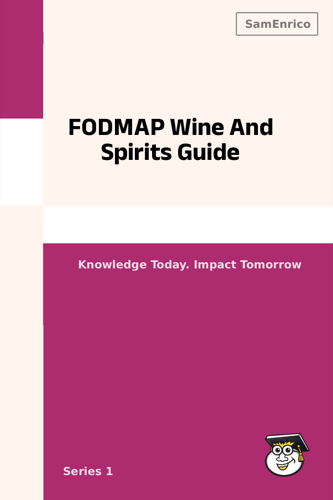
FODMAP Wine And Spirits Guide eBook
Identifies low FODMAP alcoholic beverages.
by Sauls Lacy
Identifies low FODMAP alcoholic beverages.
Formats
Free sample
Chapter 1: Beyond The Plate--–- It was a Tuesday evening when Sarah, a 34-year-old marketing director, did everything "right." She had spent six months meticulously following a low-FODMAP diet, eliminating garlic, onions, wheat, and dairy. She could finally eat a full meal at a restaurant without rushing to the bathroom afterward. Her bloating had diminished. The brain fog that had plagued her for years had lifted. She felt, for the first time since her IBS diagnosis, like a normal human being.Then came the wedding.The ceremony was lovely.
The conversation was warm. And when the champagne toast arrived—a single, elegant flute of bubbly—Sarah hesitated for only a moment before accepting. "It's just one drink," she told herself. "Alcohol doesn't have FODMAPs. Everyone says that." She sipped slowly, savored the celebration, and went home feeling fine.At 2:00 AM, she woke to abdominal pain so intense she curled into a fetal position.
The bloating returned like an old enemy. The diarrhea lasted two days.Sarah spent the next week convinced she had somehow accidentally eaten garlic or onion. She re-read every restaurant menu. She scrutinized every ingredient label. She found nothing.
And so she arrived at a conclusion that thousands of IBS sufferers have reached before her: "I guess I just can't drink alcohol at all."She was wrong. But she wasn't stupid.Sarah's story is not a story about failure. It is a story about missing information. She had learned the low-FODMAP diet from excellent sources—best-selling books, reputable websites, even a registered dietitian. All of them taught her about food.
None of them taught her about fermentation, residual sugars, or the critical difference between a FODMAP reaction and a gut irritation reaction. She did not know that a bone-dry champagne and a sweet Prosecco are chemically different animals. She did not know that the same glass of wine that destroys her gut might be perfectly safe for her best friend who also has IBS. She did not know that her "right" behavior—eliminating food FODMAPs—had left her completely unprepared for the hidden fermentable sugars lurking in her celebratory toast.This book exists because Sarah's story is not an exception. It is the rule.The Great Blind Spot in Low-FODMAP Literature Over the past decade, the low-FODMAP diet has transformed the treatment of irritable bowel syndrome.
Developed by researchers at Monash University in Australia, the diet has helped millions identify and eliminate the fermentable carbohydrates that trigger their symptoms. The evidence is overwhelming: approximately 50-80% of IBS patients experience significant symptom improvement on a low-FODMAP diet. Best-selling books like The Complete Low-FODMAP Diet, The Low-FODMAP Recipe Book, and IBS-Free at Last have become essential resources for patients and practitioners alike.But these books share a curious blind spot. They dedicate hundreds of pages to vegetables, fruits, grains, dairy, and processed foods. They offer detailed charts of which beans are safe and which onions are dangerous.
They provide elimination protocols, reintroduction schedules, and thousands of recipes. And then, in almost every case, they address alcohol in a single paragraph—often a warning paragraph that says something vague like "alcohol can irritate the gut" or "many people with IBS find that alcohol triggers their symptoms."That is not guidance. That is a disclaimer.The result is that millions of people who have successfully managed their food-related FODMAP triggers are left utterly unprepared for social situations, celebrations, and even quiet evenings at home that involve a drink. They either avoid alcohol entirely (which is socially isolating and, for many, unnecessarily restrictive) or they guess—and often guess wrong. They blame themselves.
They blame alcohol. They blame their broken guts.They almost never blame the specific, identifiable, measurable sugars that remain in their drinks after fermentation.What This Chapter Will Teach You By the end of this chapter, you will understand three fundamental concepts that every low-FODMAP book should have taught you but didn't:The fundamental distinction between alcohol itself and the fermentable carbohydrates that often accompany it. Alcohol (ethanol) is not a FODMAP. It does not contain the short-chain carbohydrates that bacteria ferment to produce gas, bloating, and diarrhea. But many alcoholic beverages contain significant amounts of residual sugars—and those sugars are very often FODMAPs.The difference between a true FODMAP reaction and a non-FODMAP reaction to alcohol.
Alcohol can trigger symptoms through multiple mechanisms: increased gut permeability, altered motility, direct irritation of the gut lining, and even histamine or sulfite sensitivity. These are not FODMAP reactions. They require different management strategies. This chapter will teach you to tell the difference so you don't waste time eliminating low-FODMAP drinks that are actually safe for you.The concept of residual sugars and why they vary so dramatically between alcoholic beverages. Not all wines are created equal.
Not all spirits are safe (especially flavored ones). The difference between a low-FODMAP drink and a high-FODMAP drink often comes down to a single decision point: how long fermentation was allowed to continue before the beverage was bottled.These concepts will form the foundation for everything else in this book. Do not skip this chapter. Do not skim it. The specific recommendations in later chapters—the wine charts, the spirit guides, the cocktail recipes, the reintroduction protocols—will make little sense without the conceptual framework you are about to build.Alcohol Is Not a FODMAP: A Biochemical Reality Check Let us begin with a statement so important that it will be repeated throughout this book: Alcohol (ethanol) is not a FODMAP.FODMAP is an acronym that stands for Fermentable Oligosaccharides, Disaccharides, Monosaccharides, And Polyols.
These are specific types of carbohydrates that share two characteristics: they are poorly absorbed in the small intestine, and they are rapidly fermented by gut bacteria. This fermentation produces gas (hydrogen, methane, or both), which causes bloating, distension, and pain. The fermentation also draws water into the large intestine through osmosis, leading to diarrhea.Ethanol is not a carbohydrate. It is a small molecule that is absorbed directly through the stomach lining and small intestine. It does not reach the large intestine intact.
It is not fermented by colonic bacteria in the same way that fructose or sorbitol are fermented. Therefore, ethanol itself cannot cause a FODMAP reaction.This is not opinion. This is basic biochemistry, confirmed by every major research group studying the low-FODMAP diet, including the Monash University team. When Monash tests alcoholic beverages for FODMAP content, they are not testing for ethanol. They are testing for residual sugars—the fructose, glucose, polyols, and other fermentable carbohydrates that remain after fermentation is complete.So why do so many people with IBS report that alcohol triggers their symptoms?
There are three answers to that question, and they are not mutually exclusive.Three Ways Alcohol Can Trigger Symptoms (Only One Is FODMAP-Related)Mechanism One: Gut Irritation and Increased Permeability Alcohol is a known gut irritant. Even in healthy individuals, moderate to heavy alcohol consumption increases the permeability of the intestinal lining—a phenomenon sometimes called "leaky gut." This allows bacteria, bacterial products like lipopolysaccharides, and partially digested food particles to cross the intestinal barrier and trigger an immune response.For someone with IBS, whose gut may already be more reactive than average, even moderate…
This is the end of the free sample. Get the eBook to keep going. Buy now
About this book
Details
- Author
- Sauls Lacy
- Publisher
- SamEnrico
- Language
- English
- Genre
- Non-Fiction, Health & Wellness, Alcohol
- Released
- 2026-06-10
- Pages (approx.)
- 158
- Available as
- eBook, Audiobook

Read better in the ZLOADR app
Your eBooks on your phone or tablet. Sign in with your SamEnrico account and start reading.
More by Sauls Lacy
 Transcendental Meditation for TinnitusSauls Lacy$11.99
 Children's Dream WorkbookSauls Lacy$11.99
 Workplace Environmental Toxin GuideSauls Lacy$11.99
 Sarcopenia Bone Density LinkSauls Lacy$11.99
 Non Stick Pan Toxin GuideSauls Lacy$11.99
 Bipolar Support GroupsSauls Lacy$11.99
 Arthritis And Covid GuideSauls Lacy$11.99
 The Battle of Tsushima: Japan's Naval Triumph in the Sky (1905)Sauls Lacy$11.99
 Bridge Jump SurvivorSauls Lacy$11.99
 The Last Round: How Mike Tyson Lost EverythingSauls Lacy$11.99
 Stanley Meets Livingstone: The Pacific Link to Africa's HeartSauls Lacy$11.99
 The Dancer's Guide to Tribal Style Belly DanceSauls Lacy$11.99
You may also like
 Hong Kong Handover 1997Dunn Johnnie$11.99
 Zumba For Postnatal Recovery CourseNeal Christian$11.99
 Zumba for BeginnersLadner Nikia$11.99
 YouTube Comment Mining GuideHumes Pandora$12.99
 Worry Box MeditationCarlin Rudy$11.99
 Workplace Stress MeditationNguyen Lynn$11.99
 Workplace Stress and Sleep RepairHawley Ivory$11.99
 Workplace Perfectionism CureDelaney Jeffry$11.99
 Workplace Injustice Anger GuideWallen Isabelle$11.99
 Work Addiction and Burnout LinkGreenwood Ester$11.99
 Women in Yoga and WellnessBeattie Galina$11.99
 Women in Stand Up ComedyChun Evangeline$11.99