

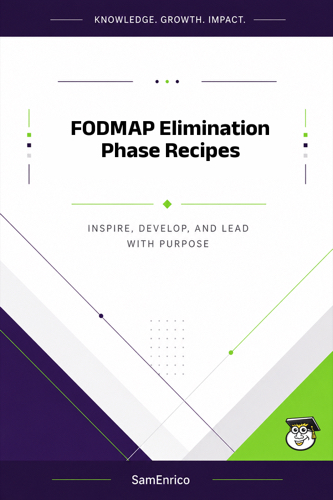
Non-FictionHealth & WellnessElimination Recipes
FODMAP Elimination Phase Recipes eBook
Cook delicious low FODMAP meals during the strict
Cook delicious low FODMAP meals during the strict elimination phase using this practical recipe guide.
Formats
Free sample
Chapter 1: The 2 AM Promise--You are reading this for one of three reasons.Either you are lying on a bathroom floor at an hour when only insomniacs and parents of newborns should be awake, knees pulled to your chest, trying to remember if the bloating was this bad last Tuesday. Or you are sitting at a kitchen table, staring at a plate of plain rice and boiled chicken, wondering if this is what healing is supposed to taste like. Or you are somewhere in between – exhausted, confused, and deeply tired of being told that your symptoms are “just stress” or “normal” or “something you have to live with.”None of those reasons require an apology.This book exists because the low-FODMAP diet works – but the way it is usually taught does not. Most books give you a list of safe foods, a handful of recipes, and a vague instruction to “avoid garlic and onion for six weeks.” Then they send you off to fail alone. You end up eating the same three meals until you would rather be bloated than bored.
You cheat. You feel guilty. You assume the diet does not work for you.That is not what is happening here.What follows is a 10-day plan. Not six weeks of vague hope. Not a lifetime sentence to bland food.
Ten days to quiet your gut. Ten days to prove that your body is capable of feeling better. And after those ten days, you will stay in the elimination phase for another two to five weeks – because healing takes time, and because rushing reintroduction is how people misidentify their triggers. But the hardest part, the part where you feel lost and hungry and sorry for yourself, lasts only ten days.This is the 2 AM Promise: You will eat garlic again. Not today.
Not next week. But soon. This book is not a life sentence. It is a six-week rental. Give me ten days of strict eating, and I will give you the quietest gut you have had in years.
Then we will find exactly which foods are your enemies – not the internet’s enemies, not your friend’s enemies, yours.Let us begin with the truth about why you have not gotten better yet.Why Most People Fail (And Why You Will Not)The low-FODMAP diet has been studied more rigorously than almost any other dietary intervention for irritable bowel syndrome. Multiple randomized controlled trials show that 50 to 80 percent of patients experience significant symptom relief during the elimination phase. Those are remarkable numbers. No medication comes close.And yet, in real life, most people abandon the diet before they reach the reintroduction phase. They quit.
They decide it does not work. They tell their friends it was too hard.The problem is not the science. The problem is the delivery.Based on surveys of thousands of low-FODMAP dieters and interviews with registered dietitians who specialize in this protocol, the barriers to success fall into five categories. They are ranked here by how frequently they derail people – not by how important they seem, but by how many people actually quit because of them.The Single Biggest Barrier: Decision Fatigue Sixty-eight percent of people who abandon the low-FODMAP diet cite the same reason: they were exhausted by constantly having to figure out what to eat. This is not weakness.
This is how human brains work. Every decision you make – what to wear, what to reply to an email, what to cook for dinner – draws from a finite pool of cognitive energy. When that pool runs dry, you default to whatever is easiest. For most people, the easiest option is not a low-FODMAP meal. It is takeout.
It is leftovers from before the diet. It is the garlicky pasta that made you sick last time but requires zero decisions.Decision fatigue is the reason meal prep is not optional on this diet. It is the reason this book includes a full chapter on batch cooking. It is the reason the recipes in Part 2 are designed to be assembled, not invented. You do not need more willpower.
You need fewer decisions.The Second Barrier: Missing Garlic and Onion Fifty-two percent of people who quit say they could not tolerate the flavor loss. This is understandable. Garlic and onion are the backbone of most savory cooking in Western cuisine. Removing them feels like removing color from a painting.What most people do not know – and what this book will teach you – is that you are not actually removing allium flavor. You are transferring it.
Garlic-infused olive oil contains the flavor of garlic without the FODMAPs. The green tops of scallions and chives provide onion flavor without the fructans. Asafoetida, a spice used in Indian cooking for exactly this purpose, tastes remarkably like garlic and onion when cooked in oil.You will not eat bland food. You will eat differently seasoned food. And after three days, you will stop missing what you lost.The Third Barrier: Hidden Ingredients in Processed Foods Forty-three percent of people who struggle on this diet do so because they are unknowingly eating high-FODMAP ingredients hidden in “safe” foods.
A gluten-free pasta that contains inulin. A “natural flavor” that is garlic powder in disguise. A can of soup that lists “vegetable broth” – which almost always means onion and garlic.This is not your fault. Food manufacturers are not trying to trick you. They are trying to make food taste good using inexpensive ingredients.
But the result is that you cannot trust a label until you learn to decode it. This book dedicates an entire chapter to label reading because guessing is not a strategy.The Fourth Barrier: Unmanaged Cravings Thirty-eight percent of people report that cravings – for sweets, for carbs, for something that tastes like normal food – drive them to cheat. Cravings are not moral failures. They are biological signals. Your body is accustomed to certain flavors and certain sources of energy.
When you remove them, your brain sends distress signals. That is not weakness. That is neurology.The solution is not willpower. The solution is planned emergency snacks. You will not resist a donut at work if your only alternative is hunger.
You will resist it if you have a maple cinnamon popcorn bar in your desk drawer.The Fifth Barrier: Stopping Too Early Twenty-nine percent of people who fail the low-FODMAP diet do so because they feel better after one week and assume they are done. Then they reintroduce high-FODMAP foods immediately, react, and conclude that the diet does not work.This is tragic because it is avoidable. The elimination phase is designed to last two to six weeks – not because you need to suffer, but because your gut needs time to heal. Inflammation does not disappear in seven days. Even after your symptoms stop, your intestinal lining is still repairing itself.
Rushing reintroduction is like taking a cast off a broken bone because it stopped hurting. The bone is still fragile.These five barriers are not insurmountable. They are predictable. And this book has been structured to address each one in the order it typically appears: first decision fatigue (Chapter 3), then flavor loss (Chapter 2), then hidden ingredients (Chapter…
This is the end of the free sample. Get the eBook to keep going. Buy now
About this book
Details
- Author
- Mchugh Hunter
- Publisher
- SamEnrico
- Language
- English
- Genre
- Non-Fiction, Health & Wellness, Elimination Recipes
- Released
- 2026-06-11
- Pages (approx.)
- 147
- Available as
- eBook, Audiobook

Read better in the ZLOADR app
Your eBooks on your phone or tablet. Sign in with your SamEnrico account and start reading.
More by Mchugh Hunter
 Retirement Loneliness RecoveryMchugh Hunter$11.99
 Credit Agreement DatabaseMchugh Hunter$11.99
 Free Audio Recording StackMchugh Hunter$11.99
 The Algorithm That Stole the Election: How AI Shaped 2016Mchugh Hunter$11.99
 The Silk Road's Last Messenger: A Caravan of SecretsMchugh Hunter$11.99
 Understanding Cennamo–gangemi SyndromeMchugh Hunter$17.99
 ESG Performance vs Financial ReturnsMchugh Hunter$12.99
 Proposal Training Plan GuideMchugh Hunter$12.99
 Ramp AgentMchugh Hunter$11.99
 How to Start a Postage Meters Business (Beginners Guide)Mchugh Hunter$11.99
You may also like
 Hong Kong Handover 1997Dunn Johnnie$11.99
 Zumba For Postnatal Recovery CourseNeal Christian$11.99
 Zumba for BeginnersLadner Nikia$11.99
 YouTube Comment Mining GuideHumes Pandora$12.99
 Worry Box MeditationCarlin Rudy$11.99
 Workplace Stress MeditationNguyen Lynn$11.99
 Workplace Stress and Sleep RepairHawley Ivory$11.99
 Workplace Perfectionism CureDelaney Jeffry$11.99
 Workplace Injustice Anger GuideWallen Isabelle$11.99
 Work Addiction and Burnout LinkGreenwood Ester$11.99
 Women in Yoga and WellnessBeattie Galina$11.99
 Women in Stand Up ComedyChun Evangeline$11.99