
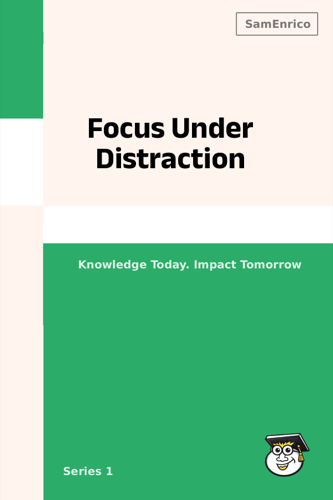
Non-FictionBusiness BriefAttention Management
Focus Under Distraction eBook
Reveals techniques for maintaining concentration i
Reveals techniques for maintaining concentration in open offices and noisy environments.
Formats
Free sample
Chapter 1: The 23-Minute Tax–- The first time a colleague’s phone rang while you were deep in thought, you probably blamed the phone. The second time, you blamed the colleague. By the fiftieth time, you blamed yourself. Why can’t I just focus? you muttered, tightening your jaw, staring harder at the screen, willing your brain to ignore the noise.
It didn’t work. It never works. And here is the liberating truth that will reframe everything in this book: it was never your fault.This chapter opens by reframing the open office not as a benign workspace but as a physiological stressor. The modern open-plan office—with its exposed brick, communal tables, and proudly unstructured “collaborative environment”—is not merely annoying. It is, in a very real biological sense, an assault on the ancient architecture of your attention.
Your brain did not evolve to process multiple, unpredictable auditory streams while performing analytical tasks. It evolved to notice a twig snapping in the tall grass, to pivot toward a sudden cry, to register the rustle of a predator behind you. That reflexive shift of attention—the orienting response—saved your ancestors’ lives. It is automatic, preconscious, and utterly indifferent to your quarterly report.The open office, then, is not a design flaw. It is a design feature—for a brain that no longer exists.
And the first step toward mastering focus under distraction is to stop fighting your biology and start understanding it.The Myth of the Strong-Willed Worker Let us begin with a simple experiment you can perform right now, wherever you are reading this. Close your eyes for five seconds. Then open them and count how many distinct sounds you hear. The hum of a laptop fan. The distant murmur of conversation.
A car passing outside. Your own breathing. Now try something harder: choose one of those sounds—say, the hum of the fan—and try to completely ignore the others. Do not hear the car. Do not hear the voices.
Only the fan.You cannot do it. Not because you lack discipline, but because the human auditory system does not have an “off” switch. Hearing is not a choice. Your ears collect sound continuously, and your brain processes that sound for threat value before you have any conscious say in the matter. This happens in the inferior colliculus and the superior temporal gyrus, deep in the brain’s auditory cortex, in less than 200 milliseconds.
By the time you decide whether to pay attention to a sound, your brain has already decided for you whether that sound might be important.This is the orienting response, first described by Russian physiologist Ivan Pavlov (yes, the same Pavlov of the dogs) and later refined by psychologists like Francis Graham and Sokolov. The orienting response is the brain’s radar system. It scans the environment for novelty, for change, for potential threat. A steady, predictable sound—the fan, the HVAC, the rain outside—eventually habituates. Your brain learns to ignore it because it carries no information.
But unpredictable sounds—a sudden laugh, a ringing phone, a colleague’s voice rising in question—trigger a full orienting response: head turn, pupil dilation, heart rate deceleration, and a cascade of cortical resources redirected toward the new stimulus.Here is the cruel irony: your brain treats a nearby conversation exactly the same way it would treat a twig snapping behind you in the forest. Not because you are anxious or weak, but because the neural circuitry is 400 million years old and has not received the memo about quarterly earnings reports.Willpower, then, is not the solution. You cannot will yourself to override an automatic, reflexive, subcortical process any more than you can will yourself to stop blinking when something approaches your eye. The myth of the strong-willed worker—the fantasy that discipline alone can conquer distraction—has caused incalculable suffering in open offices. Millions of workers have silently berated themselves for being “lazy” or “unfocused” while their brains were simply doing exactly what evolution designed them to do.The Switch Cost: Uncovering the Hidden Tax If the orienting response is automatic, the recovery from that response is agonizingly slow.
This brings us to the single most important metric in this book: the switch cost.The switch cost was first rigorously measured by psychologists like Joshua Rubinstein, David Meyer, and Jeffrey Evans in a landmark 2001 study published in the Journal of Experimental Psychology. They asked participants to switch between simple tasks—sorting geometric shapes by one rule, then by a different rule—and measured the time lost with each switch. The result: even with trivial tasks, each switch cost a fraction of a second. With complex, cognitive tasks like writing, coding, or data analysis, that cost explodes.More recent research, including work by Gloria Mark at the University of California, Irvine, has tracked knowledge workers in real office environments using computer logging and biometric sensors. Her findings are staggering: after an interruption, it takes an average of 23 minutes and 15 seconds to return to the original task at full cognitive depth.Let me repeat that because it will change how you see every interruption for the rest of your career.
Twenty-three minutes. Not 23 seconds. Not two minutes. Twenty-three minutes.What happens in those 23 minutes? The process is not a simple “resume play” on a paused movie.
Here is the actual sequence:The Interruption Itself (5–30 seconds): A sound or person breaks your attention. You look up. Your brain registers the novel stimulus. Your working memory, which was holding the context of your task, begins to degrade immediately.The Decision (3–10 seconds): You decide whether to respond. Even if you decide not to respond, the decision itself is cognitive work.
You cannot skip this step. The brain cannot ignore a novel sound without first evaluating it.The Engagement (variable): If you do respond—checking the notification, answering the question, looking at who laughed—you add 30 seconds to several minutes of active distraction.The Mental Gear Shift (30–90 seconds): You turn back to your original task. But your brain is not yet ready. The neural networks that were active before the interruption have been partially overwritten. You stare at the screen.
You reread the last sentence. You try to remember what you were about to type.The Context Reconstruction (15–20 minutes): This is the silent killer. Your brain must rebuild the cognitive context of your task: what you had already done, what you were about to do next, what assumptions you were holding, what open questions were pending. This is not fast. It is not automatic.
It is effortful, conscious reconstruction, and it takes roughly 15 to 20 minutes.Add these stages together, and you arrive at that 23-minute figure. The most brutal part? Most people believe they recover in 30 seconds. They do not feel the 23 minutes slipping away because much of it is invisible—the quiet staring at the screen, the slow rereading, the vague sense of “warming up.” The switch cost is a hidden tax, deducted from your cognitive bank account without a receipt.Real-World Devastation: Two Case Studies Let me make this concrete with stories from real workers in real open offices. Names and identifying details have been changed…
This is the end of the free sample. Get the eBook to keep going. Buy now
About this book
Details
- Author
- Pollack Edgardo
- Publisher
- SamEnrico
- Language
- English
- Genre
- Non-Fiction, Business Brief, Attention Management
- Released
- 2026-06-07
- Pages (approx.)
- 137
- Available as
- eBook, Audiobook

Read better in the ZLOADR app
Your eBooks on your phone or tablet. Sign in with your SamEnrico account and start reading.
More by Pollack Edgardo
 Emotional Affair RecoveryPollack Edgardo$11.99
 Email Automation Platform ComparisonPollack Edgardo$11.99
 Stress and Nausea GuidePollack Edgardo$11.99
 Menopause And Insomnia GuidePollack Edgardo$11.99
 Weekly Learning Review GuidePollack Edgardo$11.99
 Jennifer Doudna CRISPR PioneerPollack Edgardo$11.99
 Academic Confidence HypnosisPollack Edgardo$11.99
 The Merger That Shook the World: How a 1989 Hostile Takeover Redefined Corporate RomancePollack Edgardo$11.99
 Galahad's Forbidden GrailPollack Edgardo$11.99
 Mastering Inflation Tax: Hidden Money PrintingPollack Edgardo$11.99
 How to Become a Cotton-roll PackerPollack Edgardo$11.99
 Ghana Currency Risk WorkbookPollack Edgardo$12.99
You may also like
 Hong Kong Handover 1997Dunn Johnnie$11.99
 Zumba For Postnatal Recovery CourseNeal Christian$11.99
 Zumba for BeginnersLadner Nikia$11.99
 YouTube Comment Mining GuideHumes Pandora$12.99
 Worry Box MeditationCarlin Rudy$11.99
 Workplace Stress MeditationNguyen Lynn$11.99
 Workplace Stress and Sleep RepairHawley Ivory$11.99
 Workplace Perfectionism CureDelaney Jeffry$11.99
 Workplace Injustice Anger GuideWallen Isabelle$11.99
 Work Addiction and Burnout LinkGreenwood Ester$11.99
 Women in Yoga and WellnessBeattie Galina$11.99
 Women in Stand Up ComedyChun Evangeline$11.99