
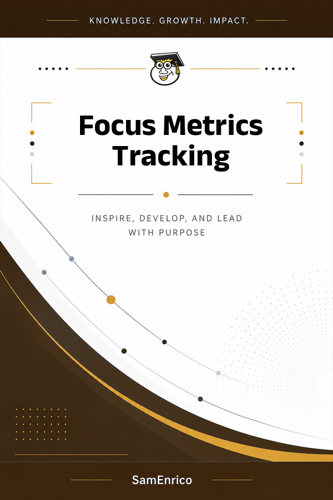
Focus Metrics Tracking eBook
Measure focus time, interruption frequency, and re
Measure focus time, interruption frequency, and recovery speed objectively.
Formats
Free sample
Chapter 1: The Twenty-Three Minute Heist--You are about to lose two hours of your day. Not at the end of it, not because of a long meeting or a late-breaking emergency, but in the next ninety minutes alone. You will not feel it happening. You will not remember it afterward. And when someone asks you what you accomplished today, you will say “not much” with a vague sense of shame that has become as routine as your morning coffee.The theft is already in progress.It began the moment you glanced at your phone while reading the previous sentence.
Or perhaps it started when you thought “I should respond to that email” before finishing this paragraph. Or maybe it has not happened yet—but it will, because the structure of your workday has been engineered to ensure it does.This is not a metaphor. This is not productivity-guru hyperbole. This is a literal, measurable, peer-reviewed fact: a single, seemingly insignificant interruption costs the average knowledge worker twenty-three minutes and fifteen seconds of cognitive output. Not twenty-three minutes of clock time.
Twenty-three minutes of focused, productive, meaningful work. The kind of work that actually moves projects forward, generates insights, and produces value.The UC Irvine study that produced this number is now more than a decade old. Since then, the problem has not improved. It has gotten catastrophically worse. The same research team later found that the average screen duration—the amount of time a person spends on a single task before switching—had collapsed from two and a half minutes in 2004 to just forty-seven seconds.
Forty-seven seconds. That is not enough time to read a single page of a book, let alone enter a state of deep concentration.Here is what most people believe: a quick interruption—checking a text, answering a Slack message, glancing at an email notification—costs only the minute or two it consumes. This belief is the most expensive cognitive error in modern work. It is wrong by a factor of roughly ten. And it is costing you between forty and sixty working days every single year.This book exists because that number is not fixed.
It is not a law of nature. It is a baseline—the performance of an untrained, environmentally chaotic, interruption-saturated worker. With measurement, intentionality, and a few structural changes, you can cut that recovery time from twenty-three minutes to under two minutes. You can reclaim those forty to sixty days. You can stop feeling like a passive victim of your notifications and start feeling like the architect of your own attention.But first, you have to see the theft.
And to see it, you have to measure it.The Structure of the Lie Why do so many smart, hardworking people believe that interruptions cost only their surface duration? The answer lies in three cognitive blind spots that affect every human brain.Blind Spot One: The Orientation Lag When you are pulled away from a task—by a notification, a colleague, or your own wandering attention—you do not return to exactly where you left off. Your brain must first locate its place. If you were reading a document, you have to find the last sentence you remember. If you were writing an email, you have to reread the partial draft to reconstruct your unfinished thought.
If you were solving a problem, you have to retrace the steps you already took to remind yourself why you took them.This orientation lag is brief. Usually ten to thirty seconds. But it is pure waste. You are not moving forward. You are not generating new work.
You are simply finding your footing. And because it happens so quickly, your brain discards it from memory. You do not remember the ten seconds of staring at a screen trying to remember what you were doing. You remember the interruption itself—the notification, the question, the distraction—and you remember the work that came after. The gap in between vanishes from your awareness.Blind Spot Two: The Working Memory Reset Here is where the real damage happens.
Your working memory—the brain’s equivalent of a computer’s RAM—can hold only a small amount of information at any given time. While you are focused on a task, that information is active, accessible, and threaded together in a coherent mental model. You know what you have already done, what you are about to do next, and why each step matters.An interruption does not just pause this model. It erases it.When you switch to a different task—even for ten seconds to answer “What time is the meeting?”—your brain unloads the first task’s mental model to make room for the second. This is not a design flaw.
It is an efficiency feature. Your brain cannot hold two complex models simultaneously. So it dumps one, loads the other, and then, when you return to the original task, it has to reload the first model from scratch.That reloading process takes time. A lot of time. The UC Irvine researchers measured it by observing workers in their natural environments and timing exactly how long passed between the end of an interruption and the resumption of productive work at the same intensity and quality as before the interruption.
The average was twenty-three minutes and fifteen seconds.Blind Spot Three: The Cumulative Multiplier The final blind spot is mathematical. Most people think linearly about interruptions. One interruption costs five minutes. Two interruptions cost ten minutes. This is wrong.
Interruptions do not add; they multiply.Consider five interruptions, each lasting one minute. The linear thinker says: five minutes lost. The reality is: five minutes of interruption time plus approximately 115 minutes of recovery time (twenty-three minutes per interruption × five). That is two hours of lost cognitive output from five minutes of surface distraction. The ratio is roughly 1:23.
One minute of interruption costs twenty-three minutes of recovery.This is the Twenty-Three Minute Heist. It happens silently, invisibly, and constantly. And until you measure it, you will continue to believe the lie that the only cost is the few seconds you glanced away from your screen.The Anatomy of a Single Switch To understand what you are losing, let us walk through a single, typical interruption in microscopic detail. This is not a worst-case scenario. This is an average Tuesday morning.Time 0:00 – The Interruption Occurs You are writing a quarterly report.
You have been working on it for forty minutes. You have a clear mental model: the introduction is complete, you are halfway through the financial summary, and you know exactly which chart you need to insert next. Your fingers are moving quickly. The words are flowing. You are in what psychologists call a state of “flow”—effortless concentration where time seems to disappear.Your phone buzzes.
A Slack message from a colleague: “Hey, quick question about the client deadline. Is it the 15th or the 22nd?”You glance at the screen. You type back: “22nd.” Three seconds.Time 0:03 – The Surface Interruption Ends From the outside, the interruption lasted three seconds. You answered the question. You put the phone down.
You look back at the quarterly report. You are ready to resume.Or so you believe.Time 0:03 to 0:25 – Orientation…
This is the end of the free sample. Get the eBook to keep going. Buy now
About this book
Details
- Author
- Lunsford Hyon
- Publisher
- SamEnrico
- Language
- English
- Genre
- Non-Fiction, Self-Help
- Released
- 2026-06-10
- Pages (approx.)
- 139
- Available as
- eBook, Audiobook

Read better in the ZLOADR app
Your eBooks on your phone or tablet. Sign in with your SamEnrico account and start reading.
More by Lunsford Hyon
 Mother Daughter CancerLunsford Hyon$11.99
 Iodine Cognitive Function GuideLunsford Hyon$11.99
 Empathetic Leadership HandbookLunsford Hyon$11.99
 NVC for Scrum MastersLunsford Hyon$11.99
 Tension Headache and BruxismLunsford Hyon$11.99
 Hero Archetype Dream JourneyLunsford Hyon$11.99
 Lying Body Language IndicatorsLunsford Hyon$11.99
 Kirsten Dunst InterviewLunsford Hyon$11.99
 The Phantom of the 405: The Highway Killer Who VanishedLunsford Hyon$11.99
 The Glass Ceiling Cracked: The Untold Story of the First Female Supreme Court JusticeLunsford Hyon$11.99
 The Silk Road Warriors: The Untold Story of Persia's Renaissance ArchersLunsford Hyon$11.99
 Toptal Screening Process GuideLunsford Hyon$12.99
You may also like
 Hong Kong Handover 1997Dunn Johnnie$11.99
 Zumba For Postnatal Recovery CourseNeal Christian$11.99
 Zumba for BeginnersLadner Nikia$11.99
 YouTube Comment Mining GuideHumes Pandora$12.99
 Worry Box MeditationCarlin Rudy$11.99
 Workplace Stress MeditationNguyen Lynn$11.99
 Workplace Stress and Sleep RepairHawley Ivory$11.99
 Workplace Perfectionism CureDelaney Jeffry$11.99
 Workplace Injustice Anger GuideWallen Isabelle$11.99
 Work Addiction and Burnout LinkGreenwood Ester$11.99
 Women in Yoga and WellnessBeattie Galina$11.99
 Women in Stand Up ComedyChun Evangeline$11.99