
Non-FictionInformativeEducational
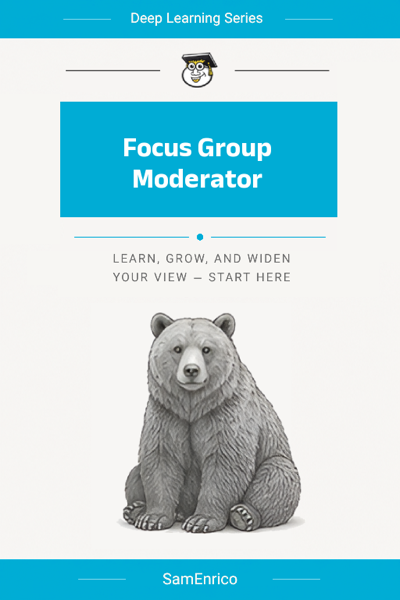
Focus Group Moderator eBook
A Coursebook on Focus Group Moderator
A Coursebook on Focus Group Moderator
Formats
Free sample
Chapter 1: The Silent Architect...--The first time I ruined a focus group, the client didn't fire me. Worse—she thanked me. She said the participants were "lovely" and the insights were "very helpful." I had just spent ninety minutes accidentally steering eight strangers toward the exact answers the client wanted to hear, and no one in the room knew it except me. That night, I sat in my car in the facility parking lot and realized something uncomfortable: I had been hired to uncover truth, but I had performed a lie. I was a silent architect of bad data, and my silence was the problem.This chapter is not a gentle introduction to focus group methodology.
It is an intervention. If you have ever left a meeting knowing that people nodded but didn't agree, or watched a group of smart people produce shallow answers because no one asked the right question, or felt the quiet desperation of a room performing politeness instead of honesty—this chapter is for you. The craft of focus group moderation is not about asking questions. It is about building a temporary world where strangers feel safe enough to tell the truth, and then having the discipline to stay out of their way.I wrote this book because most training materials treat focus group moderation as a series of checklists: recruit this way, write questions that way, analyze that way. Those checklists are necessary.
They are not sufficient. What separates a competent moderator from a master is not technique alone—it is the ability to see the invisible architecture of every conversation and to redesign it in real time without anyone noticing.The Day I Learned I Didn't Know Anything Let me tell you about the group that broke me open.I was twenty-six, working for a boutique research agency, and had been assigned to moderate a series of groups for a major healthcare client. They were testing a new app designed to help patients manage a chronic condition—something intimate, frustrating, and deeply emotional. I had prepared. I had memorized the discussion guide.
I had rehearsed my opening monologue in the mirror. I was ready.The first participant walked in and sat down. She was a woman in her late fifties, wearing a worn jacket and carrying a paper bag that she kept in her lap. She did not make eye contact with anyone. I introduced myself, gave my polished speech about no wrong answers, and asked my first warm-up question: "Tell me about a time you used technology to manage your health."She did not answer.
The other six people looked at her, then at me. I waited—what felt like an eternity, probably four seconds—and then I did the thing that novice moderators always do. I filled the silence. I rephrased the question. I gave an example.
I smiled encouragingly. I was digging a hole with every word.Twenty minutes later, she finally spoke. What she described was not a usability issue. It was shame. She had not been using the existing app because every time she opened it, she was reminded of the day she was diagnosed.
The paper bag in her lap contained her old medication bottles—she had brought them to show someone, anyone, what the last three years had felt like.I had spent twenty minutes asking about "technology adoption" while she sat there holding evidence of a life interrupted. I had been so focused on my discussion guide that I had missed the person in front of me.The client in the back room was frustrated. They wanted data on button placement and color schemes. What they got was a woman crying, six strangers passing tissues, and a young moderator who suddenly understood that focus groups are not about questions and answers—they are about permission.Why This Book Exists Most books on focus group moderation fall into one of two traps. The first trap is the procedural manual—a dry, step-by-step recitation of best practices that reads like a government document.
These books are correct and useless. They tell you what to do but not how to think. The second trap is the war story collection—a series of entertaining anecdotes from veteran moderators that inspire but do not teach. These books are enjoyable and unhelpful. They make you feel like you could do the job until you actually have to do it.This book is neither.
It is a coursebook—a hybrid of rigorous methodology and lived practice. Every chapter includes actionable exercises because reading about moderation without doing it is like reading about surgery without touching a scalpel. You will make mistakes. You will feel awkward. You will, if you are paying attention, occasionally want to crawl under the table.
That is the work. That is how you learn.The book is organized in four parts, mirroring the actual workflow of a professional moderator:Part I (Chapters 1-2) establishes the foundational mindset and competencies. You cannot execute what you do not understand.Part II (Chapters 3-5) covers preparation and strategy—recruiting, discussion guides, logistics. Eighty percent of your success happens before anyone sits down.Part III (Chapters 6-9) takes you inside the room—opening, probing, managing difficult participants, handling sensitive topics.Part IV (Chapters 10-12) moves to analysis, reporting, and the business of moderation. Insights that are not communicated do not exist.Each chapter begins with a narrative hook—a real story from my own practice or the practice of moderators I have trained—because the brain remembers stories longer than it remembers bullet points.
Each chapter ends with an actionable exercise because knowledge without application is entertainment.The Fundamental Distinction: Focus Groups vs. Everything Else Before you can moderate a focus group, you must know when to refuse one. This is not cynicism—it is ethics. I have seen clients spend tens of thousands of dollars on focus groups for questions that focus groups cannot answer, and I have watched moderators nod along because they wanted the work. Do not be that moderator.A focus group is a moderated discussion among a small group of participants (typically 6-10) that focuses on a specific topic, using group interaction to generate data that would not emerge from individual interviews.
The key phrase is "group interaction." If group dynamics are not essential to your research question, you do not need a focus group.Here is the decision flowchart I use with every client, and that I teach every moderator I train:Use a focus group when:You need to observe how people react to and influence each other You are exploring a new topic and want to generate hypotheses You want to see how language and ideas spread through a social group You need to test concepts or stimuli with rapid iteration The research question benefits from participants building on each other's ideas Do NOT use a focus group when:The topic is highly sensitive (trauma, financial shame, domestic violence, sexual health). People will not disclose intimate truths in front of strangers, no matter how skilled the moderator. Use in-depth interviews instead.You need statistical generalization. Focus groups are qualitative. They tell you what might be true, not what is true…
This is the end of the free sample. Get the eBook to keep going. Buy now
About this book
Details
- Author
- Shuman Elodia
- Publisher
- SamEnrico
- Language
- English
- Genre
- Non-Fiction, Informative, Educational
- Released
- 2026-05-08
- Pages (approx.)
- 151
- Available as
- eBook, Audiobook

Read better in the ZLOADR app
Your eBooks on your phone or tablet. Sign in with your SamEnrico account and start reading.
More by Shuman Elodia
 David Letterman Top Ten MemoirShuman Elodia$11.99
 One on One Conversation GuideShuman Elodia$11.99
 Nobel Economics LaureatesShuman Elodia$11.99
 Behavioral Addiction Therapy GuideShuman Elodia$11.99
 The HR Complaint Anger GuideShuman Elodia$11.99
 The Navigator of Nations: Prince Henry the Navigator and the Birth of the Portuguese EmpireShuman Elodia$11.99
 EUR Receiving African ExportersShuman Elodia$12.99
 Lyft GuideShuman Elodia$12.99
 Understanding Punctate Inner ChoroidopathyShuman Elodia$17.99
 How to Start a Chicken Raising and Breeding Business (Beginners Guide)Shuman Elodia$11.99
You may also like
 Hong Kong Handover 1997Dunn Johnnie$11.99
 Zumba For Postnatal Recovery CourseNeal Christian$11.99
 Zumba for BeginnersLadner Nikia$11.99
 YouTube Comment Mining GuideHumes Pandora$12.99
 Worry Box MeditationCarlin Rudy$11.99
 Workplace Stress MeditationNguyen Lynn$11.99
 Workplace Stress and Sleep RepairHawley Ivory$11.99
 Workplace Perfectionism CureDelaney Jeffry$11.99
 Workplace Injustice Anger GuideWallen Isabelle$11.99
 Work Addiction and Burnout LinkGreenwood Ester$11.99
 Women in Yoga and WellnessBeattie Galina$11.99
 Women in Stand Up ComedyChun Evangeline$11.99