
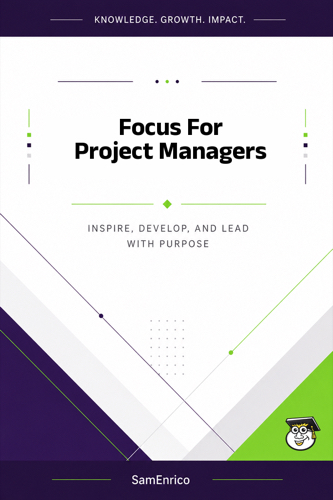
Focus For Project Managers eBook
Teaches balancing deep planning with constant team
by Baron Lorna
Teaches balancing deep planning with constant team communication.
Formats
Free sample
Chapter 1: The Hidden Tax--–- The email arrived at 9:14 AM. By 9:22 AM, you had replied to three messages, joined a “quick sync” about a blocked dependency, and opened your project schedule to check a due date. At 9:23 AM, you tried to reopen the risk register you had been updating before the interruption. You stared at the screen for forty-five seconds. You could not remember where you had stopped.
The thought was gone. The thread was lost. You scrolled, re-read, and finally gave up. At 9:31 AM, another message appeared. The cycle began again.This is not a failure of willpower.
It is not a lack of discipline. It is not a character flaw. It is a neurological tax that every project manager pays, often without knowing the rate. By the end of this chapter, you will understand exactly how much that tax costs you, your team, and your project. More importantly, you will learn how to stop paying it.The Arithmetic of Attention Let us begin with a simple question.
How many projects have you managed where the real bottleneck was not skill, not budget, not resources, but something invisible? You had good people. You had a reasonable timeline. You had executive support. Yet progress felt slow.
People were busy, even exhausted, but deliverables slipped. Meetings multiplied. Email threads grew tentacles. And at the center of it all, you felt pulled in twelve directions at once.That invisible bottleneck is called context switching. It is the act of shifting your attention from one cognitive task to another.
And it is quietly destroying the productivity of project managers more than any other single factor.The research on context switching is both fascinating and terrifying. A landmark study by Gloria Mark at the University of California, Irvine, found that knowledge workers switch tasks an average of every three minutes and five seconds. Once interrupted, it takes approximately twenty-three minutes to return to the original task with the same level of focus. Other studies have pinned the recovery time between fifteen and twenty-five minutes, depending on task complexity. For the purposes of this book, we will use the conservative estimate of twenty minutes.Let us do the math together.
Assume you are interrupted ten times in a workday. That is actually lower than the average for most project managers, but we will be generous. Ten interruptions. Each interruption costs you twenty minutes of recovery time. That is two hundred minutes per day.
Over a five-day week, that is one thousand minutes. That is sixteen and a half hours. Two full workdays lost every week, not to the interruptions themselves, but to the recovery from them.Now add the cost of the interruptions themselves. A three-minute email reply. A five-minute Slack message.
A fifteen-minute “quick” call. Those add another four to five hours per week. You are now losing nearly three workdays per week to context switching and its aftereffects. You are paying a hidden tax of more than fifty percent of your working hours.And that is just your own time.The Exponential Curve Nobody Calculates The situation becomes exponentially worse when you move from individual attention to team communication. There is a formula that every project manager should memorize, though you will not find it in the PMBOK Guide.
It comes from network theory and organizational design. It looks like this:Number of communication channels = n(n-1)/2Where “n” is the number of people in a group.For a team of three, this formula produces three channels of communication. For a team of five, it produces ten channels. For a team of eight, it produces twenty-eight channels. For a team of twelve, it produces sixty-six channels.
For a team of twenty, it produces one hundred ninety channels.Let us pause on that number. A project manager who adds twelve people to a team of eight does not increase communication channels by fifty percent. They increase them by more than two hundred percent. They add thirty-eight new channels. Each of those channels is a potential interruption.
Each interruption triggers a context switch. Each context switch costs twenty minutes of recovery time.This explains a phenomenon that every experienced project manager has observed but few have quantified. Adding people to a late project makes it later. This was famously codified as Brooks’s Law, named for Fred Brooks, the software engineering pioneer who wrote The Mythical Man-Month. Brooks observed that adding human resources to a delayed software project only delays it further, because the communication and coordination overhead grows faster than the added productive capacity.Brooks was not wrong, but he did not have the full picture.
The problem is not merely communication. The problem is context switching. Every new person added to a project does not just add their own work. They add new meeting requests, new email threads, new status update expectations, and new opportunities for interruption. They fragment the attention of everyone already on the team.The Myth of the Multitasking Project Manager At this point, some readers will object.
“I am good at multitasking,” they will say. “I can handle email while on a status call while updating a schedule. I am wired for this.”This is a comforting illusion, but it is an illusion nonetheless. The cognitive science literature on multitasking is unusually unanimous. Human beings do not multitask.
We task-switch. And task-switching comes with a performance penalty on every single task involved.A now-classic study by Rubinstein, Meyer, and Evans at the University of Michigan found that people who attempted to perform two cognitive tasks simultaneously took significantly longer to complete both tasks than people who performed them sequentially. The penalty increased with task complexity. For simple tasks, the penalty was modest. For complex tasks, such as those involving analysis, planning, or risk assessment, the penalty was dramatic—often exceeding fifty percent of total time.What does this mean for a project manager?
It means that your attempt to review the risk register while listening to a status update while scanning email is not making you more productive. It is making you less productive. You are not doing three things at once. You are doing three things poorly, one after another, with a recovery penalty between each.There is a famous analogy from the productivity writer Tim Ferriss. He compares multitasking to using a chainsaw to cut down ten trees at once.
You do not cut down ten trees faster by placing ten chainsaws side by side and running between them. You cut them down one at a time. The same principle applies to your attention.The Four Types of Switching That Plague Project Managers Not all context switches are created equal. Based on observational research of project managers across technology, construction, healthcare, and financial services, we can identify four distinct categories of context switching that drain focus. Each requires a different solution.Type One: The Self-Interruption This is the most common and the most insidious.
You are deep in a planning session, working through dependencies on the critical path. An email arrives. You do not need to read it. It is not urgent. But you click anyway.
You tell yourself it will only take a moment. Thirty seconds later, you have read the email, but now you…
This is the end of the free sample. Get the eBook to keep going. Buy now
About this book
Details
- Author
- Baron Lorna
- Publisher
- SamEnrico
- Language
- English
- Genre
- Non-Fiction, Business Brief, Project Management
- Released
- 2026-06-06
- Pages (approx.)
- 150
- Available as
- eBook, Audiobook

Read better in the ZLOADR app
Your eBooks on your phone or tablet. Sign in with your SamEnrico account and start reading.
More by Baron Lorna
 Creative Talent MigrationBaron Lorna$11.99
 Accountant Month End BlockBaron Lorna$11.99
 Randy Newman Short PeopleBaron Lorna$11.99
 Imposter In Academia GuideBaron Lorna$11.99
 Virtual Currency and CryptoBaron Lorna$11.99
 Recording Space AcousticsBaron Lorna$11.99
 The Poet and the Café: How Naguib Mahfouz Brought Cairo to LifeBaron Lorna$11.99
 Merlin's Last Apprentice: The Forgotten Sage of the NorthBaron Lorna$11.99
 How to Produce Door Repairs and Locksmith ServicesBaron Lorna$11.99
 How to Produce Pool Cover AccessoriesBaron Lorna$11.99
 Failed Payment Troubleshooting HandbookBaron Lorna$12.99
 Vietnamese Stock Option Labor ComplianceBaron Lorna$12.99
You may also like
 Mentorship for Project ManagersPerryman Karon$11.99
 Persuasive Project CharterHein Ashly$11.99
 Leading Remote Project TeamsAntoine Mina$11.99
 The Retirement Move Execution PlaybookDollar Ashlyn$11.99
 Asana Productivity TrackingJeffery Inge$11.99
 Living Abroad for Project ManagersBurgos Daine$11.99
 Housing Downsizing Timeline HandbookMauldin Penney$11.99
 Multiple Project Prioritization GuideDunham Terina$11.99
 Planning Fallacy CounterBaird Josephina$11.99
 Housing Transition Timeline ToolEscamilla Avis$11.99
 Project Accounting Automation GuideZimmer Rona$12.99
 Kenya Project Management RemoteSimpkins Voncile$12.99