
Non-FictionBusiness BriefEnvironmental Psychology
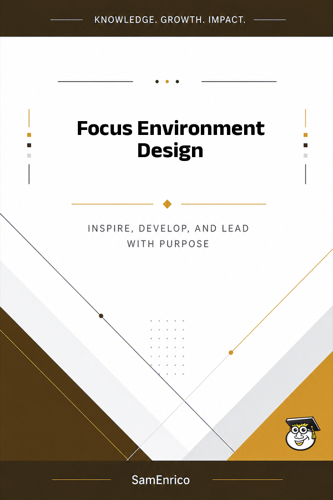
Focus Environment Design eBook
Teaches optimizing lighting, sound, and ergonomics
by Sams Willian
Teaches optimizing lighting, sound, and ergonomics for sustained concentration.
Formats
Free sample
Chapter 1: The 4 PM Fog--–- At 4:17 PM on a Tuesday that felt like every other Tuesday, I found myself staring at a blinking cursor for the eleventh consecutive minute. The document was open. The coffee was cold. The deadline was tomorrow. And my brain—my supposedly powerful, adult, capable brain—had simply left the building.
I had slept seven hours. I had exercised that morning. I had avoided social media until noon. By every conventional measure of "discipline," I was doing everything right. And yet, I could not think.
I blamed myself. I called it laziness. I called it a lack of willpower. I called it burnout. What I did not call it—what I had no language for at the time—was an environmental tax audit with a failing grade.This chapter is not about working harder.
It is not about waking up earlier, taking cold showers, or downloading another productivity app. This chapter is about reframing focus as what it actually is: not a moral virtue, not a character trait, not a badge of honor worn by the disciplined few, but a finite biological resource that is systematically drained or replenished by your physical surroundings. The conversation about productivity has spent decades obsessed with the internal: grit, habits, mindset, willpower. This book begins with a different question: what if your environment has been stealing from you, quietly, invisibly, every single day, and you have been blaming yourself for the theft?The Cost of a Blinking Cursor Before we can fix anything, we have to understand what focus actually is, neurologically speaking. Focus is not a single state but a complex orchestration of several brain systems working in concert.
At its core, what we call "concentration" is the ability of your prefrontal cortex—the executive center of your brain—to maintain goal-relevant information while suppressing distractions. This is called attentional control, and it is exhausting. Unlike your heartbeat or your breathing, which run automatically, attentional control requires constant, conscious effort. You are not supposed to be able to focus for ten hours straight. Your brain did not evolve for spreadsheets and email threads.
It evolved to notice the rustle in the grass, to track the movement of prey, to stay alert for threats while resting. The modern knowledge worker is asking their ancient brain to do something it was never designed to do: sustain abstract concentration on symbolic information for hours at a time, indoors, under artificial light, surrounded by unpredictable sounds and flickering screens.The miracle is not that we lose focus. The miracle is that we can focus at all.Cognitive load theory, developed by educational psychologist John Sweller in the 1980s and refined over decades of research, provides our first useful lens. Your working memory—the mental space where you hold and manipulate information in real time—has a very limited capacity. The classic estimate is 7 ± 2 chunks of information, though more recent research suggests it may be closer to 4 ± 1 for complex tasks.
Every piece of information you hold in mind consumes a slice of this limited resource. When you are doing complex work—writing, coding, analyzing, strategizing—you need most or all of those slots for the task itself. But here is the problem: your environment is constantly demanding slots of its own.Every time you squint against glare, that is a cognitive slot. Every time you strain to hear a conversation happening twenty feet away, that is a slot. Every time you shift in your chair because your back hurts, every time you notice the flicker of a fluorescent light, every time you feel a draft on your ankle and subconsciously adjust your posture—each of these micro-adjustments consumes a piece of your working memory.
You do not choose to spend these slots. They are taxed automatically, involuntarily, by the environment you inhabit. By the time you sit down to do your actual work, you may already have only two or three slots remaining. And then you wonder why you feel foggy.This is what I call environmental taxes: the invisible friction between you and your task, measured in micro-units of attention. A flickering light, even if you never consciously notice it, causes subtle saccadic eye movements that tax the occipital lobe and require constant recalibration.
A room that is two degrees too warm triggers mild parasympathetic activation that makes you feel sleepy without any obvious cause. A phone buzzing in your bag, even if you do not check it, triggers an orienting response that pulls attention away from your primary task. These taxes are small individually—probably imperceptible in any given moment. But over an eight-hour workday, they accumulate. And accumulation is the enemy of sustained performance.The Neuroscience of "Brain Fog"One of the most pernicious myths of modern work culture is that fatigue is always obvious.
We think we will know when we are tired, the way we know when our muscles ache after a workout. But attentional fatigue does not feel like pain. It does not announce itself with a clear signal. Instead, it feels like something else entirely: boredom, laziness, lack of motivation, character weakness. This is not an accident.
Your brain is designed to conserve energy, and one of the ways it does so is by making fatigue feel like a choice rather than a limitation. You do not feel your attention draining away; you feel an inexplicable urge to check your phone, to stand up and walk to the kitchen, to open a new browser tab and look at something—anything—else.Here is what is actually happening. The prefrontal cortex, which governs executive function, consumes a disproportionate amount of glucose and oxygen relative to its size. Sustained attention is metabolically expensive. When you have been focusing for an extended period, or when your environment has been imposing constant micro-taxes, your brain begins to ration its resources.
It does this by downregulating the activity of the prefrontal cortex and shifting toward more automatic, less demanding processing. You are not "losing focus." Your brain is making a metabolic decision that further focus is too costly given current conditions.This is why the same person who cannot write a single paragraph at 4 PM in a noisy, poorly lit, stuffy office can suddenly write three pages at 10 PM in a quiet, comfortable room. It is not a matter of willpower magically returning. It is a matter of the environmental tax rate dropping from 40% to 10%. Your brain was never the problem.
The room was the problem.The research here is startling. A study conducted by researchers at the University of California, Irvine, found that after an interruption—even a brief one lasting only a few seconds—it takes an average of twenty-three minutes to return to the original task with the same level of focus. Twenty-three minutes. If you are interrupted four times in an hour, you may spend the entire hour recovering rather than working. But most of us do not count small environmental annoyances as "interruptions." We count only the phone call, the email notification, the coworker tapping on our shoulder.
We do not count the glare that makes us squint every forty-five seconds. We do not count the intermittent speech…
This is the end of the free sample. Get the eBook to keep going. Buy now
About this book
Details
- Author
- Sams Willian
- Publisher
- SamEnrico
- Language
- English
- Genre
- Non-Fiction, Business Brief, Environmental Psychology
- Released
- 2026-06-05
- Pages (approx.)
- 148
- Available as
- eBook, Audiobook

Read better in the ZLOADR app
Your eBooks on your phone or tablet. Sign in with your SamEnrico account and start reading.
More by Sams Willian
 Personal Branding for RecruitersSams Willian$11.99
 Vacation Stress ManagementSams Willian$11.99
 Congressional Aides ConfessionsSams Willian$11.99
 Joni Mitchell Blue TapestrySams Willian$11.99
 Deep Work Block SchedulingSams Willian$11.99
 Scripting for Sleep HypnosisSams Willian$11.99
 Meeting Stand Up VirtualSams Willian$11.99
 The Tide of Destiny: Prince Henry the Navigator and the Birth of the Modern WorldSams Willian$11.99
 The Siege of Chittorgarh: A Kingdom's Last Stand Against the Mughals (1567-1568)Sams Willian$11.99
 How to Produce Plumbing Repair KitsSams Willian$11.99
 Exploring Giclee Prints: Fine Art Digital PrintingSams Willian$11.99
 Ghana Market Product Research WorkbookSams Willian$12.99
You may also like
 Hong Kong Handover 1997Dunn Johnnie$11.99
 Zumba For Postnatal Recovery CourseNeal Christian$11.99
 Zumba for BeginnersLadner Nikia$11.99
 YouTube Comment Mining GuideHumes Pandora$12.99
 Worry Box MeditationCarlin Rudy$11.99
 Workplace Stress MeditationNguyen Lynn$11.99
 Workplace Stress and Sleep RepairHawley Ivory$11.99
 Workplace Perfectionism CureDelaney Jeffry$11.99
 Workplace Injustice Anger GuideWallen Isabelle$11.99
 Work Addiction and Burnout LinkGreenwood Ester$11.99
 Women in Yoga and WellnessBeattie Galina$11.99
 Women in Stand Up ComedyChun Evangeline$11.99