
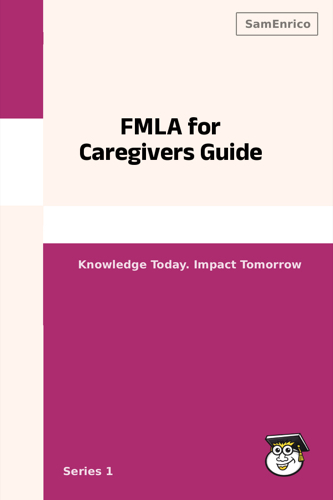
FMLA for Caregivers Guide eBook
Understand your leave rights as a working caregive
Understand your leave rights as a working caregiver using this practical workbook.
Formats
Free sample
Chapter 1: The Conspiracy of Silence--You are not failing. The system is failing you.If you are reading this book, you are likely part of the "Sandwich Generation"—a term coined by social worker Dorothy Miller in 1981 to describe adults caring for aging parents while still raising children or maintaining careers. Nearly forty-five years later, the Sandwich Generation has become the norm, not the exception. According to the National Alliance for Caregiving, over 53 million Americans provide unpaid care to an adult family member or friend. Of those, 61 percent are employed.
And of that 61 percent, a staggering 78 percent report making workplace accommodations—reducing hours, passing up promotions, using sick days for family care, or, most devastatingly, quitting their jobs entirely—because they believed they had no other choice.They were wrong.This chapter is not a legal tutorial. It is an intervention. Before you learn one single fact about eligibility forms, medical certifications, or notice deadlines, you must first understand why you have never been told the truth about your rights. Because the truth is this: the Family and Medical Leave Act (FMLA) is one of the most powerful, misunderstood, and deliberately obscured protections ever granted to American workers. And the people who could tell you about it—your human resources department, your manager, your company's legal team—have every incentive to keep you in the dark.This is the Conspiracy of Silence.
Not a literal conspiracy with secret meetings and signed affidavits. Something far more insidious: a web of institutional inertia, liability avoidance, and quiet discouragement that has convinced millions of working caregivers that they have no rights when, in fact, they have enormous power.Let me prove it to you with a story.The $47,000 Mistake Maria was a senior administrator at a mid-sized hospital in Arizona. She had worked there for nine years. Her performance reviews were exemplary. Her mother, a retired teacher, had been diagnosed with early-onset Alzheimer's three years prior.
For two years, Maria managed—early mornings, late nights, a rotating cast of part-time caregivers, and a silent, grinding exhaustion that she hid behind a bright smile and a to-do list that never ended.Then her mother fell. A hip fracture. Surgery. Six weeks of rehabilitation followed by a rapid cognitive decline that made independent living impossible. Maria's mother needed supervision twenty-four hours a day, seven days a week.
Not nursing care, necessarily, but presence. Someone to make sure she didn't wander. Someone to administer medications. Someone to hold her hand when the sundowning started and she didn't recognize her own daughter.Maria went to her HR director. She sat in a plastic chair in a beige office and said, "I need time off to care for my mother.
I've heard something about FMLA. Am I eligible?"The HR director, a well-meaning woman who had been trained primarily in worker's compensation and harassment prevention, pulled up a policy manual on her computer. She read aloud: "FMLA applies to employees who have worked at least 1,250 hours in the past twelve months and whose employer has fifty or more employees within a seventy-five-mile radius." She looked at Maria. "We have over three hundred employees here. You've been here nine years.
So yes, you're eligible on paper. But—"The "but" hung in the air like smoke."But," the HR director continued, "you need to understand that FMLA is unpaid. And you'd be required to exhaust all your accrued paid time off first. And we'd need medical certification from your mother's doctor. And intermittent leave is really hard to manage for our department.
And honestly, Maria, I don't know if your manager would approve a full twelve weeks. It might be better to request a personal leave of absence. Or maybe we can look into a flexible schedule?"Maria heard: This is complicated. This might hurt your career. You should ask for less.She did not hear: You have a legal right to twelve weeks of job-protected leave.
Your employer cannot deny it if you qualify. And if they retaliate against you for taking it, you can sue them.Maria requested a personal leave of absence. It was denied. She requested a flexible schedule. It was approved, then quietly rescinded two weeks later when her manager said the department "couldn't accommodate the disruption." Maria, exhausted and humiliated and terrified of being fired, quit.She spent the next six months burning through her savings while caring for her mother full-time.
Her mother passed away eleven months after Maria left her job. Maria is now back in the workforce, in a lower-paying position, with a gap in her resume that she explains as "family leave" while interviewers nod sympathetically and then hire someone else.The financial cost of Maria's mistake: approximately $47,000 in lost wages, plus the incalculable cost of her mother's final months spent in a household clouded by financial stress and a daughter's quiet rage at a system that had failed her.The legal reality: Maria was eligible for FMLA. Her employer was required to grant it. Her manager's comment about "disruption" was legally irrelevant. And if she had known her rights, she could have taken her twelve weeks, returned to her job, and been protected from retaliation.Maria's story is not an outlier.
It is the norm.The Three Lies They Tell You The Conspiracy of Silence operates through three primary lies. You have heard them. You may have told them to yourself. They are not accidental. They are the result of decades of employer-side legal guidance designed to minimize liability, not maximize employee rights.Lie #1: "You probably don't qualify."This is the most common lie, and the most damaging.
Employers and HR professionals are trained to state eligibility requirements in the narrowest possible terms. The fifty-employee rule becomes "we're a small company, so probably not." The 1,250-hour rule becomes "you need to work full-time for at least a year." The "serious health condition" requirement becomes "that sounds like a temporary issue, so it probably doesn't count."Each of these statements is either incomplete or flatly false.The fifty-employee rule counts all employees within a seventy-five-mile radius, not just those in your office. If your company has forty-nine employees at your location but three at a satellite office twenty miles away, you are covered. The 1,250-hour rule equates to roughly twenty-four hours per week over fifty-two weeks. Part-time workers qualify.
Remote workers qualify. Hybrid workers qualify. The only workers who don't qualify are those who have been employed for less than twelve months or who work fewer than twenty-four hours per week on average.And the "serious health condition" definition is far broader than most people realize. It includes chronic conditions like diabetes, epilepsy, and Alzheimer's. It includes multiple treatments like chemotherapy or dialysis.
It includes recovery periods after surgeries. It includes mental health conditions. It includes pregnancy and prenatal care. If a condition requires ongoing medical supervision or results in periodic incapacitation, it almost certainly qualifies.Lie #2: "You need to give us a diagnosis."You do not. The FMLA explicitly prohibits employers from requiring medical diagnoses as part of the certification process.
The Department of Labor's official form (WH-380-F) asks for a description of the medical condition, but "chronic condition requiring ongoing…
This is the end of the free sample. Get the eBook to keep going. Buy now
About this book
Details
- Author
- Kowalski Granville
- Publisher
- SamEnrico
- Language
- English
- Genre
- Non-Fiction, Self-Help, FMLA
- Released
- 2026-06-09
- Pages (approx.)
- 154
- Available as
- eBook, Audiobook

Read better in the ZLOADR app
Your eBooks on your phone or tablet. Sign in with your SamEnrico account and start reading.
More by Kowalski Granville
 Alcoholism and Wernicke KorsakoffKowalski Granville$11.99
 The Black Elk AccountKowalski Granville$11.99
 Public Commitment AccountabilityKowalski Granville$11.99
 Morning Reading Habit GuideKowalski Granville$11.99
 Affirmations For UncertaintyKowalski Granville$11.99
 Retinoid GuideKowalski Granville$11.99
 Probiotics For Brain HealthKowalski Granville$11.99
 The Spinning Jenny and the Threads of Progress: Arkwright's Textile RevolutionKowalski Granville$11.99
 The Lost Code of the Mayan MathematiciansKowalski Granville$11.99
 How to Become a PatternmakerKowalski Granville$11.99
 VAT Compliance Software GuideKowalski Granville$12.99
 B2B Sales Culture ComparisonKowalski Granville$12.99
You may also like
 Hong Kong Handover 1997Dunn Johnnie$11.99
 Zumba For Postnatal Recovery CourseNeal Christian$11.99
 Zumba for BeginnersLadner Nikia$11.99
 YouTube Comment Mining GuideHumes Pandora$12.99
 Worry Box MeditationCarlin Rudy$11.99
 Workplace Stress MeditationNguyen Lynn$11.99
 Workplace Stress and Sleep RepairHawley Ivory$11.99
 Workplace Perfectionism CureDelaney Jeffry$11.99
 Workplace Injustice Anger GuideWallen Isabelle$11.99
 Work Addiction and Burnout LinkGreenwood Ester$11.99
 Women in Yoga and WellnessBeattie Galina$11.99
 Women in Stand Up ComedyChun Evangeline$11.99