
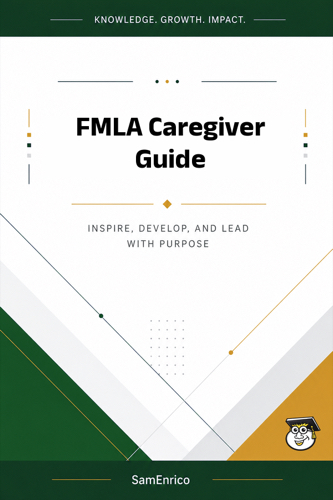
FMLA Caregiver Guide eBook
Uses Family Medical Leave Act for caregiving.
Uses Family Medical Leave Act for caregiving.
Formats
Free sample
Chapter 1: The Eligibility Maze--You are reading this because someone you love cannot fully care for themselves anymore. Maybe it is your mother, who once drove you to soccer practice and now cannot remember to take her blood pressure medication. Maybe it is your spouse, who woke up yesterday with a stroke and today cannot walk to the bathroom alone. Or maybe it is your adult child, who was perfectly healthy six months ago and now requires round-the-clock monitoring after a devastating accident.Whatever your story, you have arrived at the same terrifying question: Can I take time off work to do this without getting fired?The answer is almost certainly yes—but only if you understand a maze of rules, thresholds, and definitions that most HR departments do not fully understand themselves. The Family and Medical Leave Act (FMLA) is a powerful law, but it is also a picky one.
Miss a single eligibility requirement by a few hours, a few employees, or a few miles, and your legal protection vanishes. Your job becomes vulnerable. Your family’s income becomes uncertain.This chapter is your map through that maze. By the end, you will know exactly whether you are covered, and if not, exactly what you need to change to become covered.Let us start with the single most important fact about FMLA eligibility: It is not automatic. You do not get leave just because you are a good employee, just because you have been at your company for a decade, or just because your family member is dying.
The law draws hard lines. Your job is to prove you stand on the correct side of every single one.The 50/75/12 Rule: Your Three Numbers The FMLA eligibility test boils down to three numbers. Legal professionals call it the “50/75/12 Rule,” but you should think of it as three locked doors. You need a key for each door. Lose any key, and you cannot enter.First door: 50 employees within 75 miles of your worksite.Your employer must have at least fifty employees working within seventy-five miles of the physical location where you report to work.
Notice the careful wording: it is not fifty employees in the whole company. It is not fifty employees in your state. It is fifty employees within a seventy-five-mile radius of your specific building, warehouse, clinic, or job site.This catches many caregivers by surprise. You might work for a massive national corporation with thousands of employees, but if your local office has only forty people and the next office is eighty miles away, your employer is not covered. The law treats you as if you work for a small business, even if the corporate logo on your paycheck is a household name.There is a narrow exception: if your employer has multiple locations within seventy-five miles that together total fifty or more employees, those employees count.
So if your company has three branch offices, each with twenty employees, and all three are within seventy-five miles of each other, you meet the threshold. But if one branch is seventy-six miles away, its employees do not count toward your location’s total.Second door: 12 months of employment.You must have worked for your employer for at least twelve months. These months do not need to be consecutive. If you worked for nine months, left for two years, and then returned for three more months, you have twelve total months. The clock resets only if you had a break in service of seven years or more—unless your break was due to military service, in which case the clock does not reset.However, there is a cruel twist.
Those twelve months do not need to be recent. You could have worked for the company for ten years, quit, and then been rehired last week. You would not yet be eligible because you have not accumulated twelve months since your most recent hire date. The law looks backward from the day you request leave, counting only time employed continuously from your last start date.Third door: 1,250 hours in the past 12 months.This is where most caregivers stumble. You must have worked at least 1,250 hours during the twelve-month period immediately before the first day of your requested FMLA leave.
That averages to roughly twenty-four hours per week, or three full eight-hour days per week, year-round.But caregiving rarely respects averages. You might have worked forty hours per week for ten months, then reduced to twenty hours per week for two months as your parent’s health declined. You still meet the threshold (forty hours times forty-three weeks is 1,720 hours, well above 1,250). But if you took unpaid time off for doctor’s appointments, left early to pick up prescriptions, or used intermittent FMLA for your own health condition, those hours do not count toward the 1,250. Only hours actually worked—including paid time off like vacation, sick leave, or PTO—count.This creates a vicious cycle for caregivers.
The more you need FMLA protection, the harder it becomes to qualify for it because you have been reducing your hours or taking unpaid leave. The chapter’s worksheet below will help you calculate your actual worked hours with precision.The 1,250-Hour Worksheet: Proving Your Case Do not guess. Employers will audit your hours. HR departments have access to your timecards, payroll records, and scheduling systems. If you claim 1,250 hours and their records show 1,249, you lose.
There is no rounding up, no grace period, no “close enough.”Follow these steps to calculate your hours with the same precision an auditor would use.Step 1: Identify your twelve-month lookback period.Find the date you intend to start FMLA leave. Count backward exactly twelve months. That is your lookback period. For example, if you plan to start leave on June 1, 2026, your lookback period is June 1, 2025, through May 31, 2026.Step 2: Gather every document that shows hours worked.Request your payroll records from HR. Print your timecard history if you use a digital system.
Gather any personal calendars where you tracked your schedule. You need a complete, week-by-week record.Step 3: Count only hours actually worked or paid leave.Do count:Every hour you were clocked in or performing work Paid vacation hours Paid sick leave hours Paid PTO hours Paid holidays (if you were paid for that day)Compensatory time that you earned and then used (count the earned hours, not the used hours)Do NOT count:Unpaid leave of any kind FMLA leave (even if you used it for a different family member)Leave under the Americans with Disabilities Act Leave under state family leave laws Breaks longer than twenty minutes On-call time where you were not actually called in Step 4: Add everything.Use the printable tracking log in Appendix B to sum your hours. If you are close to 1,250—within fifty hours—consider delaying your leave by a few weeks to work additional hours and secure your eligibility.Real-world example: Maria has worked for her employer for three years. In the past twelve months, she worked 1,180 hours. She also used forty hours of paid sick leave for her own flu and eighty hours of paid vacation for a family trip.
Those 120 paid hours count. Her total is 1,300 hours. She is eligible. But if she had taken those 120…
This is the end of the free sample. Get the eBook to keep going. Buy now
About this book
Details
- Author
- Frantz Valentin
- Publisher
- SamEnrico
- Language
- English
- Genre
- Non-Fiction, Self-Help, FMLA
- Released
- 2026-06-06
- Pages (approx.)
- 134
- Available as
- eBook, Audiobook

Read better in the ZLOADR app
Your eBooks on your phone or tablet. Sign in with your SamEnrico account and start reading.
More by Frantz Valentin
 Road Rage Consequences GuideFrantz Valentin$11.99
 The 5 AM Club HandbookFrantz Valentin$11.99
 Bridge Dream SymbolFrantz Valentin$11.99
 Methamphetamine Sobriety WorkbookFrantz Valentin$11.99
 Marma Point TherapyFrantz Valentin$11.99
 SEAL BUDS InstructorFrantz Valentin$11.99
 The Supply Network Creative FixFrantz Valentin$11.99
 Time Blocking for Deep WorkFrantz Valentin$11.99
 The Last Great Land Rush: Alaska’s Gold Rush ReckoningFrantz Valentin$11.99
 The Al-Khwarizmi Code: The Birth of Algorithms in the Islamic Golden AgeFrantz Valentin$11.99
 Fenrir's Howl: The Wolf That Birthed RagnarokFrantz Valentin$11.99
 AI Chatbot App Business LaunchFrantz Valentin$11.99
You may also like
 Hong Kong Handover 1997Dunn Johnnie$11.99
 Zumba For Postnatal Recovery CourseNeal Christian$11.99
 Zumba for BeginnersLadner Nikia$11.99
 YouTube Comment Mining GuideHumes Pandora$12.99
 Worry Box MeditationCarlin Rudy$11.99
 Workplace Stress MeditationNguyen Lynn$11.99
 Workplace Stress and Sleep RepairHawley Ivory$11.99
 Workplace Perfectionism CureDelaney Jeffry$11.99
 Workplace Injustice Anger GuideWallen Isabelle$11.99
 Work Addiction and Burnout LinkGreenwood Ester$11.99
 Women in Yoga and WellnessBeattie Galina$11.99
 Women in Stand Up ComedyChun Evangeline$11.99