
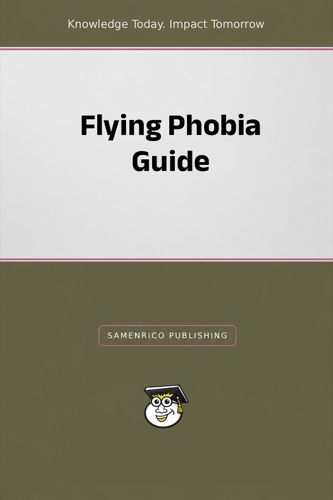
Flying Phobia Guide eBook
Teaches airplane fear with turbulence coping and e
by Hobson Trina
Teaches airplane fear with turbulence coping and exposure.
Formats
Free sample
Chapter 1: The Logic Trap–- You are holding a book about flying, yet a part of you wants to put it down. Not because the book is boring, but because reading about flying forces you to think about flying, and thinking about flying makes your chest tighten, your palms sweat, and your mind race through a slideshow of catastrophes. That reaction—right now, while you are safely on the ground—is the entire puzzle of aviophobia distilled into a single moment. This chapter exists to solve that puzzle. Not by telling you to calm down.
Not by reciting statistics you have already memorized. Not by promising you a miracle cure that erases fear overnight. But by showing you, with surgical precision, exactly how your brain built a fear that logic cannot touch. And more importantly, why that is actually excellent news. Because if your brain learned this fear, your brain can unlearn it.
The same neuroplasticity that created the problem will become the instrument of its solution.The Million-Dollar Question Let us begin with a simple thought experiment. Imagine someone offers you one million dollars to drive across the country tomorrow. Would you do it? Almost certainly yes. You might worry about traffic, fatigue, or bad weather, but you would pack your bags and go.
The money would outweigh the relatively minor discomforts of a long drive.Now imagine that same person offers you one million dollars to fly across the country tomorrow. Same distance. Same destination. Same reward. Would you hesitate?
If you are reading this book, the answer is almost certainly yes. You might feel a spike of anxiety just considering the question. You might say, "Let me think about it," which is code for "Let me see if I can tolerate the fear." You might negotiate for a different departure time, a different airline, a different seat. Or you might simply say no, because no amount of money feels worth the terror.Here is the strange thing. You already know that flying is statistically safer than driving.
You have heard the numbers: your odds of dying in a commercial plane crash are approximately one in eleven million, while your odds of dying in a car crash are roughly one in ninety-five. You know that you are more likely to be struck by lightning, attacked by a shark, or hit by a falling coconut than to die in a plane crash. You know that you probably passed dozens of cars on your way to work today, each one carrying a risk far greater than any flight you will ever take. You know all of this, and yet your body does not care.This is the central paradox of flying phobia. It is not a problem of missing information.
You are not afraid because you lack facts. You are not waiting for someone to show you the right statistic that will finally make the fear disappear. That statistic already exists, and it has not helped. Your fear operates entirely outside the reach of facts, which means that facts alone will never cure you.Understanding this distinction is the first and most important step toward freedom. You have been trying to solve an emotional problem with intellectual tools, and it has not worked because those tools were designed for a different job.
You cannot reason your way out of a fear that was never created by reason in the first place.The Two Brains Living Inside Your Skull Neuroscience has given us a useful way to think about fear. Your brain contains two very different systems for processing threat, and they do not always talk to each other. In fact, they often work at cross-purposes, which explains why you can know you are safe while feeling terrified.The first system is ancient. It evolved hundreds of millions of years ago, long before humans existed, long before mammals existed, back when our distant ancestors were small, furry creatures scrambling to avoid dinosaurs. Biologists sometimes call this the "reptilian brain," though that nickname oversimplifies things.
More accurately, it is the limbic system, and at its core sits a small, almond-shaped structure called the amygdala.The amygdala has exactly one job: detect danger and respond instantly. It does not think. It does not analyze. It does not wait for evidence. It does not consider probabilities.
It reacts. When the amygdala senses a potential threat—whether that threat is real or imagined, whether it exists in the present moment or only as a memory—it floods your body with adrenaline and cortisol. Your heart races. Your breathing quickens. Your muscles tense.
Your digestion stops. Your pupils dilate. Your blood rushes to your large muscle groups. Your peripheral vision narrows. All of this happens in less than a second, long before your conscious mind has even noticed what is happening.This system saved your ancestors from predators.
A rustle in the bushes did not require careful analysis. By the time your prefrontal cortex figured out whether the rustle was a lion or just the wind, you would already be dead. The amygdala solved this problem by shooting first and asking questions later. It is a brilliant design for a world full of sudden, physical threats.The second system is much newer, in evolutionary terms. It is called the prefrontal cortex, and it sits directly behind your forehead.
This is the part of your brain that does logic, math, planning, self-control, and delayed gratification. It can weigh evidence, consider probabilities, override impulses, and imagine multiple possible futures. It knows that flying is safe. It can recite the statistics. It can remind you that millions of people flew yesterday without incident, and millions more will fly today, and every single one of them will arrive safely.
The prefrontal cortex is the voice in your head that says, "Calm down, everything is fine."Here is the problem. When the amygdala fires, it hijacks the entire nervous system. It sends emergency signals that drown out the quiet, reasonable voice of the prefrontal cortex. You cannot logic your way out of a panic attack for the same reason you cannot reason with a fire alarm once it starts blaring. The alarm does not care that there is no fire.
It only knows that its sensors were triggered. It will continue shrieking until the sensors stop sending signals or until someone physically silences it.Your amygdala is exactly the same. It does not care that flying is statistically safe. It does not care that you have flown dozens of times without incident. It only knows that something about flying—the takeoff, the turbulence, the confined space, the loss of control, the altitude, the noises—has been labeled as a threat.
And once that label is attached, the amygdala will respond to flying exactly as it would respond to a predator.This is why you can sit on a plane, repeating "I am safe, I am safe, I am safe" fifty times, and still feel utterly terrified. Your prefrontal cortex is doing its job. It is feeding you accurate information. But your amygdala is not listening. It is running an ancient program that prioritizes speed over accuracy, survival over comfort, false positives over…
This is the end of the free sample. Get the eBook to keep going. Buy now
About this book
Details
- Author
- Hobson Trina
- Publisher
- SamEnrico
- Language
- English
- Genre
- Non-Fiction, Health & Wellness, Aviation
- Released
- 2026-06-09
- Pages (approx.)
- 144
- Available as
- eBook, Audiobook

Read better in the ZLOADR app
Your eBooks on your phone or tablet. Sign in with your SamEnrico account and start reading.
More by Hobson Trina
 Depression and Gut Health GuideHobson Trina$11.99
 Creativity for Environmental EngineersHobson Trina$11.99
 Art Recognition DeckHobson Trina$11.99
 Nick Price Zimbabwe StarHobson Trina$11.99
 Blood Pressure PregnancyHobson Trina$11.99
 Alcohol Relaxation ExpectancyHobson Trina$11.99
 Familiarity Without RecollectionHobson Trina$11.99
 Fenrir's Howl: The Binding of the World-SerpentHobson Trina$11.99
 The Ironclads Clash: The Battle That Changed Naval WarfareHobson Trina$11.99
 A Collector's Handbook to the Gilbern InvaderHobson Trina$11.99
 Service Providers Guide to Pool & SPA ServiceHobson Trina$11.99
 How to Produce Household Storage ContainersHobson Trina$11.99
You may also like
 Nap for Pilots GuideHenson Ula$11.99
 Shift Work for Pilots GuideEstrella Adelle$11.99
 Pilot Nap GuideRosado Antionette$11.99
 Pilot Nap Cockpit StrategyMurdock Eugenie$11.99
 Aviation Emergency Survival KitMyers Santiago$11.99
 AED Use in AirplanesEzell Karena$11.99
 The Airport Proximity GuideBrunson Zonia$11.99
 Flight Attendant Stretching PlanAmato Marva$11.99