
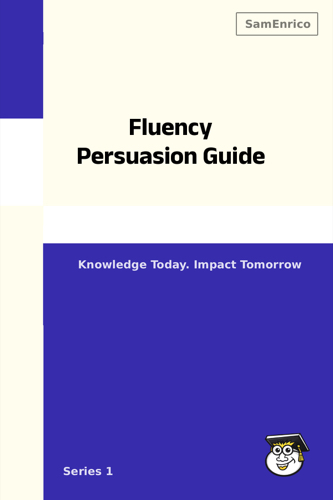
Non-FictionSelf-HelpProcessing Fluency
Fluency Persuasion Guide eBook
Uses easy-to-process messages for higher agreement
Uses easy-to-process messages for higher agreement.
Formats
Free sample
Chapter 1: The Cognitive Miser--–- In a Florida courtroom in 2011, a man sat waiting for his verdict. The evidence against him was substantial. Witnesses placed him at the scene. Physical evidence tied him to the crime. By any objective measure, the prosecution had built a solid case.
The jury deliberated for six hours and returned a guilty verdict. The judge sentenced him to twenty-seven years.The defense appealed. But they did not appeal on the evidence. They did not claim a witness was lying or that DNA had been mishandled. They appealed on a single, seemingly trivial detail: the font.The jury instructions—the document that explained the legal standards the jury was required to apply—had been printed in a difficult-to-read typeface.
Not illegible, but uncomfortable. The letters were crowded. The contrast was low. The text ran in dense, unbroken paragraphs across multiple pages. The defense argued that this typographic friction had caused the jurors to experience cognitive strain, and that strain had been unconsciously misattributed to the defendant’s guilt.
The appellate court agreed. The conviction was overturned.The dissenting judge called it absurd. “We are now reversing criminal convictions because of fonts?” he wrote. But the majority understood something the dissenting judge did not: the brain does not experience difficulty neutrally. When processing feels hard, the brain looks for something to blame.
In a courtroom, that something is often the defendant.This is not a story about fonts. This is a story about the most underrated force in human persuasion: cognitive fluency.Every day, you send messages that you believe are clear, logical, and compelling. You assume that if the evidence is strong and the reasoning is sound, people will agree with you. But that assumption is wrong. It is not wrong because people are irrational.
It is wrong because people are misers.The Cognitive Miser The human brain consumes approximately twenty percent of the body’s energy while representing only two percent of its mass. It is the most expensive organ you own. To survive, evolution equipped the brain with a powerful bias: it seeks to minimize effort whenever possible. Psychologists call this tendency the “cognitive miser” hypothesis, first formalized by Susan Fiske and Shelley Taylor in the 1980s. The idea is simple but profound.
The brain does not process information neutrally. It processes information efficiently. It takes shortcuts. It relies on heuristics. It judges based on how things feel, not just how they are.Think about your own behavior.
When you pick a book off a shelf, do you read the entire first chapter before deciding? No. You glance at the cover, read a few sentences, flip through the pages. You make a judgment in seconds based on surface-level ease. When you open a website, do you read every word before deciding whether to stay?
No. You scan. If the layout is clean and the text is readable, you stay. If it is cluttered and confusing, you leave—even if the content is brilliant. You are a cognitive miser.
So is everyone you are trying to persuade.This chapter introduces the single most important concept in this book: the brain’s relentless drive for ease. Understanding this drive changes everything about how you communicate. It reframes persuasion not as a battle of logic, but as an engineering problem. Your goal is not to convince. Your goal is to make agreement feel effortless.The Florida courtroom is not an isolated example.
In a 2005 study led by Rolf Reber and Norbert Schwarz, participants read two versions of an exercise instruction. The first version was printed in a clean, high-contrast font. The second was printed in a faint, difficult-to-read font. The content was identical. The participants who read the easy version estimated the exercise would take eight minutes.
The participants who read the difficult version estimated it would take nearly twice as long. The information was the same. Only the font changed. But the font changed the prediction.Why? Because the brain uses processing ease as a signal.
When something is easy to read, the brain thinks: “I understand this. I can do this. This is probably true.” When something is hard to read, the brain thinks: “This is difficult. Something is wrong. I should be cautious.”This is the cognitive miser at work.
The brain does not have the energy to evaluate every claim on its merits. So it takes a shortcut: easy = true.The Two Systems To understand why this shortcut exists, you need to understand how the brain is organized. Daniel Kahneman, the Nobel Prize-winning psychologist, popularized the distinction between two cognitive systems. System 1 is fast, automatic, intuitive, and effortless. It is the brain’s default mode.
When you recognize a familiar face, read a billboard, or catch a ball, you are using System 1. System 2 is slow, deliberate, analytical, and effortful. It activates when you solve a complex math problem, compare two mortgage offers, or learn a new language.Here is the critical insight: System 2 is lazy. It prefers not to activate. The brain will use System 1 for as long as possible.
Only when System 1 encounters something it cannot handle does it call upon System 2 for backup. And that call requires energy. The cognitive miser hates spending energy.Fluency—the ease with which you process information—determines whether System 1 can handle the task or whether System 2 must be summoned. When a message is visually clear, linguistically simple, and structurally coherent, System 1 processes it effortlessly. The brain stays in its comfortable, fast mode.
Agreement feels natural because no effort is required. When a message is visually cluttered, linguistically dense, or structurally confusing, System 1 struggles. The brain flags difficulty. System 2 activates. And when System 2 activates, skepticism activates with it.
The brain starts asking questions. Is this true? What is missing? Why should I believe this?You do not want your audience in System 2. System 2 is where arguments die.
System 2 is where objections are born. System 2 is where the beautiful logic you spent hours crafting gets picked apart by a suspicious brain that would rather be doing something else.This chapter is the foundation of everything that follows because it establishes the single most important rule of fluency-based persuasion: keep the brain in System 1. Do not give it a reason to wake up System 2. Every extra word, every confusing layout, every abstract noun, every hedge word—these are not minor errors. They are invitations for the brain to become skeptical.The Legal System Is a Fluency Laboratory Courtrooms are brutal testing grounds for persuasion.
The stakes are high. The audience (the jury) is captive but resistant. And the evidence is often ambiguous. Legal scholars have studied fluency effects extensively because the consequences are so concrete.Consider another study, this time led by Jason Chin and colleagues in 2013. Mock jurors read a legal brief that was formatted either in an easy-to-read font (Times New Roman, 12 point) or a difficult-to-read font (italicized Comic Sans, small size).
The content was identical. The jurors who read the easy font rated the argument as more persuasive and the attorney as more intelligent. They also reported greater confidence in their verdicts. The same words. Different fonts.
Different outcomes.Or consider the work of Matthew Weaver and colleagues, who found that when jury instructions were rewritten in plain…
This is the end of the free sample. Get the eBook to keep going. Buy now
About this book
Details
- Author
- Estrada Molly
- Publisher
- SamEnrico
- Language
- English
- Genre
- Non-Fiction, Self-Help, Processing Fluency
- Released
- 2026-06-08
- Pages (approx.)
- 122
- Available as
- eBook, Audiobook

Read better in the ZLOADR app
Your eBooks on your phone or tablet. Sign in with your SamEnrico account and start reading.
More by Estrada Molly
 I Statements for AssertivenessEstrada Molly$11.99
 Weekly Interruption Audit GuideEstrada Molly$11.99
 Napoleon Death Theories GuideEstrada Molly$11.99
 Charlie Munger PartnerEstrada Molly$11.99
 Fishing Trip Alibi CheckEstrada Molly$11.99
 Golfer's Elbow Rehabilitation PlanEstrada Molly$11.99
 The Freelance Automated InvoicingEstrada Molly$11.99
 Scripting MistakesEstrada Molly$11.99
 The Great Unmasking: How the Internet Outed a Secret SocietyEstrada Molly$11.99
 The Battle of the Bulge: Hitler's Last Gamble in the ArdennesEstrada Molly$11.99
 The Complete Guide to the No Fad DietEstrada Molly$11.99
 US Visa Interview For Art StudentsEstrada Molly$12.99
You may also like
 Hong Kong Handover 1997Dunn Johnnie$11.99
 Zumba For Postnatal Recovery CourseNeal Christian$11.99
 Zumba for BeginnersLadner Nikia$11.99
 YouTube Comment Mining GuideHumes Pandora$12.99
 Worry Box MeditationCarlin Rudy$11.99
 Workplace Stress MeditationNguyen Lynn$11.99
 Workplace Stress and Sleep RepairHawley Ivory$11.99
 Workplace Perfectionism CureDelaney Jeffry$11.99
 Workplace Injustice Anger GuideWallen Isabelle$11.99
 Work Addiction and Burnout LinkGreenwood Ester$11.99
 Women in Yoga and WellnessBeattie Galina$11.99
 Women in Stand Up ComedyChun Evangeline$11.99