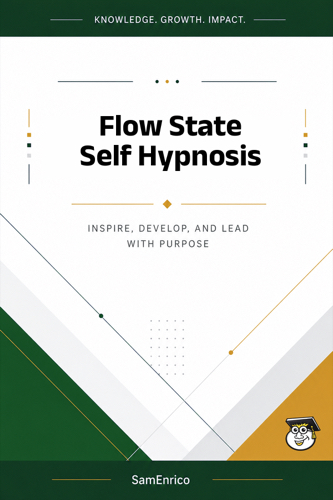
Flow State Self Hypnosis eBook
Trigger automatic flow state on command using cond
by Aguiar Malia
Trigger automatic flow state on command using conditioned hypnotic anchors.
Formats
Free sample
Chapter 1: The 47-Time Betrayal--You have already hypnotized yourself today. Probably more than once. Probably without noticing. And almost certainly against your own best interests.Consider the arithmetic of modern attention. The average smartphone user checks their device ninety-six times per day.
That is once every ten waking minutes. Each check follows a reliable sequence: a buzz or a glow (the cue), a reach and a swipe (the routine), a small hit of dopamine (the reward). This is not habit. This is conditioning. This is self-hypnosis performed poorly, unconsciously, and repeatedly until the response becomes automatic as breathing.You have been training your brain to fragment attention, to crave interruption, to mistake noise for urgency.
And you have done this thousands of times. The average person will trigger their "distraction anchor" more than forty-seven thousand times this year alone. Forty-seven thousand repetitions of a single conditioned response. Forty-seven thousand votes cast for the proposition that focus is impossible, that flow is a myth, that your attention belongs to whatever beeps loudest.This book exists because that arithmetic is reversible.Flow state—that elusive condition of effortless absorption, time distortion, and peak performance—is not a mystical gift reserved for elite athletes or genius artists. It is not the product of luck, genetics, or cosmic alignment.
Flow is a specific neurophysiological state, measurable by electroencephalography, distinguishable by its brainwave signature, and reproducible through systematic conditioning. More precisely, flow occupies the border between high alpha waves (8–12 Hz) and low theta waves (4–8 Hz)—the same frequency range observed in light hypnosis, meditation, and the hypnagogic moment just before sleep.The convergence is not coincidental. Flow and hypnosis share neurological architecture. Both require the temporary suspension of the conscious mind's critical faculty. Both depend on absorbed attention.
Both produce altered time perception and reduced self-referential thinking. The difference is one of intention and control. Hypnosis, when performed by another, is a state induced. Self-hypnosis, when performed deliberately, is a state triggered. And flow, when reduced to its mechanical components, is simply self-hypnosis applied to performance.This book teaches you to install a conditioned hypnotic anchor—a physical trigger activated consciously, producing flow on command.
No meditation required. No willpower exhausted. No waiting for inspiration to strike like lightning. Just conditioning, repetition, and the same neurological mechanisms that Pavlov discovered in 1901, applied not to dogs and saliva but to humans and peak performance.By the end of Chapter 5, you will have installed your personal Flow Switch. By the end of Chapter 6, you will have overwritten your primary anxiety anchor.
By the end of Chapter 10, you will be able to trigger a flow state in under thirty seconds, in any environment, at any time, without external aids. This is not speculation. This is the applied neuroscience of conditioned response, translated from laboratory to life.But first, you must understand why waiting for flow has failed you. You must see the architecture of your own distraction. And you must accept a difficult truth: your conscious mind is not your ally in this work.
It is the gatekeeper, the critic, the editor who interrupts the first draft. Flow lives in the subconscious. And the subconscious does not respond to persuasion. It responds to conditioning.The Conspiracy of the Conscious Mind Joseph Murphy, author of the enduring classic The Power of Your Subconscious Mind, drew a distinction that will serve as the foundation for everything that follows. The conscious mind, he argued, is the reasoning faculty.
It analyzes, compares, judges, and decides. It operates slowly, sequentially, and with limited bandwidth. The conscious mind can hold approximately seven pieces of information at once. It tires easily. It doubts constantly.
It is, to borrow a phrase from Daniel Kahneman, "a lazy controller."The subconscious mind, by contrast, is the automatic pilot. It regulates heartbeat, respiration, and digestion without conscious input. It stores every memory, every conditioned response, every learned skill. It operates in parallel, processing millions of sensory signals per second. The subconscious does not reason.
It does not judge. It does not decide. It simply executes the programs it has been given—whether those programs were installed deliberately or accidentally.Here is the critical insight that most self-help books get wrong: you cannot persuade your subconscious mind. You cannot reason with it, negotiate with it, or convince it through argument. The subconscious does not understand language in the way the conscious mind does.
It understands repetition, emotion, and sensory association. It understands conditioning.Think of the conscious mind as the programmer and the subconscious as the operating system. The programmer can write new code. The programmer can debug old routines. But the programmer cannot reason with the operating system during execution.
The operating system simply runs what it has been given. If the operating system has been conditioned to fragment attention every time a notification arrives, no amount of conscious willpower will override that response consistently. Willpower is a limited resource. Conditioning is automatic.This explains why "trying harder" fails. This explains why affirmations feel hollow.
This explains why you can genuinely want to focus, genuinely intend to focus, and still find yourself scrolling through email twenty minutes later. Your conscious mind wanted focus. Your subconscious executed distraction. The programmer wrote one instruction; the operating system ran another.The solution is not to strengthen the programmer. The solution is to rewrite the operating system.
And the only tool that rewrites the operating system is conditioned response.Newton's First Law of Productivity Sir Isaac Newton’s first law of motion states that an object at rest stays at rest, and an object in motion stays in motion, unless acted upon by an external force. This law applies to mental states with the same inexorable logic that it applies to physical objects.A mind at rest—scrolling, checking, switching, skimming—stays at rest. A mind in flow—absorbed, effortless, timeless—stays in flow. The problem is not maintaining flow once it arrives. The problem is the transition from rest to motion.
That transition requires an external force. And for most people, that external force is either an emergency (a deadline, a crisis, a panicked last-minute surge) or an accident (a moment of unintended absorption that they cannot replicate).Waiting for inspiration is waiting for an accident. Inspiration does not strike like lightning. Lightning is random, destructive, and unrepeatable. Inspiration, when it arrives unbidden, is simply a moment when the subconscious executed a focus program that you did not know you had installed.
It feels magical only because you cannot see the conditioning that produced it.This book replaces accident with engineering. The external force you will apply is your conditioned hypnotic anchor—a physical trigger that you will train to produce the neurophysiological signature of flow. The anchor is the hand on the flywheel. The anchor breaks inertia. And once the flywheel spins, momentum carries you forward.Consider the research of Anders Ericsson, the psychologist whose work inspired the "10,000-hour rule." Ericsson found that elite performers did not simply practice more hours than amateurs.
They practiced with a specific quality of attention—a state he called "deliberate practice." Deliberate practice requires full concentration, immediate feedback, and the absence of distraction. In other words, deliberate…
This is the end of the free sample. Get the eBook to keep going. Buy now
About this book
Details
- Author
- Aguiar Malia
- Publisher
- SamEnrico
- Language
- English
- Genre
- Non-Fiction, Self-Help, Flow Psychology
- Released
- 2026-06-11
- Pages (approx.)
- 154
- Available as
- eBook, Audiobook

Read better in the ZLOADR app
Your eBooks on your phone or tablet. Sign in with your SamEnrico account and start reading.
More by Aguiar Malia
 The Small Talk DeepenerAguiar Malia$11.99
 The Pain Reframing GuideAguiar Malia$11.99
 Estimate Your Downsize ProceedsAguiar Malia$11.99
 Military Combat Stress ManagementAguiar Malia$11.99
 The Velvet Throne: How a Princess Stole the CrownAguiar Malia$11.99
 The Salt of the Earth: Uncovering Jordan's Ancient SeasAguiar Malia$11.99
 How to Start a Cyclotron Business (Beginners Guide)Aguiar Malia$11.99
 Procurement in Oil and GasAguiar Malia$12.99
 Executive Summary Best Practices for Government ProposalsAguiar Malia$12.99
 Penalty Box AttendantAguiar Malia$11.99
 Understanding Factor V DeficiencyAguiar Malia$17.99