
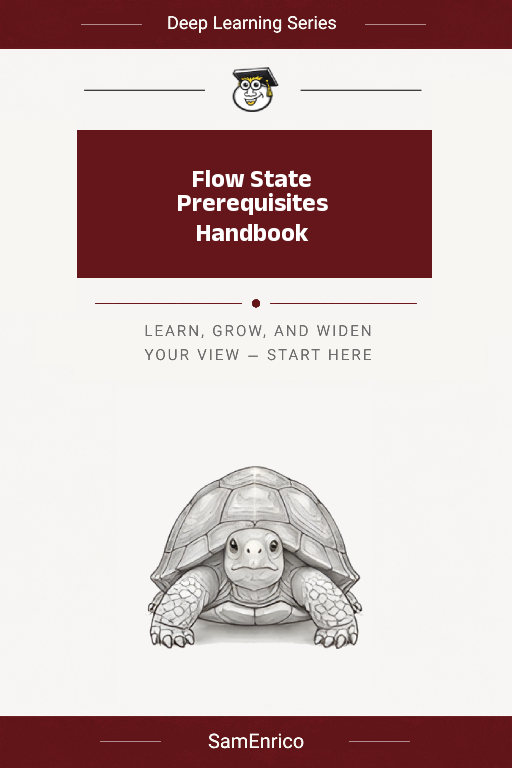
Non-FictionMental WealthFlow Psychology
Flow State Prerequisites Handbook eBook
Remove digital friction like slow wifi or pop ups
by Couch Ned
Remove digital friction like slow wifi or pop ups that interrupt deep work and creative flow.
Formats
Free sample
Chapter 1: The 300ms Thief...--You are losing hours of your life every week to a thief you cannot see, cannot hear, and have likely never named. This thief does not break into your home or steal from your bank account. Instead, it steals something far more precious: the fragile, easily shattered state of concentrated attention known as flow. The thief’s name is latency, and it operates in the silent gaps between your actions and your computer’s responses.Most people believe that waiting half a second for a screen to load is a minor annoyance—a brief irritation to be tolerated and forgotten. This belief is catastrophically wrong.
The psychological damage inflicted by a 300-millisecond delay is not proportional to the duration of the wait. It is exponentially larger. That tiny gap between clicking and seeing, between typing and appearing, between expecting and receiving, does not merely cost you a moment of time. It costs you the entire architecture of focused thought.This chapter will prove that claim. We will explore the neurochemistry of flow, dissect the hidden layers of digital friction, and introduce a systematic framework for understanding the four distinct types of resistance that block your path to deep work.
By the end of this chapter, you will never look at a loading spinner the same way again. You will see it for what it truly is: a small, red warning light on the dashboard of your attention.The Neurochemistry of a Broken Promise Mihaly Csikszentmihalyi, the father of flow theory, spent decades studying the conditions under which human beings experience their most productive and satisfying states of consciousness. His central finding—replicated across cultures, professions, and age groups—is that flow requires immediate and unambiguous feedback. The painter sees the brushstroke appear on the canvas the instant the bristles touch. The pianist hears the note the moment the key is pressed.
The surgeon feels the resistance of tissue as the scalpel moves. In each case, action and consequence are welded together in time. There is no gap.That gap matters because of how the brain predicts the world. Every voluntary action you take generates what neuroscientists call an efference copy—a predictive signal sent from the motor cortex to the sensory regions of the brain. This signal tells your sensory systems exactly what to expect as a result of your movement.
When you reach for a coffee cup, your brain predicts the sensation of smooth ceramic before your fingers touch it. When you type the letter "T," your brain predicts the visual appearance of that letter on the screen 50 milliseconds after your finger moves.When the prediction matches reality, the brain releases a small pulse of dopamine—the neurotransmitter of reward and learning. This pulse feels like satisfaction. It says, "Good job. The world worked the way you expected.
Keep going." This dopamine feedback loop is the engine of concentration. It is why you can write for hours without fatigue, why a programmer can debug code until 2 AM, why a designer can lose track of time while adjusting kerning. Each successful prediction generates a tiny reward, and the accumulation of those rewards sustains focus indefinitely.Now consider what happens when the prediction fails. You type "T," and nothing appears. Or it appears after a noticeable delay.
Or the screen flickers. Your brain’s predictive system registers a mismatch—an error. This error triggers a sharp release of cortisol and norepinephrine, the brain’s alarm neurotransmitters. Your heart rate increases slightly. Your pupils dilate.
Your attention snaps away from your creative work and toward the source of the error. You are no longer thinking about the sentence you were writing. You are now thinking about the computer. You are now in a state of micro-stress.One such micro-stress is trivial. You recover in a second or two.
But knowledge workers today experience hundreds of these micro-stresses per hour. Every loading spinner. Every stuttering video frame. Every delayed keystroke. Each one triggers the same ancient alarm system that evolved to help you notice a predator in the bushes.
That system was never designed to fire 500 times per day. When it does, the result is a low-grade but persistent state of cognitive fragmentation—the inability to sustain a single line of thought for more than a few seconds without being interrupted by your own environment.The Latency Case Study: Video Editing To make this concrete, let us contrast two creative tools. On one side, consider a local video editing application running on a modern laptop with sufficient RAM and a fast solid-state drive. When you scrub the timeline—dragging the playhead across the video track—the preview window updates instantaneously. There is no visible delay.
Each frame appears exactly when you expect it. The relationship between your hand movement and the visual result is so tight that you stop noticing the interface at all. You are simply editing. That is flow.On the other side, consider a cloud-based video editor running in a web browser. The interface looks similar.
The controls are familiar. But when you scrub the timeline, a gray spinner appears for 300 to 500 milliseconds. The preview window updates in chunks rather than continuously. Every cut you make requires a round trip to a server hundreds or thousands of miles away. The delay is not enormous—less than the blink of an eye in absolute terms.
But the effect on your cognitive state is profound.A controlled experiment comparing the two environments found the following: editors using the local application completed their work in 68 percent of the time required by cloud-based editors. But more importantly, the local editors reported zero instances of spontaneous task-switching (checking email, opening social media, looking at their phones) during the work session. The cloud-based editors, by contrast, switched tasks an average of 12 times per hour. The spinners created gaps, and the gaps became invitations to escape. The brain, seeking to avoid the frustration of broken predictions, fled to more predictable environments—email, news, social media—where the feedback loops, however shallow, were at least reliable.This is the hidden mathematics of latency.
A 300-millisecond delay costs you far more than 300 milliseconds of time. It costs you the continuity of attention necessary to enter flow. Once flow is broken, the average recovery time is not 300 milliseconds but 15 to 20 minutes. The spinner does not steal a third of a second. It steals a third of an hour.The Four Faces of Digital Friction Before we go further, we need a shared language for talking about the different ways digital environments resist our attention.
The term "digital friction" is useful, but it is too broad. A slow internet connection and a cluttered desktop and a colleague tapping your shoulder are all forms of friction, but they require completely different solutions. Throughout this book, we will use a master taxonomy of digital friction with four distinct categories:1. Latency Friction Latency friction is the gap between action and response. It includes slow wifi, high ping times, delayed keystrokes, buffering videos, and any other situation where your input does not produce an immediate output.
This is the category that destroys flow most directly because it attacks the prediction-reward loop at its core. Latency friction…
This is the end of the free sample. Get the eBook to keep going. Buy now
About this book
Details
- Author
- Couch Ned
- Publisher
- SamEnrico
- Language
- English
- Genre
- Non-Fiction, Mental Wealth, Flow Psychology
- Released
- 2026-06-01
- Pages (approx.)
- 138
- Available as
- eBook, Audiobook

Read better in the ZLOADR app
Your eBooks on your phone or tablet. Sign in with your SamEnrico account and start reading.
More by Couch Ned
 Creative Constraints GuideCouch Ned$11.99
 Parent Growth Mindset GuideCouch Ned$11.99
 Flow and Exercise GuideCouch Ned$11.99
 Assertiveness for Medical SettingsCouch Ned$11.99
 The Committed OKR GuideCouch Ned$11.99
 Money Affirmation Daily GuideCouch Ned$11.99
 Mindfulness for Beginners WorkbookCouch Ned$11.99
 Delegation for Nonprofit LeadersCouch Ned$11.99
 The Jade Dragon’s Last Flight: A Forgotten Tale of the Celestial BeastsCouch Ned$11.99
 The Lost Ballad of the Pacific Pitcher: A Medieval Baseball LegendCouch Ned$11.99
 Ryegrass Seed: Perennial & AnnualCouch Ned$11.99
 How to Start a Man-made Fibres and Yarns (commission Agent) Business (Beginners Guide)Couch Ned$11.99
You may also like
 Hong Kong Handover 1997Dunn Johnnie$11.99
 Zumba For Postnatal Recovery CourseNeal Christian$11.99
 Zumba for BeginnersLadner Nikia$11.99
 YouTube Comment Mining GuideHumes Pandora$12.99
 Worry Box MeditationCarlin Rudy$11.99
 Workplace Stress MeditationNguyen Lynn$11.99
 Workplace Stress and Sleep RepairHawley Ivory$11.99
 Workplace Perfectionism CureDelaney Jeffry$11.99
 Workplace Injustice Anger GuideWallen Isabelle$11.99
 Work Addiction and Burnout LinkGreenwood Ester$11.99
 Women in Yoga and WellnessBeattie Galina$11.99
 Women in Stand Up ComedyChun Evangeline$11.99