
Non-FictionSelf-HelpSelf Tracking
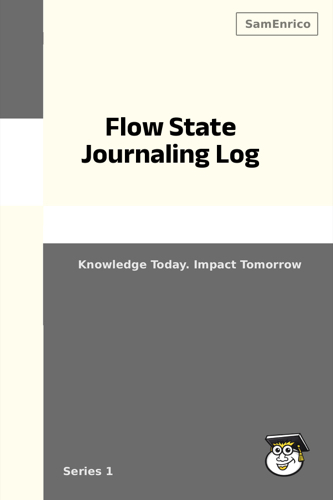
Flow State Journaling Log eBook
Track when and where you enter flow to identify pe
Track when and where you enter flow to identify personal trigger patterns.
Formats
Free sample
Chapter 1: The Accidental Superpower...--Most people have experienced a superpower without ever realizing they possessed it. You have felt it—perhaps while painting, coding, running, writing, or playing an instrument. The clock vanished. Your inner critic fell silent. The action felt effortless, almost automatic, as if the activity was flowing through you rather than being performed by you.
Hours passed like minutes. When you finally stopped, you felt energized rather than drained, and you couldn't quite explain how you got there or how to get back.That feeling has a name. It is called flow.The paradox of flow is that nearly everyone has tasted it, yet almost no one can summon it on command. It arrives like a capricious guest—unannounced, unpredictable, and unforgettable. One morning you sit down to write and the words pour out effortlessly for three hours.
The next morning, same chair, same coffee, same document—and nothing. The cursor blinks mockingly. Your mind wanders to grocery lists and email and that thing you said five years ago. The superpower has abandoned you.This book exists to solve that problem.For the past fifty years, researchers have studied flow state extensively. The pioneering work of psychologist Mihaly Csikszentmihalyi (pronounced "cheek-sent-me-high") revealed that flow is not mystical or random.
It is a scientifically observable state of consciousness with specific triggers, measurable characteristics, and predictable patterns. More importantly, flow can be engineered. The conditions that produce flow are not mysterious—they are environmental, biological, psychological, and behavioral. And they can be tracked.But here is the critical insight that most flow literature misses: your flow triggers are unique to you.The ambient coffee shop noise that sends one person into creative flow might completely shatter another person's concentration. The early morning hours that unlock deep focus for a lark might find an owl staring blankly at a screen.
The pressure of a deadline that ignites one person's performance might paralyze another. Generic advice—"find your passion," "eliminate distractions," "work in 90-minute blocks"—is useful but incomplete. What you need is not general principles but personal data.This book provides the system for collecting that data.The Central Argument Most people experience flow accidentally during roughly 5-10% of their working hours. They wait for the conditions to align by chance—the right task, the right mood, the right environment, the right time of day—and when those stars align, they perform at their peak. The rest of the time, they operate below their potential, mistaking effort for effectiveness.This book argues that you can move from accidental flow to intentional flow.
By systematically tracking the conditions surrounding your flow experiences—where you were, what time it was, what you were doing, how you felt beforehand, what distractions were present—you can identify your personal trigger patterns. With that data, you can engineer your environment and schedule to produce flow reliably, potentially increasing your flow time to 40-50% of your working hours.That is not a small improvement. Doubling or tripling your flow time means doubling or tripling your periods of effortless high performance. It means finishing creative work in half the time. It means ending the day energized instead of exhausted.
It means transforming work from a struggle into something that feels like play.Why This Book Is Different There is no shortage of books about flow. Csikszentmihalyi's own Flow: The Psychology of Optimal Experience remains a classic. Steven Kotler's The Rise of Superman and Stealing Fire explore flow in extreme sports and business. Cal Newport's Deep Work offers valuable protocols for focused concentration. These books are excellent.
They provide the theoretical foundation and the inspirational case studies.But they do not give you a system for discovering your flow patterns.This book is not a collection of general principles. It is a 12-week data collection and analysis system. The first half teaches you what to track and why. The second half provides the structured logbook for tracking it. By the end, you will not have abstract knowledge about flow.
You will have a one-page Flow Resume that specifies your optimal conditions: your Golden Hours, your ideal environment, your task archetypes, your pre-flow rituals, and your personal flow blockers.You will move from being someone who occasionally experiences flow to someone who can trigger it intentionally.The Problem with Generic Advice Consider the common advice to "eliminate distractions." This seems universally useful. And yet, research on creativity has shown that some people perform better with ambient noise at 65-75 decibels—roughly the level of a moderately busy coffee shop. Absolute silence, for these individuals, is not a trigger but a blocker. They need the gentle stimulation of background chatter to reach flow.Or consider the advice to "work in 90-minute blocks." This is based on solid research about ultradian rhythms—the natural cycles of focus and fatigue that the human brain follows. But the ideal block length varies significantly by individual and by task.
Some people sustain deep focus for 45 minutes; others for three hours. The 90-minute average is not a prescription for you until your data confirms it.Or consider the advice to "follow your passion." This is emotionally compelling but practically useless. Passion is not a switch you flip; it is an emergent property of competence, autonomy, and relatedness. You do not discover your passion by staring inward. You build it by noticing which tasks produce flow for you and then structuring your life to do more of those tasks.Generic advice fails because it ignores variance.
The average person does not exist. You are not the average. You are a specific individual with a unique neurobiology, unique chronotype, unique history, and unique set of skills. Your flow triggers will be unique as well. Only data can reveal them.The Data-Driven Approach This book treats you as both a philosopher and a scientist.As a philosopher, you will reflect on what gives your work meaning, what tasks feel intrinsically rewarding, and what conditions make you feel most alive.
This reflective practice is essential because flow is an autotelic experience—it is its own reward. You cannot hack your way into flow for tasks you secretly despise. The philosophical work of aligning your actions with your values is the foundation.As a scientist, you will collect data. You will log your environment before each work session. You will rate your pre-task mood and energy.
You will record the task archetype, the challenge-skill balance, and the outcome. You will review your logs weekly, hunt for correlations, and test hypotheses. You will treat each work session as an experiment, and each low-flow day not as a failure but as valuable data about what does not work.This dual identity—philosopher and scientist—is what makes the system work. The philosopher provides the direction. The scientist provides the feedback.
Together, they transform accidental flow into intentional flow.What You Will Learn By completing this 12-week system, you will answer specific questions about your optimal performance:Where do you flow best? Your optimal location (home office, coffee shop, library, co-working space), noise level (silence, white noise, ambient music), temperature, and lighting.When do you flow best? Your chronotype (lark, owl, or intermediate), your Golden Hours…
This is the end of the free sample. Get the eBook to keep going. Buy now
About this book
Details
- Author
- Dickerson Ardis
- Publisher
- SamEnrico
- Language
- English
- Genre
- Non-Fiction, Self-Help, Self Tracking
- Released
- 2026-06-06
- Pages (approx.)
- 107
- Available as
- eBook, Audiobook

Read better in the ZLOADR app
Your eBooks on your phone or tablet. Sign in with your SamEnrico account and start reading.
More by Dickerson Ardis
 WFH Virtual Morning HuddleDickerson Ardis$11.99
 Financial Stress and DigestionDickerson Ardis$11.99
 Gambling Addiction for AccountantsDickerson Ardis$11.99
 El Greco and the Fire of Toledo: Painting the DivineDickerson Ardis$11.99
 Learn to Play the RuanDickerson Ardis$11.99
 Press Release Newsworthiness GuideDickerson Ardis$12.99
 Network Support SpecialistDickerson Ardis$11.99
 How to Start a Black Pudding Business (Beginners Guide)Dickerson Ardis$11.99
You may also like
 Hong Kong Handover 1997Dunn Johnnie$11.99
 Zumba For Postnatal Recovery CourseNeal Christian$11.99
 Zumba for BeginnersLadner Nikia$11.99
 YouTube Comment Mining GuideHumes Pandora$12.99
 Worry Box MeditationCarlin Rudy$11.99
 Workplace Stress MeditationNguyen Lynn$11.99
 Workplace Stress and Sleep RepairHawley Ivory$11.99
 Workplace Perfectionism CureDelaney Jeffry$11.99
 Workplace Injustice Anger GuideWallen Isabelle$11.99
 Work Addiction and Burnout LinkGreenwood Ester$11.99
 Women in Yoga and WellnessBeattie Galina$11.99
 Women in Stand Up ComedyChun Evangeline$11.99