
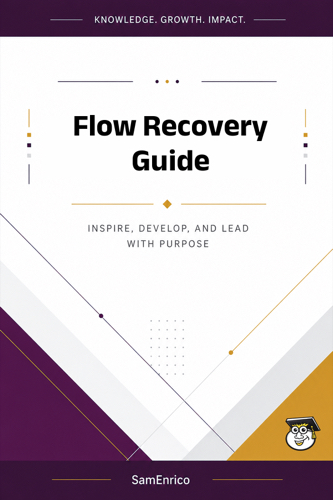
Non-FictionSelf-HelpInterruption Management
Flow Recovery Guide eBook
Return to flow after interruptions using this prac
by Zimmer Amina
Return to flow after interruptions using this practical handbook.
Formats
Free sample
Chapter 1: The 23-Minute Ghost--You have just been interrupted. Maybe it was a Slack ping, a colleague tapping your shoulder, or your own mind wandering to tonight's dinner plans. Whatever it was, you are now reading this sentence instead of doing what you were doing a moment ago. And here is the question that will determine everything about your productivity, your creativity, and your sanity for the rest of your working life: how long will it take you to get back?If you are like most people, the answer is somewhere between twenty and thirty minutes. Twenty-three minutes, to cite the figure that has emerged from cognitive psychology research over the past decade.
That is the average time required for the human brain to return to a state of deep focus after a single interruption. Not to resume working in a shallow, distracted manner—that happens almost immediately. To return to the state of effortless concentration, time distortion, and intrinsic reward that psychologists call flow.Twenty-three minutes. For a ten-second interruption. The math is brutal, and it gets worse.
The average knowledge worker toggles between applications over twelve hundred times per day. Each toggle carries with it the ghost of the previous task, a phenomenon that researchers call attentional residue. By the time you finish reading this chapter, you will understand why your brain behaves this way, why blaming yourself for being "distractible" is both wrong and counterproductive, and why recovery time is not a fixed limit but a trainable skill.This chapter is called The 23-Minute Ghost because that is what follows you after every interruption: a specter of divided attention that reduces your cognitive capacity, slows your thinking, and makes you feel like you are wading through mud. But ghosts, as it turns out, can be exorcised. Let us begin by meeting yours.The Anatomy of an Interruption Before we can understand recovery, we must understand what we are recovering from.
An interruption is not simply a break in action. It is a neurological event with measurable consequences. When you are engaged in a task, your brain constructs what cognitive scientists call a goal structure: a hierarchical map of intentions, sub-goals, and ongoing actions. This structure is maintained in your working memory, which is the brain's equivalent of a very small, very expensive whiteboard.Working memory has severe limitations. The most widely accepted model suggests it can hold roughly four discrete items at once.
When you are in flow, those four slots are filled with the current state of your task: where you are, what you just did, what you need to do next, and a partially formed hunch about how to overcome the next obstacle. This delicate structure is highly efficient but also highly fragile.An interruption does not merely add a new item to your working memory. It displaces the existing items. The phone buzzes, and your brain automatically shifts attention to evaluate the stimulus. Is it important?
Is it a threat? Is it an opportunity? In that moment, your goal structure collapses. The four items that were holding your place evaporate, replaced by whatever the interruption demands.This is where the twenty-three minutes come from. Most people assume that when the interruption ends, they can simply pick up where they left off.
They cannot. Because the goal structure has collapsed, they must rebuild it from scratch. And rebuilding requires retracing steps, re-establishing context, and re-engaging the neural networks that were active before the break. That process takes time. A lot of time.Consider what happens when you are reading a dense paragraph and someone interrupts you with a question.
When you return to the page, you do not start at the sentence you were on. You typically scan backward several sentences, sometimes to the beginning of the paragraph, to reorient yourself. Now multiply that across every interruption, every day, for an entire career. The cost is staggering.The Research Behind the Number The twenty-three-minute figure is not pulled from thin air. It emerges from a body of research conducted over the past two decades, most notably by Gloria Mark at the University of California, Irvine.
Mark and her colleagues have studied knowledge workers in real-world settings, equipping them with sensors and conducting time-use studies that capture the granular reality of modern work.In a landmark study published in 2008, Mark found that the average worker spent only eleven minutes on any given task before being interrupted or switching voluntarily. After the interruption, it took an average of twenty-five minutes to return to the original task. Later studies refined this figure, with most settling in the twenty-to-thirty minute range. The 2021 replication found an average of twenty-three minutes and seventeen seconds.But the number alone does not tell the full story. Mark also discovered that interrupted workers reported significantly higher stress levels, lower frustration tolerance, and a greater perception of time pressure than their uninterrupted counterparts.
In other words, interruptions do not just cost time; they cost well-being.Other researchers have quantified the cost differently. In a study of software engineers, the consulting firm Basex estimated that interruptions cost the US economy roughly $650 billion per year in lost productivity. That is larger than the GDP of all but twenty countries. The same study found that knowledge workers spend an average of twenty-eight percent of their workweek recovering from interruptions. Nearly one-third of your working life, by this estimate, is spent not doing work but recovering from the things that stop you from doing work.These numbers are so large that they become abstract.
Let us make them concrete. Imagine you are a knowledge worker who earns $80,000 per year. If twenty-eight percent of your workweek is spent recovering from interruptions, that means roughly $22,400 of your employer's money—and your time—is burned on recovery. Over a forty-year career, that amounts to nearly $900,000. Interruptions, in this light, are not a minor annoyance.
They are a financial catastrophe.The Myth of the Multitasker Before we go further, we must address a dangerous and persistent myth: that some people can multitask effectively. This myth is perpetuated by job descriptions that demand "strong multitasking skills" and by a culture that glorifies busyness. It is also completely false.The human brain is not capable of true multitasking. What we call multitasking is actually rapid task-switching, and it comes with a cognitive penalty every single time. The classic study by Meyer and Kieras at the University of Michigan demonstrated that even simple task-switching—alternating between two keys on a keyboard—results in a measurable delay of several hundred milliseconds per switch.
When the tasks are complex, the delay expands to seconds or minutes.The reason is neurological. The prefrontal cortex, which is responsible for executive control and goal management, cannot process two complex tasks simultaneously. When you attempt to multitask, your brain must perform a "task set reconfiguration": unloading the rules, goals, and context of Task A, loading those of Task B, then unloading and loading again to return to Task A. Each reconfiguration carries a cost.You can experience this cost for yourself with a simple experiment. Take a stopwatch and perform two tasks: writing the sentence "The quick brown fox jumps over the lazy dog" while…
This is the end of the free sample. Get the eBook to keep going. Buy now
About this book
Details
- Author
- Zimmer Amina
- Publisher
- SamEnrico
- Language
- English
- Genre
- Non-Fiction, Self-Help, Interruption Management
- Released
- 2026-06-08
- Pages (approx.)
- 140
- Available as
- eBook, Audiobook

Read better in the ZLOADR app
Your eBooks on your phone or tablet. Sign in with your SamEnrico account and start reading.
More by Zimmer Amina
 Idea Parking Lot MethodZimmer Amina$11.99
 Assertiveness for EmpathsZimmer Amina$11.99
 Growth Mindset Praise GuideZimmer Amina$11.99
 Outsourcing for TherapistsZimmer Amina$11.99
 The Team OKR Facilitation GuideZimmer Amina$11.99
 Financial Support Group GuideZimmer Amina$11.99
 Dual Diagnosis MasterZimmer Amina$11.99
 The Lost Voyages of Abubakari II: The African Admiral Who Sailed Beyond the HorizonZimmer Amina$11.99
 The God Complex: How a Self-Help Guru Built a Billion-Dollar Empire on BeliefZimmer Amina$11.99
 Runner Bean: Harvesting For Shelling & Immature PodsZimmer Amina$11.99
 The Essential Guide to German FolkZimmer Amina$11.99
 How to Produce Punch Bowl StandsZimmer Amina$11.99
You may also like
 Hong Kong Handover 1997Dunn Johnnie$11.99
 Zumba For Postnatal Recovery CourseNeal Christian$11.99
 Zumba for BeginnersLadner Nikia$11.99
 YouTube Comment Mining GuideHumes Pandora$12.99
 Worry Box MeditationCarlin Rudy$11.99
 Workplace Stress MeditationNguyen Lynn$11.99
 Workplace Stress and Sleep RepairHawley Ivory$11.99
 Workplace Perfectionism CureDelaney Jeffry$11.99
 Workplace Injustice Anger GuideWallen Isabelle$11.99
 Work Addiction and Burnout LinkGreenwood Ester$11.99
 Women in Yoga and WellnessBeattie Galina$11.99
 Women in Stand Up ComedyChun Evangeline$11.99