
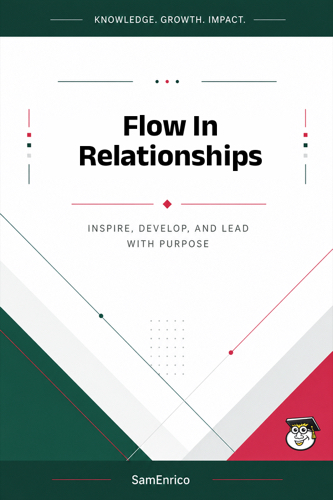
Non-FictionSelf-HelpInterpersonal
Flow In Relationships eBook
Explores mutual absorption in conversation, dancin
by Jude Willena
Explores mutual absorption in conversation, dancing, and intimate connection.
Formats
Free sample
Chapter 1: The Third Entity...--–- You have probably never thought of your relationship as a living thing. That is the first mistake.Most people treat their relationship like a contract. Two individuals agree to certain terms—fidelity, shared rent, holiday obligations, perhaps children—and then they manage that contract like a business merger. They track who did the dishes. They tally who initiated sex last.
They negotiate bedtime routines like labor disputes. And when the relationship feels flat, they assume one of the two individuals is broken.But what if the relationship itself—the space between you, the invisible third thing that emerges when two people commit to each other—has its own needs, its own energy, its own life? What if the reason your relationship feels stagnant is not because you chose the wrong partner or because you are fundamentally flawed, but because you have been starving the third entity?This chapter introduces a radical reframe: a relationship is not merely a contract between two individuals. It is a third, living entity that requires its own attention, its own goals, and its own nourishment. Drawing from the psychology of flow—first articulated by Mihaly Csikszentmihalyi and now applied to couples for the first time in this book—we will explore how treating your relationship as an entity rather than an agreement transforms everything.
You will learn why most couples fail not because they fight too much, but because they have stopped dancing together. And you will be challenged to do something that feels strange at first: name your "We."The Mistake of the Contract Mindset Let us begin with a simple question. When you think about your relationship, what image comes to mind? For most people, the image is of two separate figures facing each other, negotiating, trading, sometimes embracing but always aware of their individuality. This is the contract mindset.
It says: I have my needs. You have your needs. We will exchange goods and services—affection for security, labor for appreciation, sex for emotional support—and if the exchange remains balanced, the relationship succeeds.This mindset is not wrong. It is incomplete.Consider a dance. Two people come to the floor.
Each has their own body, their own training, their own history of injuries and triumphs. If they simply stand facing each other and negotiate who will lead, no dance occurs. The dance is not the man. The dance is not the woman. The dance is the third thing that emerges when they commit to a shared frame, a shared rhythm, a shared surrender to the music.
You cannot point to the dance. It has no physical mass. But you know when it is there, and you know—viscerally, immediately—when it is gone.The relationship is the dance. And you cannot negotiate a dance into existence.The contract mindset produces what relationship experts call the "performance relationship." Couples in this mode do not fight. They do not fight because they have stopped risking anything.
They schedule date nights like calendar appointments. They have sex on predictable intervals. They communicate using "I feel" statements learned from a therapist three years ago. Externally, everything looks fine. Internally, the third entity is starving to death.The performance relationship is the enemy of flow.
Flow—as we will define it throughout this book—is the state of being so absorbed in an activity that self-consciousness disappears. When you are in flow, you do not ask, "Am I doing this right?" You simply do it. Jazz musicians in flow do not think about their fingers. Rock climbers in flow do not think about falling. And couples in flow do not think about whether they are being good partners.
They are too busy being absorbed in the shared activity, whether that is conversation, dancing, lovemaking, or building something together.The contract mindset kills flow because it keeps you self-conscious. Every action is evaluated. Every word is weighed. "Was that the right thing to say?" "Am I pulling my weight?" "Is this fair?" These questions are the death of mutual absorption. You cannot lose yourself in the dance if you are constantly checking your reflection in the mirror.What Is a Third Entity?The phrase "third entity" sounds mystical.
It is not. It is a practical tool for shifting attention away from individual performance and toward shared creation.Think of a jazz quartet. Four individuals walk onto the stage. Each has decades of individual practice. Each has a unique style, a unique ego, a unique relationship to the instrument.
But when they play, something emerges that is not reducible to any one of them. Critics call it the "group sound." Musicians call it the "pocket." A bad quartet is four individuals playing at the same time. A good quartet is one entity expressing itself through four instruments.Your relationship is the same. A bad relationship is two individuals negotiating. A good relationship is one third entity expressing itself through two bodies.This is not erasure.
You do not lose your individuality. The jazz musicians do not lose their technique. But they subordinate their individual egos to the shared creation. The guitarist does not ask, "Am I playing a cool solo?" He asks, "What does the song need right now?" That shift in question—from "What am I getting?" to "What are we creating?"—is the entire difference between a contract and a third entity.The third entity has specific needs, just as a living organism has specific needs. It needs:Attention.
The third entity cannot survive on autopilot. It requires you to look at it directly, to notice when it is thriving and when it is wilting. Most couples go weeks without ever directing their attention to the relationship itself. They talk about the kids, the mortgage, the in-laws, the vacation. They never ask, "How is we doing?"Goals.
Not rigid outcomes, but direction. A third entity needs to know where it is going. Without direction, it drifts. Drifting feels safe—no conflict, no risk—but drifting is the slow death of flow. Flow requires a rising challenge.
A relationship that is not growing toward something is shrinking toward nothing.Feedback. The third entity needs to know how it is doing. This is not criticism. This is information. A dancer cannot improve without knowing whether she is on the beat.
A couple cannot improve without knowing whether they feel connected. The weekly "Relationship Flow Audit" introduced in Chapter 12 is one form of feedback. But feedback can be as simple as asking, "How did that conversation feel to you?" and listening to the answer without defense.Nourishment. The third entity eats experiences. It grows on shared novelty, shared risk, shared laughter, shared silence.
The couple who does the same thing every week—same restaurant, same TV shows, same sexual script—is starving the third entity. It needs new music, new moves, new questions.Protection. The third entity is fragile, especially in the beginning. It needs boundaries. No phones at dinner.
No bringing up old wounds during sex. No third parties in the bed, whether literal (children, pets) or metaphorical (work stress, social media). Protection is not control. Protection is saying, "This space between…
This is the end of the free sample. Get the eBook to keep going. Buy now
About this book
Details
- Author
- Jude Willena
- Publisher
- SamEnrico
- Language
- English
- Genre
- Non-Fiction, Self-Help, Interpersonal
- Released
- 2026-06-06
- Pages (approx.)
- 153
- Available as
- eBook, Audiobook

Read better in the ZLOADR app
Your eBooks on your phone or tablet. Sign in with your SamEnrico account and start reading.
More by Jude Willena
 Blue Zone Fasting Mimicking GuideJude Willena$11.99
 Refugee Breath PracticeJude Willena$11.99
 Chennai BPO Operations GuideJude Willena$11.99
 The Symphony of Souls: How Black Composers Shaped Classical MusicJude Willena$11.99
 How to Start a Producers - Independent BusinessJude Willena$11.99
 Employee Monitoring Legal BoundariesJude Willena$12.99
 How to Produce Cake ServersJude Willena$11.99
 Head of Business OperationsJude Willena$11.99
You may also like
 Hong Kong Handover 1997Dunn Johnnie$11.99
 Zumba For Postnatal Recovery CourseNeal Christian$11.99
 Zumba for BeginnersLadner Nikia$11.99
 YouTube Comment Mining GuideHumes Pandora$12.99
 Worry Box MeditationCarlin Rudy$11.99
 Workplace Stress MeditationNguyen Lynn$11.99
 Workplace Stress and Sleep RepairHawley Ivory$11.99
 Workplace Perfectionism CureDelaney Jeffry$11.99
 Workplace Injustice Anger GuideWallen Isabelle$11.99
 Work Addiction and Burnout LinkGreenwood Ester$11.99
 Women in Yoga and WellnessBeattie Galina$11.99
 Women in Stand Up ComedyChun Evangeline$11.99