
Non-FictionSelf-HelpCaregiving
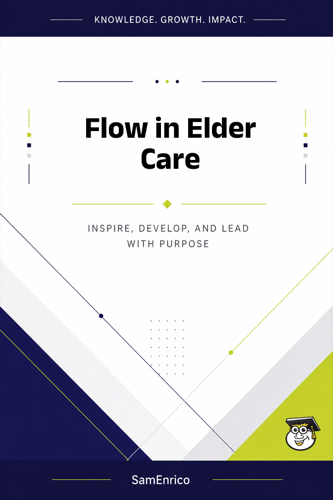
Flow in Elder Care eBook
Caregivers finding flow in daily routines.
Caregivers finding flow in daily routines.
Formats
Free sample
Chapter 1: The Invisible Walls--The moment you became a caregiver, the walls went up. You did not see them being built. There was no construction crew, no hammering, no caution tape. But one morning you woke up and realized that your world had shrunk. The coffee shop you used to visit on Saturdays—when had you last been there?
The friend who used to call just to chat—when had she stopped? The hour you used to spend reading before bed—where had it gone? The walls are invisible because they are made not of brick but of obligation, repetition, and the slow accumulation of small surrenders. You gave up your lunch break first, then your gym membership, then your book club, then your book. You told yourself it was temporary.
You told yourself you would go back to normal when things settled down. But things never settled down. The walls kept closing in. And now you are reading this book because somewhere inside you, a voice is whispering: I cannot live like this much longer.This chapter is about seeing those walls for the first time. Not to depress you, but to liberate you.
Because you cannot change what you refuse to see. And what you are about to see—the geography of caregiving, the fragmentation of your attention, the mismatch between your skills and your challenges—is not a sign that you are failing. It is a sign that you have been operating without a map. This book is that map. And the first landmark on the map is something called the geography of restriction.Understanding the Geography of Restriction Every caregiver lives in a geography of restriction.
This is not a metaphor. It is a measurable, observable reality that affects your physical space, your social connections, and your experience of time. Let us walk through each dimension together.Physical Space: The Home That Became a Hospital Think about the room you are sitting in right now. Before caregiving, this room had a purpose. The dining room was for dinner parties.
The living room was for relaxing. The guest bedroom was for guests. Now look around. Is there medical equipment in your living room? A hospital bed where your sofa used to be?
A commode in the corner? Boxes of adult briefs stacked by the window? Your home has been converted into a care facility without your explicit consent, and every square foot now reminds you of the role you did not choose.I interviewed a caregiver named Robert who moved his mother into his two-bedroom condo after her stroke. “The first week, I thought we could make it work,” he told me. “By the third week, my bedroom was a storage unit.
By the second month, I was sleeping on the couch because the hospital bed took up the whole guest room and I couldn’t sleep next to the sound of the oxygen machine.” Robert’s story is not unusual. Research on the Ecological Model of Aging—a framework that examines how physical environments affect the well-being of older adults and their caregivers—shows a direct correlation between environmental compression and caregiver distress. The more your living space becomes dedicated to care tasks, the less space you have for rest, recovery, and identity. Every room becomes a task. No room remains a sanctuary.Social Space: The Radius That Shrank to Nothing Before caregiving, you had a radius.
You could drive twenty minutes to a friend’s house. You could spend an afternoon at a museum. You could take a weekend trip without calculating medication schedules. Now that radius has contracted. Perhaps you cannot leave for more than two hours because of feeding times.
Perhaps you cannot accept dinner invitations because sundowning begins at six o’clock and your elder becomes agitated. Perhaps you cannot attend your niece’s soccer game because no one else knows how to transfer your spouse from the bed to the chair without causing pain.One caregiver in a recent study described her social world as “a house with no doors.” She said, “The phone still rings sometimes, but I’ve stopped answering because I don’t know what to say. ‘How are you?’ Fine. ‘What’s new?’ Nothing. ‘Do you want to get coffee?’ I can’t.
After a while, people stop asking. And you can’t blame them. You’ve become boring. You’ve become unavailable. You’ve become a ghost who still pays taxes.”The geography of restriction is self-reinforcing.
The more you cannot leave, the fewer people ask. The fewer people ask, the more alone you feel. The more alone you feel, the harder it is to reach out. The walls are invisible because they are made of silence.Temporal Space: The Fragmentation of Minutes This is perhaps the most disorienting dimension of caregiving geography. Before caregiving, time moved in blocks—morning, afternoon, evening, a day, a week, a month.
Now time moves in fragments. Fifteen minutes for medication. Twenty minutes for toileting. Thirty minutes for a meal that may or may not be eaten. Ten minutes to shower before the elder wakes up.
Five minutes to eat something yourself. Two minutes to breathe before the next round begins.Caregivers report a bizarre distortion of time. A day feels like a week because it is packed with so many small, repetitive tasks. But a year feels like a month because the tasks blur together into an undifferentiated fog. You look up and realize you have been doing this for three years, but you cannot account for where the time went because you were never in a single moment long enough to remember it.This fragmentation is not a failure of your attention.
It is a predictable neurological consequence of what scientists call anticipatory vigilance. Your brain is constantly scanning for the next crisis, the next need, the next interruption. You are not living in the present moment because your brain has been trained to live thirty seconds into the future. This is exhausting. More importantly, it is the direct enemy of flow.What Is Flow, and Why Do You Need It?The psychologist Mihaly Csikszentmihalyi spent decades studying a phenomenon he called flow—the state of total immersion in an activity where time falls away, self-consciousness disappears, and the activity becomes its own reward.
Rock climbers report flow. Surgeons report flow. Jazz musicians, chess players, and long-distance runners all report flow. And so do caregivers—when conditions are right.Let me give you an example. I spoke with a caregiver named Delia who cares for her husband with early-onset Alzheimer’s.
“Most days are chaos,” she told me. “But every morning, I make him oatmeal. Same pot. Same spoon. Same three minutes of stirring.
And in those three minutes, I am not a caregiver. I am just a woman stirring oatmeal. The rest of the day falls away. I don’t think about the diagnosis or the bills or the future. I just stir.
And for those three minutes, I am okay.”That is flow. Low challenge, high skill. Delia has made oatmeal thousands of times. She does not need to think about it. Her skill is automatic.
The challenge is minimal. And in that gap between high skill and low challenge, she finds presence. This is what…
This is the end of the free sample. Get the eBook to keep going. Buy now
About this book
Details
- Author
- Schrader Moshe
- Publisher
- SamEnrico
- Language
- English
- Genre
- Non-Fiction, Self-Help, Caregiving
- Released
- 2026-06-10
- Pages (approx.)
- 139
- Available as
- eBook, Audiobook

Read better in the ZLOADR app
Your eBooks on your phone or tablet. Sign in with your SamEnrico account and start reading.
More by Schrader Moshe
 Eisenhower Matrix for StudentsSchrader Moshe$11.99
 Candlelit Bath VisualizationSchrader Moshe$11.99
 Affirmations for AutismSchrader Moshe$11.99
 The Focus ChallengeSchrader Moshe$11.99
 Fencer's Hypnosis GuideSchrader Moshe$11.99
 Stress Fertility ConnectionSchrader Moshe$11.99
 Star Gazing Field GuideSchrader Moshe$11.99
 The Last Oracle of Delphi: Riddles That Shook the Ancient WorldSchrader Moshe$11.99
 Barra Brava: The Beautiful and Brutal Art of Latin American Football Fan CultureSchrader Moshe$11.99
 How to Become a Sales RepresentativeSchrader Moshe$11.99
 White-faced Capuchins: Clever MonkeySchrader Moshe$11.99
 A Collector's Handbook to the Wolseley Hornet (1930-32)Schrader Moshe$11.99
You may also like
 Hong Kong Handover 1997Dunn Johnnie$11.99
 Zumba For Postnatal Recovery CourseNeal Christian$11.99
 Zumba for BeginnersLadner Nikia$11.99
 YouTube Comment Mining GuideHumes Pandora$12.99
 Worry Box MeditationCarlin Rudy$11.99
 Workplace Stress MeditationNguyen Lynn$11.99
 Workplace Stress and Sleep RepairHawley Ivory$11.99
 Workplace Perfectionism CureDelaney Jeffry$11.99
 Workplace Injustice Anger GuideWallen Isabelle$11.99
 Work Addiction and Burnout LinkGreenwood Ester$11.99
 Women in Yoga and WellnessBeattie Galina$11.99
 Women in Stand Up ComedyChun Evangeline$11.99