
Non-FictionSelf-HelpCommunication
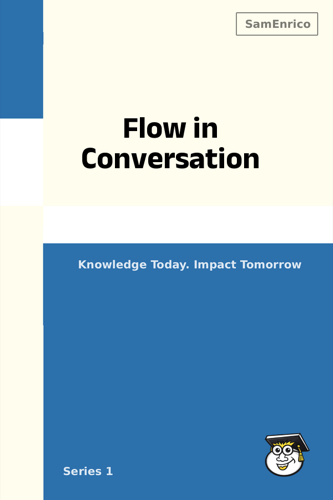
Flow in Conversation eBook
Achieves flow during dialogue and deep listening.
by Royster Mana
Achieves flow during dialogue and deep listening.
Formats
Free sample
Chapter 1: The Listening Lie–- You have been lied to about what makes a great conversationalist.The lie is subtle, pervasive, and repeated so often that it has become invisible, like the air you breathe or the background hum of a refrigerator. The lie says this: great talkers are fast, witty, confident, and loud. They are the ones who fill silences before silences become awkward. They command rooms. They never run out of things to say.
They are the extroverts, the storytellers, the people who can sell ice to Eskimos and charm their way out of speeding tickets.And if you are not one of those people—if you are quieter, slower to speak, more comfortable listening than performing—then the lie whispers something crueler: You are at a disadvantage. You will never be truly great at conversation. You should learn to talk more, faster, and with more confidence.Everything in this book will argue the opposite.The most extraordinary conversationalists I have studied, interviewed, and learned from are rarely the loudest people in the room. They are not the ones who dominate airtime or dazzle with verbal acrobatics. Instead, they possess a quality so rare and so misunderstood that most books on communication completely miss it.
They have learned to listen in a way that creates a state I call flow—a seamless, effortlessness, almost magical zone where dialogue stops feeling like work and starts feeling like music.This chapter dismantles the listening lie. It reveals why your brain is wired to fake attention, why extroverts often fail at deep connection, and why introverts may already possess the hidden superpower that flow requires. Most important, it introduces the single mindset shift that separates performative talkers from transformative listeners.Let me start with a story.The Executive Who Could Not Stop Talking A few years ago, I was invited to observe a leadership team at a struggling technology company. The CEO, whom I will call Marcus, had been described to me as "brilliant but exhausting." He was a classic extrovert—quick with a joke, faster with an opinion, and seemingly incapable of allowing a pause to last longer than half a second. In our first conversation, Marcus talked for eleven minutes without asking me a single question.
He told me about his rise through the ranks, his turnaround strategy, his frustrations with his team, and his theory on why the market had misunderstood their product.When he finally stopped for breath, I said something deliberately quiet: "It sounds like you've been carrying a lot alone."Marcus went silent. Not a polite pause. A real silence. His eyes softened. He looked down at his hands.
When he spoke again, his voice was different—slower, lower, more human. "I haven't told anyone that," he said. "I didn't realize how tired I was."In that moment, Marcus experienced something he rarely allowed himself to feel: being heard. Not being agreed with. Not being advised.
Not being impressed by. Just heard. And that feeling, more than any strategy or joke or witty comeback, is the doorway to flow.Marcus was not a bad person. He was a victim of the listening lie. He believed that his value in conversation came from what he said—the insights he contributed, the problems he solved, the stories he told.
No one had ever taught him that his presence, his attention, and his ability to create safety for others were infinitely more valuable than his cleverest remark.By the end of this chapter, you will understand why Marcus's transformation was not magic but neuroscience. And you will learn the first and most important skill of flow: how to shift from performing in conversation to being present in conversation.The Anatomy of Performative Listening Before we can build flow, we have to name its enemy. I call it performative listening—and chances are, you do it constantly without realizing it.Performative listening looks like listening. It sounds like listening. But it is not listening at all.
It is a sophisticated performance designed to convince the other person that you care while your brain is actually doing something entirely different.Here is what performative listening looks like in practice:You nod at regular intervals, but your nods are mechanical, like a metronome, not responsive to what is actually being said.You make eye contact, but your eyes are slightly unfocused because you are rehearsing your next sentence in your head.You say "uh-huh," "right," "I see," and "yeah" on autopilot, but you could not repeat the last thing the person said if your life depended on it.You wait for the smallest gap in their speech to jump in with your own story, your own opinion, or your own solution.You finish their sentences (which you think shows engagement but actually shows impatience).You ask questions, but the questions are really veiled attempts to steer the conversation back to your own experience.Performative listening is not malice. It is anxiety. Your brain is afraid of what might happen if you stop performing—silence, awkwardness, judgment, the loss of control. So your brain works overtime, generating responses, evaluating the other person, and preparing your next move. The problem is that a brain doing all that work has no attention left for the one thing that actually matters: understanding what the other person is trying to say.Research on conversational dynamics reveals a disturbing statistic: when two people are engaged in what they both describe as "a good conversation," each person typically spends less than 30 percent of their mental energy on actually comprehending the other person's meaning.
The rest goes to self-presentation, response preparation, and social evaluation. In other words, even our best conversations are only partially about listening.Flow requires the opposite. In a flow state, your brain stops multitasking. It stops preparing. It stops evaluating.
It simply receives. And that receiving, as we will see throughout this book, is not passive. It is one of the most active, demanding, and rewarding things a human brain can do.The Introvert's Hidden Superpower If performative listening is the enemy of flow, then who is most likely to already possess the skills of flow? The answer may surprise you: introverts.I want to be careful here. I am not saying that extroverts cannot achieve flow, or that all introverts are naturally great listeners.
But the personality traits associated with introversion align remarkably well with the prerequisites for conversational flow.Consider what introverts typically do well:They tolerate silence. Extroverts often experience silence as a problem to be solved, a void that must be filled immediately. Introverts are more likely to experience silence as a neutral space—or even a productive one. This is crucial because, as we will explore in depth in Chapter 3, strategic silence is one of the most powerful tools for deepening a conversation.They observe before they speak. Introverts tend to process information internally before responding.
This means they are less likely to interrupt, less likely to blurt out the first thing that comes to mind, and more likely to actually absorb what the other person has said before formulating a reply.They are less threatened by the loss of control.…
This is the end of the free sample. Get the eBook to keep going. Buy now
About this book
Details
- Author
- Royster Mana
- Publisher
- SamEnrico
- Language
- English
- Genre
- Non-Fiction, Self-Help, Communication
- Released
- 2026-06-09
- Pages (approx.)
- 115
- Available as
- eBook, Audiobook

Read better in the ZLOADR app
Your eBooks on your phone or tablet. Sign in with your SamEnrico account and start reading.
More by Royster Mana
 Self Hypnosis for FibromyalgiaRoyster Mana$11.99
 Group Creativity For Startups CourseRoyster Mana$11.99
 Morning Pages HabitRoyster Mana$11.99
 The Dubai AI Study ToolsRoyster Mana$11.99
 Email Writing for Remote WorkRoyster Mana$11.99
 Acupuncture for LymphedemaRoyster Mana$11.99
 Dental Database SearchingRoyster Mana$11.99
 The Alchemist of Rome: Pliny the Elder and the Birth of Scientific InquiryRoyster Mana$11.99
 The Man Who Discovered Bebop: John Hammond and the Birth of Modern MusicRoyster Mana$11.99
 How to Produce Pig IronRoyster Mana$11.99
 A Collector's Handbook to the Wanderer W50Royster Mana$11.99
 Sparrows: Backyard BirdRoyster Mana$11.99
You may also like
 Hong Kong Handover 1997Dunn Johnnie$11.99
 Zumba For Postnatal Recovery CourseNeal Christian$11.99
 Zumba for BeginnersLadner Nikia$11.99
 YouTube Comment Mining GuideHumes Pandora$12.99
 Worry Box MeditationCarlin Rudy$11.99
 Workplace Stress MeditationNguyen Lynn$11.99
 Workplace Stress and Sleep RepairHawley Ivory$11.99
 Workplace Perfectionism CureDelaney Jeffry$11.99
 Workplace Injustice Anger GuideWallen Isabelle$11.99
 Work Addiction and Burnout LinkGreenwood Ester$11.99
 Women in Yoga and WellnessBeattie Galina$11.99
 Women in Stand Up ComedyChun Evangeline$11.99