
Non-FictionSelf-HelpArtistic Productivity
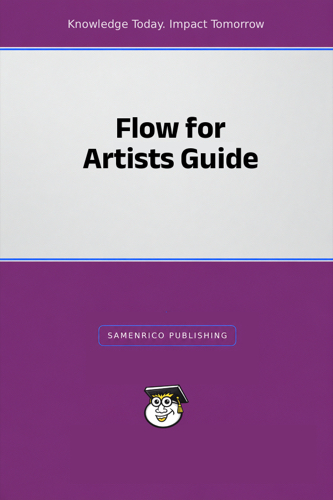
Flow for Artists Guide eBook
Enter creative flow states for painting, drawing,
Enter creative flow states for painting, drawing, and design work.
Formats
Free sample
Chapter 1: The Resistance Audit--–- The blank canvas is not your enemy. Your assumption that you need to feel inspired before you begin—that is the enemy. This chapter will teach you why waiting is the first act of self-sabotage, how to identify your personal "stopping points," and why the first stroke you are afraid to make is actually the only one that matters right now.You have been lied to by every romanticized portrait of the artist in existence. The starving painter in the garret, struck by lightning at midnight. The designer who wakes from a dream with a logo fully formed.
The illustrator who downs three espressos and produces a masterpiece in a single, caffeinated breath. These stories are not merely exaggerated; they are actively harmful. They teach you to wait. And waiting is the most expensive thing you will ever do as an artist.Let us name the lie directly: Inspiration is not a cause of flow. Inspiration is a result of showing up.You do not wait for the muse.
You sit down at the easel, make an intentionally bad mark, and the muse—annoyed, hungry, or bored—arrives to correct you. That is the secret that no bestseller has told you in language specific to painting, drawing, and design. Until now.This chapter is called "The Resistance Audit" because before you can enter flow, you need to conduct a forensic investigation of exactly what stops you. Not the vague feeling of "being blocked." The specific, observable, repeatable thoughts and behaviors that occur between the moment you decide to create and the moment you actually make your first mark.The Anatomy of Resistance Steven Pressfield, in his indispensable book The War of Art, named the force that opposes creative work. He called it Resistance.
Resistance is not laziness. It is not a lack of talent. It is a specific psychological friction that feels like:Procrastination (I will start after I check Instagram)Fear (What if this drawing is terrible?)Perfectionism (I need the right pencil, the right paper, the right lighting)Self-sabotage (I will clean my studio first, then I will paint)Comparison (Why bother? Someone else has already done this better)Resistance is not your enemy in the sense that you can defeat it once and be done. Resistance is gravity.
You cannot defeat gravity. You can only learn to work with it, around it, or in spite of it. The goal of this chapter is not to eliminate Resistance—that is impossible. The goal is to recognize Resistance so quickly, so reflexively, that you stop mistaking it for your own valid feelings.Here is the distinction that changes everything:Feeling Is it Resistance?What to do"I am tired."Sometimes yes, sometimes no Check if you slept less than 6 hours. If yes, rest.
If no, Resistance."I don't know what to draw."Almost always Resistance Draw something badly. The "what" will appear."My tools are not ready."Usually Resistance Use a bad tool. A ballpoint pen on a napkin."I am not a real artist."Always Resistance Make ten terrible drawings. Then call yourself whatever you want.The most insidious form of Resistance is the one that feels like responsible adult behavior. "I should clean the studio before I paint." "I should return those emails first." "I should research reference images for another hour." These are not productivity.
These are Resistance wearing a business casual outfit.Technical Effort vs. Flow Effortlessness Before we go further, we need to distinguish between two states that feel completely different in the body. Most artists confuse them, which leads to abandoning the wrong state.Technical Effort feels like: strained concentration, conscious decision-making, frequent checking of reference materials, erasing, re-measuring, frustration. This is the state of learning. It is necessary.
It is valuable. It is not flow.Flow Effortlessness feels like: automatic mark-making, time distortion (two hours feel like twenty minutes), a quieting of the inner monologue, a sense that the brush is moving itself. This is the state of optimal experience. It is the goal of this book.The critical insight: You cannot start in flow effortlessness. You must pass through technical effort to get there.
Every single time. Even after thirty years of practice.This is why the first twenty minutes of any session are so important—and so frequently abandoned. Chapter 5 will give you the full ritual for those twenty minutes. For now, simply accept this premise: The first twenty minutes will feel bad. That is not a sign that you are doing something wrong.
That is the price of admission.Your Personal Stopping Points: A Diagnostic Every artist has a unique "stopping point"—the exact moment when Resistance wins. For some, it is before they even enter the studio. For others, it is after sharpening pencils but before touching paper. For a few, it is three brushstrokes in, when the first mark does not look like the image in their head.Your job in this chapter is to identify your stopping point with surgical precision. Vague descriptions will not help you.
"I get blocked" is useless. "I stop when I have selected my colors but before I mix them" is actionable.Take out a piece of paper right now. Do not use your studio journal for this—use a scrap. We are going to conduct what I call a Resistance Audit.Step 1: Recall the last three times you intended to create and did not.For each occasion, write down:Where were you?What time of day was it?What was the last thing you did before you stopped?Step 2: Identify the thought that occurred at the stopping point.Not the feeling. The actual sentence in your head.
Examples:"This is going to look terrible.""I should watch a tutorial first.""I don't have the right blue.""What's the point?""I'll do it after lunch."Step 3: Categorize your stopping point.Category Description Sample Thought Fear of judgment Concerned about how the work will be received"People will laugh at this"Perfectionism Waiting for ideal conditions"I need a bigger brush"Overwhelm The project feels too large"I don't know where to start"Comparison Measuring against others"Instagram artists are so much better"Exhaustion Genuine depletion (rare) or Resistance in disguise (common)"I'm too tired to think"The First Stroke You Are Afraid to Make Here is the most important exercise in this chapter—and, arguably, in this entire book. It is deliberately small. It is deliberately incomplete. It is designed to bypass Resistance by asking for so little that Resistance cannot be bothered to show up.The exercise: Set a timer for three minutes. On a scrap piece of paper, draw only the first stroke you are afraid to make.
Then stop.Not the second stroke. Not the finished drawing. Just the first one.What does "the first stroke you are afraid to make" mean? For a painter, it might be the first dab of cadmium red on a white canvas. For a drawer, it might be the first line of a portrait's eye.
For a designer, it might be the first shape placed in a blank layout.Crucial note: This exercise is diagnostic, not curative. Its…
This is the end of the free sample. Get the eBook to keep going. Buy now
About this book
Details
- Author
- Carney Filomena
- Publisher
- SamEnrico
- Language
- English
- Genre
- Non-Fiction, Self-Help, Artistic Productivity
- Released
- 2026-06-06
- Pages (approx.)
- 115
- Available as
- eBook, Audiobook

Read better in the ZLOADR app
Your eBooks on your phone or tablet. Sign in with your SamEnrico account and start reading.
More by Carney Filomena
 The OKR Execution HandbookCarney Filomena$11.99
 Creative Warm Up ActivitiesCarney Filomena$11.99
 Gambling Disorder SignsCarney Filomena$11.99
 Embracing Failure For GrowthCarney Filomena$11.99
 Breath Release TechniqueCarney Filomena$11.99
 Foreclosure Stress SurvivalCarney Filomena$11.99
 Delegation for Healthcare LeadersCarney Filomena$11.99
 The Celestial Architects of Meroë: How Kushite Astronomers Mastered the SkyCarney Filomena$11.99
 The Great Irish Auction: When Europe’s Banks Betrayed a NationCarney Filomena$11.99
 Redtop: BentgrassCarney Filomena$11.99
 How to Produce Electronic Musical InstrumentsCarney Filomena$11.99
 Digital Sabbath Implementation GuideCarney Filomena$12.99
You may also like
 Hong Kong Handover 1997Dunn Johnnie$11.99
 Zumba For Postnatal Recovery CourseNeal Christian$11.99
 Zumba for BeginnersLadner Nikia$11.99
 YouTube Comment Mining GuideHumes Pandora$12.99
 Worry Box MeditationCarlin Rudy$11.99
 Workplace Stress MeditationNguyen Lynn$11.99
 Workplace Stress and Sleep RepairHawley Ivory$11.99
 Workplace Perfectionism CureDelaney Jeffry$11.99
 Workplace Injustice Anger GuideWallen Isabelle$11.99
 Work Addiction and Burnout LinkGreenwood Ester$11.99
 Women in Yoga and WellnessBeattie Galina$11.99
 Women in Stand Up ComedyChun Evangeline$11.99