
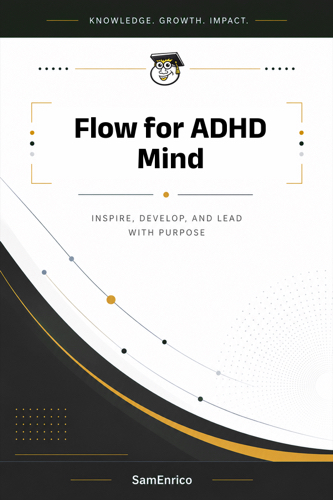
Flow for ADHD Mind eBook
Leverages hyperfocus as a gateway to flow state.
by Mccrary Kera
Leverages hyperfocus as a gateway to flow state.
Formats
Free sample
Chapter 1: The Hunter’s Inheritance...--–- You are not broken.Let me say that again, because you have probably spent decades believing the opposite. You are not lazy. You are not undisciplined. You are not morally flawed. You do not have a character defect disguised as a brain condition.
You have, instead, inherited something ancient and powerful and profoundly mismatched to the world you are trying to live in.This chapter exists to catch you. It is the net below the high wire you have been walking without a net your entire life. By the time you finish these pages, you will have a new story about who you are and why focusing has always felt like swimming upstream through molasses. More importantly, you will have the first concrete tool to build a different way of living—not by fixing yourself, but by finally working with the brain you actually have.The Shame That Comes Before the First Word Before we talk about flow, before we talk about hyperfocus, before we talk about any strategy or system in this book, we have to talk about shame. Because shame is the reason you picked up this book.
Not curiosity alone. Not productivity alone. Shame.You have tried to be on time. You have tried to remember what people told you five minutes ago. You have tried to sit through a meeting without your mind launching itself into orbit.
You have tried to finish the project before the deadline became a five-alarm fire. And sometimes—maybe often—you have failed. Not because you didn't care. Not because you didn't try. You cared so much that the caring itself became a kind of paralysis.
You tried so hard that you exhausted yourself before you even began.And after each failure, a voice whispered: Maybe they are right. Maybe you are lazy. Maybe you just need to try harder.That voice is lying to you. But the lie is so familiar, so well-worn, that it feels like the truth. This chapter is where that voice loses its power.The Farmer and the Hunter: A Tale of Two Brains Imagine two different worlds.
The first world is the world of the farmer. It emerged about twelve thousand years ago, when humans learned to plant seeds, domesticate animals, and live in settled communities. The farmer wakes at dawn, works steadily until dusk, performs repetitive tasks day after day, delays gratification for months until the harvest, follows schedules dictated by seasons and sunrises, and thrives on routine. The farmer's brain rewards patience, consistency, and the ability to sustain effort on tasks that are neither urgent nor interesting.The second world is the world of the hunter. It is far older—hundreds of thousands of years older.
The hunter does not know where the next meal will come from. The hunter must scan the environment constantly for threats and opportunities, react instantly to movement in the periphery, lock onto a target with total absorption when the moment arrives, and then rest deeply before the next burst of intensity. The hunter's brain rewards novelty, urgency, risk-taking, and the ability to hyperfocus when something interesting or dangerous appears.Here is the problem, and it is not a small one: you have a hunter's brain. And you are trying to live in a farmer's world.School is a farmer's institution. Sit still.
Raise your hand. Follow the schedule. Complete homework that is due in a week. The corporate office is a farmer's institution. Nine to five.
Annual reviews. Long-term strategic plans. Meetings that could have been emails. Even our language is farmer's language: "stay on task," "plow through," "harvest the rewards of your labor."Your hunter's brain looks at the farmer's world and asks a perfectly reasonable question: Where is the prey? Where is the urgency?
Where is the novelty? Where is the interest? When the world provides none of those things, your brain does not conclude that the world is poorly designed. It concludes that you are broken.You are not broken. You are a hunter who has been told, every single day of your life, that you should be a farmer.
And you have believed it.The Two Kinds of Attention (And Why One Feels Easy)To understand why the hunter's brain struggles in the farmer's world, we need to understand attention. Not as a single thing—the way we usually talk about it—but as two fundamentally different processes.Reactive attention is what happens when something in your environment grabs you. A loud noise. A flashing light. A notification.
A new email. A conversation happening across the room. Reactive attention is automatic, effortless, and ancient. It is the hunter scanning the savanna for movement. Your ADHD brain is excellent at reactive attention.
In fact, you may be better at it than most neurotypical people. You notice things others miss. You hear the distant siren. You spot the typo in the fine print. You feel the shift in someone's mood before they speak.Intentional attention is what happens when you choose to focus on something that is not automatically interesting or urgent.
Reading a dry manual. Filling out tax forms. Listening to a slow presentation. Staying on a task that offers no immediate reward. Intentional attention requires effort, and it requires dopamine—the brain's "get moving" chemical.Here is the cruel fact: your ADHD brain does not produce enough dopamine to make intentional attention feel easy or even possible for most uninteresting tasks.
This is not a theory. This is neurobiology. The dopamine pathways in the ADHD brain are different. They have fewer receptors. They reuptake dopamine too quickly.
They require a much stronger signal to activate.When a neurotypical person decides to do a boring task, their brain releases a small, steady stream of dopamine—just enough to make the task feel tolerable, even mildly rewarding. When you decide to do the same boring task, your brain releases almost nothing. You are not choosing to struggle. Your brain is simply not providing the fuel that intention requires.And so you procrastinate. You distract yourself.
You wait for urgency to supply the dopamine that interest and novelty did not provide. This is not laziness. This is a brain that has learned, correctly, that waiting for a crisis is the only reliable way to get the chemicals it needs to act.The Interest-Based Nervous System: Your Hidden Operating System Most productivity advice assumes a neurotypical nervous system. It assumes that you can prioritize by importance, that you can sustain effort through willpower alone, that you can work on something today because it will matter tomorrow. This advice fails for you not because you are applying it wrong, but because it was written for a different operating system.You have what ADHD specialists call an interest-based nervous system.
This means that your brain only fully engages when one of four conditions is met:Novelty: Something new, unexpected, or unexplored. A fresh problem. A new tool. A different location. Your brain wakes up when the familiar becomes unfamiliar.Interest: Deep personal fascination.
A topic you love. A puzzle you cannot put down. A creative challenge that feels like play. When you are…
This is the end of the free sample. Get the eBook to keep going. Buy now
About this book
Details
- Author
- Mccrary Kera
- Publisher
- SamEnrico
- Language
- English
- Genre
- Non-Fiction, Self-Help, ADHD
- Released
- 2026-06-09
- Pages (approx.)
- 144
- Available as
- eBook, Audiobook

Read better in the ZLOADR app
Your eBooks on your phone or tablet. Sign in with your SamEnrico account and start reading.
More by Mccrary Kera
 Cove Protection VisualizationMccrary Kera$11.99
 Canva Animation for LogosMccrary Kera$11.99
 CBT for Phobias WorkbookMccrary Kera$11.99
 Nap for Overachievers GuideMccrary Kera$11.99
 Acupuncture for VeteransMccrary Kera$11.99
 Self Hypnosis for CostochondritisMccrary Kera$11.99
 Digital Communication for NonprofitsMccrary Kera$11.99
 The Poisoned Chalice: Argentina's Deadly Duellists (1953)Mccrary Kera$11.99
 The Trial of the Imaginary: Latin America's Sci-Fi WarsMccrary Kera$11.99
 Tetras: Aquarium FishMccrary Kera$11.99
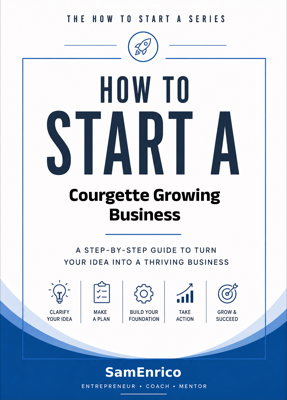 How to Start a Courgette Growing Business (Beginners Guide)Mccrary Kera$11.99
 A Collector's Handbook to the Wolseley 50Mccrary Kera$11.99
You may also like
 Hong Kong Handover 1997Dunn Johnnie$11.99
 Zumba For Postnatal Recovery CourseNeal Christian$11.99
 Zumba for BeginnersLadner Nikia$11.99
 YouTube Comment Mining GuideHumes Pandora$12.99
 Worry Box MeditationCarlin Rudy$11.99
 Workplace Stress MeditationNguyen Lynn$11.99
 Workplace Stress and Sleep RepairHawley Ivory$11.99
 Workplace Perfectionism CureDelaney Jeffry$11.99
 Workplace Injustice Anger GuideWallen Isabelle$11.99
 Work Addiction and Burnout LinkGreenwood Ester$11.99
 Women in Yoga and WellnessBeattie Galina$11.99
 Women in Stand Up ComedyChun Evangeline$11.99