
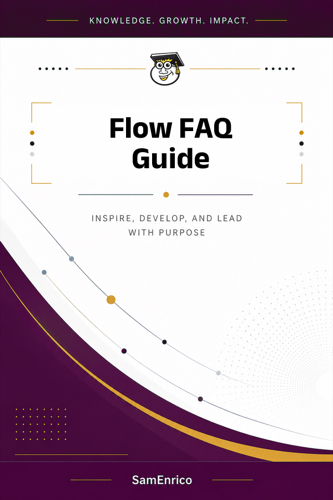
Flow FAQ Guide eBook
Answers to common questions about optimal experien
Answers to common questions about optimal experience.
Formats
Free sample
Chapter 1: The Cake Illusion--–- Let’s start with a simple experiment. Think back to the last time you felt truly happy. Not just okay. Not just relieved that a stressful day was over. Truly, deeply, unmistakably happy.
Got a memory? Good. Now answer this: Were you doing something, or were you having something done to you?This is not a trick question. But the answer reveals something most people never notice about their own happiness.If your memory involves lying on a beach, eating a delicious meal, watching a sunset, or scrolling through a perfect Instagram feed, you were experiencing pleasure. And pleasure is wonderful.
Pleasure is the frosting on the cake of life. But here is the problem that this entire book exists to solve: pleasure is not enough. In fact, pleasure—when pursued as a goal—often leaves us emptier than when we started.If your memory involves solving a difficult puzzle, finishing a challenging run, writing a paragraph that finally works, fixing something that was broken, learning a new skill, or performing under pressure, you were experiencing something else entirely. You were experiencing enjoyment. And enjoyment, as we will use the term in this book, is the doorway to flow.The difference between pleasure and enjoyment is the difference between eating cake and baking one.
Both can make you feel good. But one leaves you passive. The other leaves you changed.This chapter is called The Cake Illusion because we have been sold a lie. The lie says that happiness is something that happens to you—a state of passive contentment that arrives when you have enough money, enough rest, enough likes, enough leisure. The lie says that the goal of life is to minimize effort and maximize comfort.
The lie says that work is the enemy of happiness and that play is its only true ally.The truth is the opposite. The truth is that the most alive you have ever felt was not when you were resting. It was when you were struggling toward something that mattered. It was when you were so engaged that you forgot to check your phone. It was when the voice in your head that usually criticizes everything you do went quiet because you were too busy doing.That state has a name.
It is called flow.And the first step toward understanding flow is understanding why most of what we call "happiness" is actually a trap.The Pleasure Trap Let us define our terms clearly because confusion here will derail everything that follows.Pleasure is a passive experience. It happens when a need or desire is satisfied without requiring effort from you. Eating a slice of cake is pleasure. The cake does the work. Your taste buds receive the reward.
Watching a good movie is pleasure. The filmmakers did the work. You sat and received. Receiving a compliment is pleasure. The other person did the emotional labor.
You soaked it up.There is nothing wrong with pleasure. Humans need pleasure. It is a biological reward system that encourages us to eat, rest, and bond. But pleasure has a dark side that most self-help books refuse to acknowledge.Pleasure is subject to hedonic adaptation. The first bite of cake is glorious.
The tenth bite is just cake. The hundredth bite, if you could stomach it, would be miserable. Your brain is wired to return to baseline. This is why winning the lottery does not make people lastingly happier. This is why the promotion feels amazing for a week and then becomes the new normal.
This is why the new phone, the new car, the new relationship—all of them deliver a spike of pleasure that fades into the background noise of ordinary life.The pleasure trap looks like this: You feel a little low. You crave a hit of pleasure. You get the cake, the show, the purchase, the like. You feel better for a moment. Then you return to baseline—or, often, slightly below baseline because the contrast makes ordinary life feel dull.
So you crave another hit. A bigger hit. A faster hit. Before you know it, you are chasing pleasure like a hamster on a wheel, running faster and faster, going nowhere, wondering why you feel so exhausted and empty.This is not a moral failing. This is neuroscience.Enjoyment, by contrast, is an active experience.
It happens when you apply skill to a challenge and succeed. Baking the cake from scratch is enjoyment. You did the work. You measured, mixed, timed, and adjusted. When it comes out of the oven, the satisfaction is not just about the taste.
It is about what you did. Solving a crossword puzzle is enjoyment. Learning a new song on the guitar is enjoyment. Finishing a difficult work project is enjoyment. Having a deep conversation where you struggle to articulate an idea and finally find the right words—that is enjoyment.Here is the critical difference: Pleasure requires nothing from you.
Enjoyment requires everything from you. And that is precisely why enjoyment is more durable, more satisfying, and more connected to what this book calls flow.Pleasure makes you feel good for a moment. Enjoyment makes you feel capable for a long time. Pleasure is a drug. Enjoyment is a muscle.The Nine Dimensions of Flow Now that we have separated pleasure from enjoyment, we can ask a more precise question: What does enjoyment look like when it is working at its highest level?The answer comes from decades of research conducted by psychologist Mihaly Csikszentmihalyi (pronounced “cheek-sent-me-high-ee”) and his colleagues around the world.
They interviewed climbers, chess players, surgeons, dancers, factory workers, monks, and grandmothers. They asked one question: When did you feel your best, and what were you doing?The answers were remarkably consistent across culture, age, and activity. Whether a Japanese teenager playing video games or an Italian grandmother making pasta, the descriptions of optimal experience shared the same nine features. These are the nine dimensions of flow. Think of them as a checklist.
When all nine are present, flow is almost inevitable. When any are missing, flow becomes difficult or impossible.Dimension 1: Clear Goals You know what you are supposed to do next. There is no ambiguity. In a game of chess, the goal is clear: checkmate. In a surgery, the goal is clear: remove the tumor without damaging healthy tissue.
In a conversation, the goal might be less obvious, but flow still requires clarity: “I want to understand what they are feeling” or “I want to explain this idea so they get it.”Clarity is the enemy of anxiety. When you do not know what you are supposed to be doing, your brain defaults to worry. When you know exactly what the next action is, your brain relaxes into the work.Dimension 2: Immediate Feedback You know how well you are doing right now. In a video game, the score changes instantly. In a sport, you see the ball go in or miss.
In writing, you see the sentence on the page and feel whether it works. Feedback does not need to come from other people. It just needs to come quickly.Feedback is the enemy of…
This is the end of the free sample. Get the eBook to keep going. Buy now
About this book
Details
- Author
- Hughey Tristan
- Publisher
- SamEnrico
- Language
- English
- Genre
- Non-Fiction, Self-Help, Reference
- Released
- 2026-06-11
- Pages (approx.)
- 145
- Available as
- eBook, Audiobook

Read better in the ZLOADR app
Your eBooks on your phone or tablet. Sign in with your SamEnrico account and start reading.
More by Hughey Tristan
 Elderly Parent ConversationHughey Tristan$11.99
 Political Nonprofit Fraud GuideHughey Tristan$11.99
 Food Addiction Recovery MilestonesHughey Tristan$11.99
 The Leftover Reinvention GuideHughey Tristan$11.99
 The Phantom of Park Lane: The $1.5M Bugatti Heist That Shocked the WorldHughey Tristan$11.99
 Virtual BaristaHughey Tristan$11.99
 How to Start a Photoflash Bulb Business (Beginners Guide)Hughey Tristan$11.99
 Ghana Government GrantsHughey Tristan$12.99
 Founder Nutrition for DepressionHughey Tristan$12.99
 Understanding Wildervanck SyndromeHughey Tristan$17.99
You may also like
 NVC Quick Reference GuideHines Alfredo$11.99
 Loneliness FAQ GuideAmato Marva$11.99
 Children's Dream FAQColburn Corrin$11.99
 Improv FAQ GuideGreiner Akiko$11.99
 Emotion Regulation HandoutsFerrer John$11.99
 Creative Block FAQWeber Viola$11.99
 Priority Cheat Sheet GuideBeasley Lou$11.99
 Drug Dependency FAQHawley Ara$11.99
 Envy FAQ GuideMeeker Marya$11.99
 Divorce FAQ GuideBurchfield Allie$11.99
 Walking Meditation FAQ GuideUtley Elna$11.99
 The Conversation Starter BibleBobo Jeanice$11.99