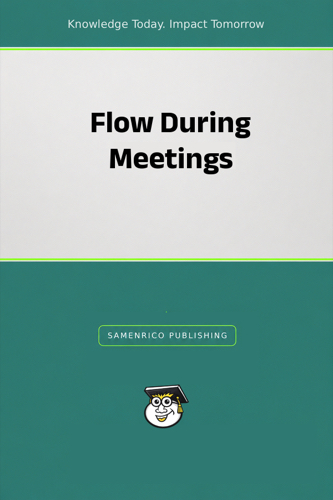
Flow During Meetings
Designs meeting structures that facilitate group f
Designs meeting structures that facilitate group flow.
Formats
About this book
Free sample
Chapter 1: The Meeting Myth--–- The email arrives at 2:47 PM on a Tuesday. You glance at the calendar invite: “Q3 Planning Sync.” Duration: 60 minutes. Attendees: fourteen people. Agenda: none. By 2:48 PM, you have already sighed, accepted the invitation out of obligation, and mentally subtracted an hour from your day.
You will attend. You will say little. You will leave wondering what was accomplished. Tomorrow, another identical invite will appear.This is not a failure of people. It is a failure of design.Over the past decade, researchers have estimated that professionals spend an average of 18 hours per week in meetings—a number that has increased by more than 30 percent since the 1980s.
Senior executives report spending closer to 23 hours per week. And when surveyed, more than 70 percent of those same professionals describe their meetings as “unproductive,” “inefficient,” or “a complete waste of time.” The math is staggering: a single sixty-minute meeting with eight attendees consumes eight person-hours. A typical organization running twenty such meetings per week burns the equivalent of one full-time employee’s entire weekly output on conversation alone.Yet the problem is not that we meet too often. The problem is that we meet badly.We have inherited a meeting template from an era of command-and-control management, where information flowed upward and decisions flowed downward. That template—a group of people sitting around a table, taking turns speaking, with one person (usually the most senior) dominating the airtime—was never designed for the kind of collaborative knowledge work that dominates modern organizations.
It was designed for status reporting and rubber-stamping. And it has barely changed in eighty years.This book offers a radical alternative: what if meetings could be the highest-leverage activity of your day? What if the collective energy of a group could be channeled into a state of effortless, creative collaboration—a state that psychologists call flow?Flow is not a mystical concept reserved for artists and athletes. It is a well-documented psychological state characterized by complete absorption, clear goals, immediate feedback, and the satisfying sensation that time is bending around you. Individual flow occurs when a person’s skill…
This is the end of the free sample. Get the eBook to keep going. Buy now
Contents
- Chapter 1
- Chapter 2
- Chapter 3
- Chapter 4
- Chapter 5
- Chapter 6
- Chapter 7
- Chapter 8
- Chapter 9
- Chapter 10
- Chapter 11
- Chapter 12
Details
- Author
- Quinones Sheilah
- Publisher
- SamEnrico
- Language
- English
- Genre
- Non-Fiction, Self-Help, Meeting Design
- Released
- 2026-06-11
- Pages (approx.)
- 131
- Available as
- eBook, Audiobook

Read better in the ZLOADR app
Your eBooks on your phone or tablet. Sign in with your SamEnrico account and start reading.
More by Quinones Sheilah
 Group Creative Pause GuideQuinones Sheilah$11.99
 Weekend Catch Up NapQuinones Sheilah$11.99
 SMART For Social MediaQuinones Sheilah$11.99
 The Dubai Roommate GuideQuinones Sheilah$11.99
 Self Hypnosis for Migraine ReliefQuinones Sheilah$11.99
 Massage Complete EncyclopediaQuinones Sheilah$11.99
 Acupuncture for TinnitusQuinones Sheilah$11.99
 The Golden Scrolls of Timbuktu: Where Knowledge Reigned SupremeQuinones Sheilah$11.99
 The Butcher of Kinshasa: Congo's Shadowy Organ TradeQuinones Sheilah$11.99
 Snowy Owls: Arctic BirdQuinones Sheilah$11.99
 How to Start a Pistachio Growing Business (Beginners Guide)Quinones Sheilah$11.99
 How to Produce Piercing and TattooingQuinones Sheilah$11.99