
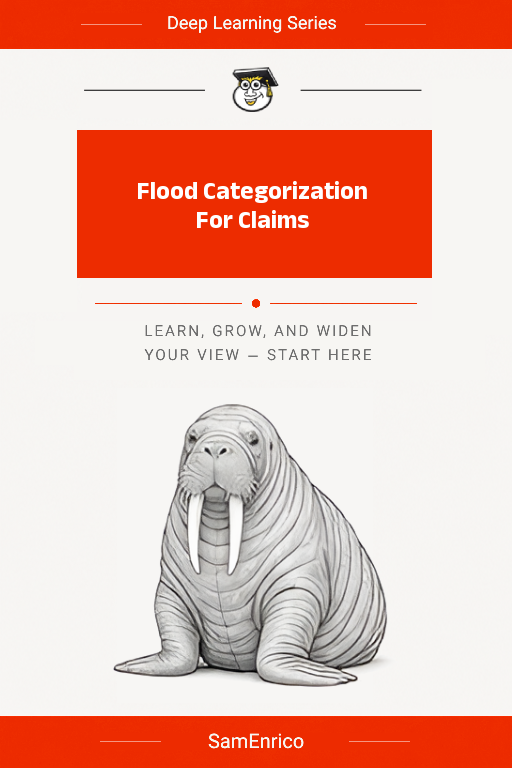
Flood Categorization For Claims eBook
Distinguish clean water from grey or black water b
Distinguish clean water from grey or black water because coverage varies for sewage versus pipe leaks.
Formats
Free sample
Chapter 1: The Three Faces of Water--It begins the same way for nearly every homeowner: a sound you do not recognize, a damp smell that was not there yesterday, or the quiet horror of stepping onto a soaking wet carpet in the middle of the night. Your heart races. Your mind runs through possibilities. A pipe burst. The washing machine overflowed.
Maybe the sump pump finally gave up after ten years of faithful service. You grab towels, buckets, your phone, and you call your insurance company expecting help. What you get instead is a question that will determine everything that follows: "Where did the water come from?"You think it is an odd question. Water is water, right? It is all wet.
It all ruins drywall and ruins carpet and ruins your day. But the person on the other end of the phone is not being difficult. They are following a system that has been used by the restoration industry for decades, a system that divides water into three distinct categories. And here is the truth that most homeowners learn too late: the difference between a fully covered claim and a denied claim often comes down to a single word. Clean.
Grey. Black. These three words represent the difference between a 500deductibleanda500 deductible and a 500deductibleanda50,000 out-of-pocket nightmare.This chapter introduces the three faces of water. By the time you finish reading, you will understand exactly what separates a burst pipe from a sewage backup in the eyes of your insurance company. You will know why the source matters more than the damage.
And you will never look at a puddle on your basement floor the same way again.The Birth of the Three-Category System Before we dive into the definitions, you need to understand where this system came from. The three-category framework is not something your insurance company invented to deny claims, though it certainly feels that way when you are standing in six inches of dirty water. The system comes from the Institute of Inspection, Cleaning and Restoration Certification, an organization known in the industry simply as the IICRC. The IICRC has been around since 1972, and its S500 standard is the bible of water damage restoration. Every professional contractor, every insurance adjuster, every industrial hygienist who works with water damage is trained on the IICRC S500.The S500 standard divides water into three categories based on the source of the water and the level of contamination present.
Category 1 is clean water from a sanitary source. Category 2 is grey water with significant contamination. Category 3 is black water containing pathogens that can make you seriously ill. These categories matter because they determine not only what your insurance will cover but also how the damage must be cleaned up, what materials can be saved, and whether you can do the work yourself or must hire a professional.Think of it like a traffic light. Green means go, and Category 1 means you can handle this yourself with the right equipment and fast action.
Yellow means caution, and Category 2 means you need professional help and specialized cleaning. Red means stop, and Category 3 means you need to get out of the house, call a professional remediation company immediately, and prepare for a significant insurance claim.But here is where it gets tricky. Water does not stay in its original category forever. Category 1 water left untreated for forty-eight hours can become Category 2 or even Category 3 water. This is the single most important concept in the entire book, and we will explore it fully in Chapter 2.
For now, understand that the clock starts ticking the moment water touches your floor, and every hour you wait changes the nature of your claim.Category 1: The Clean Water That Wants to Be Your Friend Category 1 water is the best kind of water damage you can have, if there is such a thing as "good" water damage. The IICRC defines Category 1 water as water that is clean at the point of origin and does not pose a substantial risk to humans. This means the water comes from a sanitary source, has not had time to pick up contaminants from the environment, and is essentially the same quality as the water that comes out of your kitchen faucet.Common sources of Category 1 water include broken supply lines to toilets, sinks, and appliances. When the flexible braided hose under your kitchen sink bursts, that is Category 1 water. A failed supply line to your washing machine, a burst pipe inside a wall, or a leaking ice maker line are all Category 1.
Melting snow or ice dams that leak through your roof can be Category 1, provided the water has not flowed through contaminated materials. An overflowing sink or bathtub that does not contain soap, dirt, or other contaminants is also Category 1, though this becomes contested if the water sat in a dirty tub for hours.Here is what most homeowners do not realize. Category 1 water is often covered by insurance with relatively few disputes, provided you act quickly. Your standard homeowners policy almost always covers sudden and accidental discharge of water from a plumbing system. This is not the part of your policy where insurance companies fight you.
They know that a burst pipe is a genuine accident, that clean water is relatively cheap to remediate, and that paying your claim is easier than arguing about it.But there are traps even in Category 1 claims. The biggest trap is time. Category 1 water that sits for more than forty-eight hours begins to degrade. It absorbs contaminants from your carpet, your drywall, your subfloor. Bacteria begin to multiply.
The water becomes grey, then black. And when that happens, your insurance company may reduce your coverage or deny portions of your claim because you failed to mitigate the damage. We will cover this extensively in Chapter 2, but you need to know now that the clock is running.The other trap is the source of the water. Category 1 requires that the water comes from a supply line, not from a drain or from outside. Water from a dishwasher that overflowed because the drain was clogged is not Category 1 water, even though it came out of an appliance.
That water has already traveled through dirty pipes and picked up food particles, grease, and bacteria. That is Category 2 at best. Similarly, water from a toilet supply line is Category 1 if the line bursts, but water from the toilet bowl is Category 3. The distinction is everything.Category 2: The Grey Water That Looks Innocent but Is Not Category 2 water is the middle child of the water damage family. It is not as obviously dangerous as Category 3, but it is not as safe as Category 1.
The IICRC defines Category 2 water as water that contains significant contamination and has the potential to cause discomfort or illness if consumed or contacted. This is the category where things get complicated, because grey water can look exactly like clean water. You might not be able to tell the difference by looking at it, but your insurance company and your body certainly can.Common sources of Category 2 water include washing machine overflows and discharge. The water that comes out of a washing machine contains detergent, fabric softener, dirt…
This is the end of the free sample. Get the eBook to keep going. Buy now
About this book
Details
- Author
- Haynes Alberta
- Publisher
- SamEnrico
- Language
- English
- Genre
- Non-Fiction, Crisis Management
- Released
- 2026-05-30
- Pages (approx.)
- 156
- Available as
- eBook, Audiobook

Read better in the ZLOADR app
Your eBooks on your phone or tablet. Sign in with your SamEnrico account and start reading.
More by Haynes Alberta
 Bipolar And Work LifeHaynes Alberta$11.99
 Stress Communication Workshop GuideHaynes Alberta$11.99
 Medical Listening Skills GuideHaynes Alberta$11.99
 Nurse Shift Distraction GuideHaynes Alberta$11.99
 Interleaving PracticeHaynes Alberta$11.99
 The Quit Smoking Erectile GuideHaynes Alberta$11.99
 Mental Health Access GuideHaynes Alberta$11.99
 The Caravan of HopeHaynes Alberta$11.99
 EQ for LGBTQIA+ AffirmationHaynes Alberta$11.99
 Scandal in the Spotlight: The Secret Affair That Shook Hollywood's Golden AgeHaynes Alberta$11.99
 Colors of Resistance: The Graffiti Revolution of Latin AmericaHaynes Alberta$11.99
 The Phantom Legion: Hannibal's Ghosts at Cannae (216 BC)Haynes Alberta$11.99
You may also like
 Hong Kong Handover 1997Dunn Johnnie$11.99
 Zumba For Postnatal Recovery CourseNeal Christian$11.99
 Zumba for BeginnersLadner Nikia$11.99
 YouTube Comment Mining GuideHumes Pandora$12.99
 Worry Box MeditationCarlin Rudy$11.99
 Workplace Stress MeditationNguyen Lynn$11.99
 Workplace Stress and Sleep RepairHawley Ivory$11.99
 Workplace Perfectionism CureDelaney Jeffry$11.99
 Workplace Injustice Anger GuideWallen Isabelle$11.99
 Work Addiction and Burnout LinkGreenwood Ester$11.99
 Women in Yoga and WellnessBeattie Galina$11.99
 Women in Stand Up ComedyChun Evangeline$11.99