
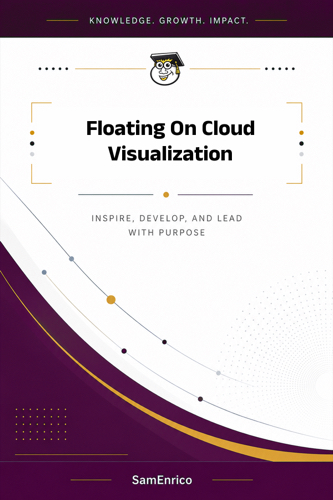
Floating On Cloud Visualization eBook
Drift weightlessly on a soft cloud to release phys
Drift weightlessly on a soft cloud to release physical tension and worry.
Formats
Free sample
Chapter 1: The Sky Above You...--–- You are already floating. You just do not know it yet.Look up. Right now, wherever you are sitting or standing, tilt your head back and glance at the ceiling, or better yet, through a window. Notice the empty space above you. That void between your eyes and the ceiling, or between your face and the clouds, is not actually empty.
It is filled with light, with air currents, with the subtle electromagnetic hum of the planet turning beneath you. And somewhere in that space, invisible to your rational mind but felt by your nervous system, is the possibility of weightlessness.This book exists because you are tired. Not just sleepy-tired, though that may be part of it. You are tired in the way that lives in the bones, the kind that coffee cannot fix and a full night of sleep only postpones. You carry tension in your shoulders like a second occupation.
Your jaw knows how to clench before you even realize you are anxious. And your mind has learned a terrible habit: it takes a small worry and spins it into a story, then replays that story until the worry feels like a fact.You have probably tried to relax. You have downloaded the meditation apps, purchased the expensive pillow, taken the bath with the salts that promised to melt away the day. And for a moment, maybe it worked. But the tension returned, because tension is not a problem you solve once.
It is a pattern you rewire slowly, like teaching a river to carve a new path to the sea.This chapter is the foundation of everything that follows. It will give you the scientific reasons why looking at the sky changes your brain chemistry. It will introduce the single most important principle of this entire book, a principle called the Law of Non-Grip, which will appear again and again as the spine of every technique you learn. And it will establish the default position that you will return to throughout your thirty-day journey: the image of yourself lying on your back on a single, soft cloud, looking up at an endless blue sky.But before we go anywhere, you need to understand one thing.You are not broken.You do not need to be fixed. Your anxiety, your tension, your racing mind—these are not signs of a defect.
They are signs of a nervous system doing exactly what it evolved to do: scanning for threats, preparing for danger, keeping you alive. The problem is not your nervous system. The problem is that your nervous system cannot tell the difference between a saber-toothed tiger and an email from your boss. It responds to both the same way.So this book is not about curing you. It is about teaching your nervous system a new language.
And that language begins with the sky.The Science of Soft Fascination Let us start with a question. When was the last time you looked at the sky for no reason? Not to check the weather, not to see if it would rain on your commute, but simply to watch? To watch the clouds drift, to notice the gradient of blue shifting from deep cerulean near the horizon to pale powder directly above, to feel the impossible vastness of an atmosphere that stretches fifty miles up before it becomes space?If you are like most people, it has been a long time. Decades, maybe.
And that is not your fault. Screens have captured your gaze. Notifications have trained your attention to flicker from one small rectangle to another. The average adult now spends over seven hours per day looking at screens, and almost none of that time is spent looking at the sky.This matters because your brain has a default mode. When you are not actively focused on a task—when you are staring out a window, walking without headphones, lying in the dark before sleep—your brain enters what neuroscientists call the Default Mode Network, or DMN.
The DMN is where you process your life story, replay memories, plan for the future, and, unfortunately, ruminate on worries. When the DMN is overactive, you get stuck in loops: Why did I say that? What if they are angry at me? Why do I feel this way?Here is what most people do not know. The DMN can be quieted not by effort, but by a specific kind of attention called soft fascination.Soft fascination is a term from environmental psychology.
It describes a state where your attention is gently engaged by a stimulus that requires no effort to process. Watching clouds drift is soft fascination. Watching flames in a fireplace is soft fascination. Listening to rain on a roof is soft fascination. These experiences hold your attention just enough to prevent mind-wandering, but not so much that they exhaust your cognitive reserves.Compare this to hard fascination.
Watching a thriller movie is hard fascination. Playing a competitive video game is hard fascination. Scrolling through a heated social media argument is hard fascination. These experiences demand your full attention, and they leave you depleted.And compare it to boredom. Staring at a blank wall is not soft fascination—it is under-stimulation, which often causes the DMN to become more active as your brain searches for something to think about.Soft fascination occupies the sweet spot.
It is the mental equivalent of a hammock. You are held, but not trapped. Engaged, but not exhausted. And when you practice soft fascination, something remarkable happens to your body: your cortisol levels drop, your heart rate slows, and your breathing deepens, all without you trying to make any of those things happen.The sky is the perfect source of soft fascination. It is always changing—clouds form and dissolve, light shifts, birds cross the field of view—but it changes slowly, without demanding your analysis.
You do not need to understand the sky. You only need to look at it.But here is the secret that most relaxation books miss. You do not even need to see the sky to get the benefit. Your brain is so deeply wired to respond to the color blue and the concept of openness that simply recalling the sky—visualizing it with your eyes closed—triggers a similar physiological response. The same neural pathways that activate when you look at the sky also activate when you imagine it.This is why cloud visualization works.
You are not escaping reality. You are accessing a hardwired relaxation response that your ancestors used every time they looked up from the hunt and watched the weather roll in. You are reclaiming something that was stolen from you by screens, by cubicles, by the artificial lighting of indoor life.The Law of Non-Grip Before we go any further, I need to give you a principle. This principle will appear in almost every chapter that follows. It is the philosophical spine of this entire book.
I call it the Law of Non-Grip.Here it is: What you resist persists. What you allow transforms.This is not new age mysticism. It is cognitive science, backed by decades of research in…
This is the end of the free sample. Get the eBook to keep going. Buy now
About this book
Details
- Author
- Odell Gertrud
- Publisher
- SamEnrico
- Language
- English
- Genre
- Non-Fiction, Self-Help, Stress Relief
- Released
- 2026-06-06
- Pages (approx.)
- 130
- Available as
- eBook, Audiobook

Read better in the ZLOADR app
Your eBooks on your phone or tablet. Sign in with your SamEnrico account and start reading.
More by Odell Gertrud
 Plant Slant Longevity DietOdell Gertrud$11.99
 Improv for DepressionOdell Gertrud$11.99
 Filibuster Exceptions GuideOdell Gertrud$11.99
 The Cloud Skills Gap ForecastOdell Gertrud$11.99
 Anansi's Web: The Spider Who Wove the WorldOdell Gertrud$11.99
 Understanding Rapunzel SyndromeOdell Gertrud$17.99
 Highway Maintenance WorkerOdell Gertrud$11.99
 Non Resident LLC Annual ReportOdell Gertrud$12.99
 Food Consumption GuideOdell Gertrud$12.99
 How to Start a Drawn Products Made of Copper Business (Beginners Guide)Odell Gertrud$11.99
You may also like
 TM Stress Release ProcessCline Mozell$11.99
 Waterfall Mist Calming GuideHarder Felisha$11.99
 The Floating Cloud MethodJacob Pilar$11.99
 Calming Breath MeditationPorter Antonio$11.99
 Calm State AnchoringCovert Nicki$11.99
 Full Body Relaxation CourseStringer Emmie$11.99
 The Waterfall Release VisualizationStahl Thad$11.99