
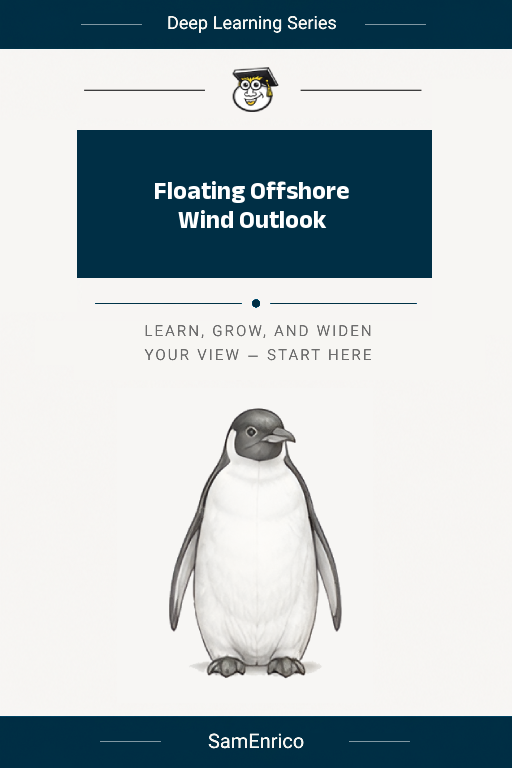
Non-FictionForecast & OutlookOffshore Wind
Floating Offshore Wind Outlook
Project semi-submersible and spar deployment in de
Project semi-submersible and spar deployment in deep-water zones of Europe, Asia, and US West Coast with cost reduction curves.
Formats
About this book
Free sample
Chapter 1: The Depths Beyond...--The wind does not stop at the shoreline. It accelerates, smooths, and gains consistency over open water, transforming from the gusty, turbulent resource that turns turbines on land into a steady, muscular force that has powered ships for millennia and now promises to power entire economies. For decades, the offshore wind industry has tiptoed along the continental shelves, planting steel monopiles and jacket foundations in waters no deeper than fifty or sixty meters. These fixed-bottom structures have delivered remarkable results, with levelized costs plummeting to levels that would have seemed impossible just a decade ago. But they have reached a natural boundary—not a technological ceiling, but a geological one.Beyond the shallow shelf, the seabed falls away.
In some places, like the Pacific coast of the United States, it drops to a thousand meters within fifty kilometers of the beach. In the Mediterranean, the Aegean Sea plunges to depths that swallow entire skyscrapers. Around Japan, the continental shelf is so narrow that fixed-bottom wind is effectively impossible across most of the country's exclusive economic zone. And yet, these deep waters contain the strongest, most consistent winds on the planet. They lie closer to major population centers than many shallow-water sites currently under development.
They represent the next frontier—not of exploration, but of exploitation.This book argues that floating offshore wind is not merely an extension of fixed-bottom technology. It is a fundamentally different engineering, economic, and logistical challenge that demands new ways of thinking about stability, manufacturing, installation, and financing. The industry is currently bifurcating into two distinct technological trajectories: the semi-submersible, which prioritizes logistics flexibility and manufacturability, and the spar, which prioritizes motion control and deep-water performance. The convergence of concrete substructures, advanced mooring systems, and serial production will drive Levelized Cost of Energy below fifty to seventy dollars per megawatt-hour by 2035—but only if the industry solves what this book calls the "port paradox": the uncomfortable reality that the most advanced floating wind technology in the world is worthless without a suitable harbor to build, assemble, and deploy it.This opening chapter establishes the fundamental…
This is the end of the free sample. Get the eBook to keep going. Buy now
Contents
- Chapter 1
- Chapter 2
- Chapter 3
- Chapter 4
- Chapter 5
- Chapter 6
- Chapter 7
- Chapter 8
- Chapter 9
- Chapter 10
- Chapter 11
- Chapter 12
Details
- Author
- Loomis Billie
- Publisher
- SamEnrico
- Language
- English
- Genre
- Non-Fiction, Forecast & Outlook, Offshore Wind
- Released
- 2026-05-29
- Pages (approx.)
- 152
- Available as
- eBook, Audiobook

Read better in the ZLOADR app
Your eBooks on your phone or tablet. Sign in with your SamEnrico account and start reading.
More by Loomis Billie
 Remote Communication Skills GuideLoomis Billie$11.99
 Menstrual Cycle Exercise GuideLoomis Billie$11.99
 MBSR for Workplace BurnoutLoomis Billie$11.99
 Sex Addiction And Attachment Styles CourseLoomis Billie$11.99
 Trauma Dream Art Therapy GuideLoomis Billie$11.99
 Quetzalcoatl’s Feathered Whisper: The Serpent’s Lost ProphecyLoomis Billie$11.99
 The Icebound Scholar: How a Humble Librarian Unlocked the Arctic's SecretsLoomis Billie$11.99
 Online Exam Tricks For Faster RecallLoomis Billie$12.99
 Communications ManagerLoomis Billie$11.99
 How to Start a Brush Head Made of Wood Business (Beginners Guide)Loomis Billie$11.99
 Understanding Heart Defect Round Face Congenital Retarded DevelopmentLoomis Billie$17.99
You may also like
 Hong Kong Handover 1997Dunn Johnnie$11.99
 Zumba For Postnatal Recovery CourseNeal Christian$11.99
 Zumba for BeginnersLadner Nikia$11.99
 YouTube Comment Mining GuideHumes Pandora$12.99
 Worry Box MeditationCarlin Rudy$11.99
 Workplace Stress MeditationNguyen Lynn$11.99
 Workplace Stress and Sleep RepairHawley Ivory$11.99
 Workplace Perfectionism CureDelaney Jeffry$11.99
 Workplace Injustice Anger GuideWallen Isabelle$11.99
 Work Addiction and Burnout LinkGreenwood Ester$11.99
 Women in Yoga and WellnessBeattie Galina$11.99
 Women in Stand Up ComedyChun Evangeline$11.99