
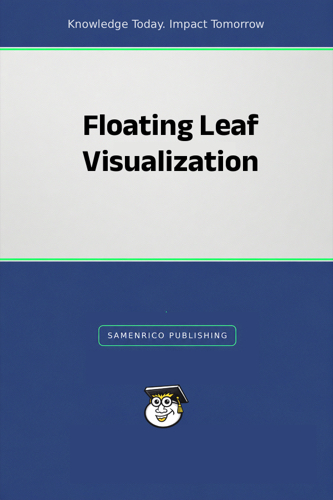
Non-FictionSelf-HelpLeafDrifting
Floating Leaf Visualization eBook
Drift as imagined leaf on stream watching sky pass
Drift as imagined leaf on stream watching sky pass by above.
Formats
Free sample
Chapter 1: The Origin Shore--–- Before you can float, you must know what you are floating from. Most people who struggle with meditation, visualization, or any kind of inner stillness share a hidden problem: they try to release without first acknowledging what holds them. They sit down, close their eyes, and immediately attempt to "let go" of thoughts, feelings, and bodily discomforts. But letting go of something you have not yet recognized is like trying to drop a rope you do not know you are holding. This chapter is not about the leaf, the stream, or the sky.
This chapter is about the shore. Specifically, the Origin Shore—the place where you begin every practice, whether you name it or not.The Origin Shore is everything you carry into the moment: your history, your habits, your hopes, your wounds. It is the tree from which you will eventually fall (as Chapter 11 will explore in depth), but for now, it is simply the ground beneath your feet before you enter the water. Many mindfulness traditions ask you to ignore the shore, to treat it as illusion or distraction. This book asks the opposite.
You cannot drift authentically if you pretend you have no attachments. You can only drift in relationship to what you have released. And you cannot release what you refuse to see.This chapter will teach you three things. First, how to identify your personal Origin Shore without judgment or analysis. Second, how to create the physical and temporal conditions for practice—what this book calls "finding your stream." Third, how to take your first step into the water using a new kind of breath awareness called Current Breathing, which is fundamentally different from the deliberate breathing techniques you may have learned elsewhere.
By the end of this chapter, you will have completed your first full practice session without once trying to "empty your mind" or "become the leaf." Those come later. First, you must stand on the shore and admit that you are standing.What the Origin Shore Is (And Is Not)The Origin Shore is not a philosophical concept. It is a felt experience. Close your eyes for five seconds right now—go ahead, this book will wait. What did you notice?
Perhaps a sound in the room, a pressure in your lower back, a thought about the rest of your day, a vague sense of hurry. That cluster of sensations, thoughts, and environmental inputs is your Origin Shore in this moment. It is not good or bad. It is simply where you are starting from.Many self-help books make a catastrophic error at this point. They tell you to "set aside your distractions" or "leave your worries at the door." This assumes you have a door.
It assumes you have the ability to compartmentalize. For people with anxiety, trauma, chronic pain, ADHD, or simply a very full life, that instruction is not just unhelpful—it is actively shaming. It implies that if you cannot set aside your worry, you are failing before you begin. The Origin Shore reframes this completely. You do not set aside anything.
You acknowledge everything. You say, "I am standing on a shore that contains my sore knee, my unfinished email, my memory of an argument, and my hope that this book works." That acknowledgment is not a failure of meditation. It is the first and most essential act of honest visualization.The Origin Shore is also the place where the Tree of Origin grows. The tree is a specific symbol introduced in this chapter and revisited throughout the book. It represents your deepest attachments: primary relationships, core identity, vocational purpose, spiritual beliefs, and any other structure from which you might one day need to fall (as in loss, grief, or transition).
For now, you do not climb the tree or cut it down. You simply notice that it stands on the shore behind you. Some readers will feel a pang of recognition when they imagine their tree—perhaps a person's face, a job title, a role like "mother" or "provider." That pang is not a problem. It is data. The practice begins with collecting data, not with fixing anything.The Three Pillars of Finding Your Stream Before any visualization can occur, you must establish three conditions.
This book calls them the Three Pillars: Environment, Posture, and Timing. Without these, even the most beautiful leaf visualization will feel like trying to float in a dry riverbed.Pillar One: Environment (Your Water)The word "stream" in this book is both metaphor and literal instruction. You need a physical space that supports the feeling of flow. This does not mean you need a dedicated meditation room with incense and cushions. It means you need to identify, in your actual life, a location where you can reliably practice without constant interruption.
For some readers, this is a parked car before work. For others, it is a specific chair in a living room after everyone else has gone to sleep. For a parent of young children, it might be a bathroom floor with the fan on. The environment does not need to be beautiful. It needs to be yours.When choosing your environment, ask three questions: First, Can I be here for fifteen minutes without being urgently needed?
Second, Is the temperature and light tolerable enough that I will not spend the whole time fighting discomfort? Third, Does this place feel safe? If the answer to any of these is no, keep looking. Do not try to "push through" an unsafe or impossible environment. That is paddling, not drifting.Once you have chosen your environment, name it.
Not out loud necessarily, but in your mind. "This is my stream. The carpet is the streambed. The wall color is the bank. The window is the sky." This naming ritual is surprisingly powerful.
It transforms a mundane location into a ritual space without any mystical trappings. You are not converting your laundry room into a temple. You are simply telling your brain: here, in this specific place, we do things differently.Pillar Two: Posture (The Streambed)The body is not separate from the visualization. In this book, we adopt a consistent mapping that will serve you across all twelve chapters: your body is the leaf. This is not the same as saying you are the leaf (that shift happens in Chapter 6).
For now, simply understand that your physical form—sitting, lying, or otherwise positioned—is the vehicle of floating. The surface beneath you is the streambed. The air around you is the water. Your breath is the current.Do not fight your body's natural tendencies. If you have back pain, do not sit upright on a hard floor because some meditation tradition says you should.
If you fall asleep when lying down, do not lie down. The only rule is sustainable, alert comfort. This usually means one of three postures:Seated on a chair (feet flat on floor, hands resting on thighs, spine self-supporting but not rigid). This is the most reliable posture for most people.Seated on a cushion (knees lower than hips, a gentle curve in the lower back). This works well if you have hip flexibility and…
This is the end of the free sample. Get the eBook to keep going. Buy now
About this book
Details
- Author
- Grubbs Madalyn
- Publisher
- SamEnrico
- Language
- English
- Genre
- Non-Fiction, Self-Help, Leaf, Drifting
- Released
- 2026-06-08
- Pages (approx.)
- 138
- Available as
- eBook, Audiobook

Read better in the ZLOADR app
Your eBooks on your phone or tablet. Sign in with your SamEnrico account and start reading.
More by Grubbs Madalyn
 The Pain Identity Detachment GuideGrubbs Madalyn$11.99
 Capacity Planning FormulaGrubbs Madalyn$11.99
 Raw Vegan Nutrition GuideGrubbs Madalyn$11.99
 The Doctor Visit Day Efficiency PlanGrubbs Madalyn$11.99
 Finn MacCool’s Last Stand: The Giant Who Tamed the SeaGrubbs Madalyn$11.99
 How to Start a Cabs for Motor Vehicles Business (Beginners Guide)Grubbs Madalyn$11.99
 Pest Bird Control TechnicianGrubbs Madalyn$11.99
 Successful Application Essays DecodedGrubbs Madalyn$12.99
 AI Business Valuation Tool GuideGrubbs Madalyn$12.99
 Understanding Neutropenia, Severe ChronicGrubbs Madalyn$17.99
You may also like
 Hong Kong Handover 1997Dunn Johnnie$11.99
 Zumba For Postnatal Recovery CourseNeal Christian$11.99
 Zumba for BeginnersLadner Nikia$11.99
 YouTube Comment Mining GuideHumes Pandora$12.99
 Worry Box MeditationCarlin Rudy$11.99
 Workplace Stress MeditationNguyen Lynn$11.99
 Workplace Stress and Sleep RepairHawley Ivory$11.99
 Workplace Perfectionism CureDelaney Jeffry$11.99
 Workplace Injustice Anger GuideWallen Isabelle$11.99
 Work Addiction and Burnout LinkGreenwood Ester$11.99
 Women in Yoga and WellnessBeattie Galina$11.99
 Women in Stand Up ComedyChun Evangeline$11.99