
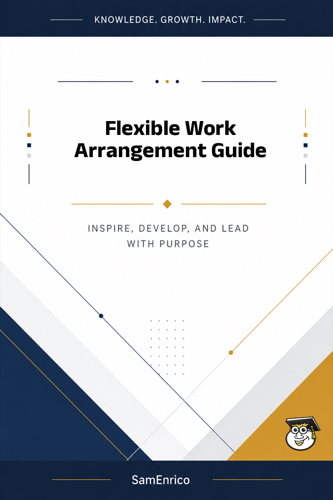
Non-FictionSelf-HelpFlexible WorkNegotiation
Flexible Work Arrangement Guide eBook
Request and implement flexible hours or remote wor
Request and implement flexible hours or remote work that reduces commute fatigue and improves focus.
Formats
Free sample
Chapter 1: The Commute Tax--–- At 7:47 AM on a damp Tuesday, Sarah pulled her car onto the shoulder of Interstate 405 for the third time that month. Not because of an accident, not because of a mechanical failure, but because her vision had blurred to the point where she could no longer safely distinguish the brake lights of the semi-truck twenty yards ahead. She was thirty-four years old, healthy by every medical metric, and she had just experienced what her doctor would later call "a transient episode of stress-induced visual disturbance." Sarah called it Tuesday.She sat there for eleven minutes, hazard lights flashing, watching the red snake of taillights crawl toward an exit she would not reach for another forty-five minutes. In that stillness, she did something she had never done before: she calculated the math of her life. Her commute was one hour and twenty minutes each way.
That was two hours and forty minutes per day. Multiply by five days. Multiply by forty-eight working weeks. The number that emerged was 640 hours per year. She sat with that number.
Six hundred and forty hours. That was nearly twenty-seven full days. Almost an entire month of her life, every year, spent staring at the back of someone else’s vehicle while her children ate breakfast without her and her husband fell asleep before she got home.She was not late for work that day. She was not fired. No single dramatic consequence occurred.
But something shifted in Sarah’s understanding of her own existence. She realized that her commute was not merely an inconvenience. It was a tax. A brutal, invisible, cognitively devastating levy extracted from her intelligence, her patience, her health, and her relationships—all for the privilege of sitting in a building that contained the same laptop, the same internet connection, and the same colleagues she could reach from her dining room table.This chapter is about that tax. It is about the science of why your commute is stealing more than just time, about the hidden architecture of fatigue that follows you from the highway to your desk and from your desk back to your dinner table, and about the first concrete step you will take toward reclaiming what has been taken from you.The Three Lies We Tell Ourselves About Commuting Before we can dismantle the commute, we must first name the lies that keep us trapped inside it.
These are not malicious falsehoods told by employers or urban planners. They are the quiet, self-protective stories we tell ourselves to make the unbearable bearable. And they are wrong.Lie Number One: "The commute is just time."This is the most seductive lie because it contains a grain of truth. Yes, a commute occupies a quantity of minutes and hours. But to treat it as merely temporal is to ignore the entire field of environmental psychology, which has demonstrated repeatedly that commuting is a unique category of stressor distinct from both work and leisure.
Unlike a long workday (which at least produces output) or a long wait at the doctor’s office (which is passive but low-stakes), the commute combines active cognitive demands (navigating traffic, monitoring speed, watching for hazards, managing frustration) with zero productive output and unpredictable negative stimuli. You are doing hard work that produces nothing while waiting for something bad to happen.A 2014 study published in the Journal of Urban Economics found that each additional minute of commuting time reduced life satisfaction more than any other measured variable—including unemployment, divorce, or a significant pay cut. The researchers were startled by the magnitude. Commuting, they concluded, was uniquely corrosive because it combined the loss of agency (you cannot leave the train, you cannot make traffic move faster) with the loss of autonomy (you are not choosing this activity; it is imposed upon you). Time spent commuting is not neutral time.
It is negative time. It actively subtracts from your well-being at a rate that economists struggled to quantify.Lie Number Two: "I'll just listen to podcasts and make it productive."This is the lie of the optimizer. The person who buys noise-canceling headphones and builds a library of educational audio, convinced that they are turning their commute into a mobile university. The research suggests otherwise. A 2017 study from the University of California, Irvine, measured cognitive absorption during commutes and found that even with engaging audio content, participants retained less than half of what they would have retained in a quiet room.
The reason is simple: your brain is still performing the invisible work of commuting. It is monitoring your surroundings, anticipating the braking patterns of the car ahead, scanning for police lights, tracking your exit countdown. That background monitoring consumes cognitive bandwidth regardless of what you put in your ears.More troubling, the study found that people who attempted to "productively use" their commute reported higher levels of post-commute fatigue than those who simply listened to music or sat in silence. The effort of splitting attention between traffic and learning created a hidden tax on top of the visible tax. You are not turning your commute into a classroom.
You are turning your classroom into an accident risk.Lie Number Three: "Everyone does it. This is just normal."Normalization is the most powerful anesthetic in human psychology. When everyone around you complains about traffic, when your colleagues laugh about the same train delays, when your manager shrugs and says "that's just the price of working here"—you absorb the message that your suffering is unremarkable. But consider what else was once normalized: smoking in restaurants, leaded gasoline, the absence of seatbelts. Normal is not a synonym for acceptable.
Normal is simply a description of collective adaptation to a suboptimal reality.The commute is not normal in any biological or psychological sense. Human beings evolved to walk approximately three to five miles per day in small groups, with frequent stops for food, water, and social interaction. The modern commute—an hour of solitary, sedentary, hypervigilant transit in a metal box surrounded by strangers—is a radical deviation from our evolutionary context. That it has become common does not mean it has become benign. It means we have collectively normalized a form of low-grade torture.The Neuroscience of Residual Commute Stress Let us now enter the brain.
Specifically, let us enter the amygdala and the prefrontal cortex, two regions that are locked in a constant struggle for control of your behavior. The amygdala is your threat detector. It evolved to identify predators, enemies, and environmental dangers. The prefrontal cortex is your executive function—the region responsible for planning, impulse control, and complex decision-making. When the amygdala activates, it floods your system with cortisol and adrenaline.
When that happens, the prefrontal cortex effectively goes offline. You cannot think deeply when you are preparing to flee from a tiger.Your commute activates your amygdala. Not because of tigers, but because of the modern equivalent: unpredictable threats. Will the car ahead brake suddenly? Will the driver beside you merge without signaling?
Will the train be delayed? Will you make it to the office before your 9 AM meeting? These questions trigger the same threat-detection circuitry as physical danger, albeit…
This is the end of the free sample. Get the eBook to keep going. Buy now
About this book
Details
- Author
- Mcnutt Myesha
- Publisher
- SamEnrico
- Language
- English
- Genre
- Non-Fiction, Self-Help, Flexible Work, Negotiation
- Released
- 2026-06-08
- Pages (approx.)
- 130
- Available as
- eBook, Audiobook

Read better in the ZLOADR app
Your eBooks on your phone or tablet. Sign in with your SamEnrico account and start reading.
More by Mcnutt Myesha
 Misrepresentation CasesMcnutt Myesha$11.99
 Confident Teen WorkbookMcnutt Myesha$11.99
 The Travel Recovery TranceMcnutt Myesha$11.99
 Retirement Housing Tax DeductionMcnutt Myesha$11.99
 The Frozen Passage: Paleo-Inuit Navigators and the Arctic's Lost RoutesMcnutt Myesha$11.99
 The Day the Internet Broke: How a Single Bug Caused Global ChaosMcnutt Myesha$11.99
 How to Become a Mold Filler And DrainerMcnutt Myesha$11.99
 Understanding Disinhibited Attachment DisorderMcnutt Myesha$17.99
 UK Visa English ExemptionMcnutt Myesha$12.99
 Student Culture Argentina GuideMcnutt Myesha$12.99
 Beard Grooming SpecialistMcnutt Myesha$11.99
You may also like
 Hong Kong Handover 1997Dunn Johnnie$11.99
 Zumba For Postnatal Recovery CourseNeal Christian$11.99
 Zumba for BeginnersLadner Nikia$11.99
 YouTube Comment Mining GuideHumes Pandora$12.99
 Worry Box MeditationCarlin Rudy$11.99
 Workplace Stress MeditationNguyen Lynn$11.99
 Workplace Stress and Sleep RepairHawley Ivory$11.99
 Workplace Perfectionism CureDelaney Jeffry$11.99
 Workplace Injustice Anger GuideWallen Isabelle$11.99
 Work Addiction and Burnout LinkGreenwood Ester$11.99
 Women in Yoga and WellnessBeattie Galina$11.99
 Women in Stand Up ComedyChun Evangeline$11.99