
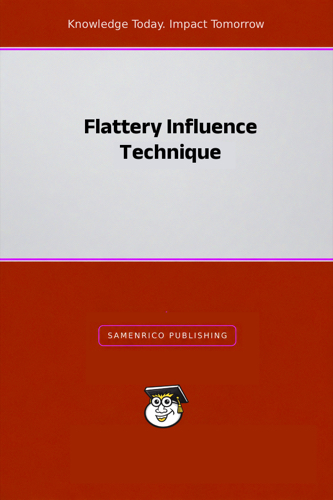
Flattery Influence Technique eBook
Genuine compliments increase agreement rates.
by Lowell Aimee
Genuine compliments increase agreement rates.
Formats
Free sample
Chapter 1: The $60 Billion Mistake--–- In 2019, a top-performing regional sales manager named Sarah walked into a conference room to close a deal worth $2.3 million. She had prepared for two weeks. She knew the client’s product line, their competitors, their supply chain vulnerabilities, and even the names of the CEO’s children. She opened with a warm smile, asked about the weekend, complimented the office renovations, and spent the first twelve minutes building rapport. Then she made her pitch.
The client listened, nodded, and said, “Let me think about it.” Three days later, they signed with a competitor whose representative had walked in, said, “Your Q3 logistics restructuring was the most elegant solution I have seen in this industry—specifically, the way you consolidated the Midwest hubs,” paused for three seconds, and then asked for the deal. That representative’s name was Tom. Tom had spent zero minutes on weekend small talk. He had spent ten seconds on a specific compliment. He won $2.3 million dollars because he understood something that 99 percent of salespeople, managers, and negotiators get wrong.This chapter will show you why Sarah’s approach—the one taught by nearly every persuasion book, sales trainer, and well-meaning mentor—is not just inefficient.
It is a $60 billion mistake. And by the end of this chapter, you will never again waste time trying to make people like you before you ask them for something.The Great Misdiagnosis Every year, corporations spend an estimated $60 billion on sales training, leadership development, and negotiation coaching. A significant portion of that money goes toward teaching what I call the “Warmth First” doctrine: build rapport, find common ground, make them like you, then ask. This doctrine is repeated so often that it has become invisible. It is the air that influence books breathe.Dale Carnegie’s How to Win Friends and Influence People, first published in 1936 and still one of the best-selling books of all time, devotes chapter after chapter to the virtues of smiling, remembering names, being a good listener, and talking in terms of the other person’s interests.
Carnegie was a brilliant observer of human nature. He was right that these behaviors increase likability. What he got wrong—and what no one has corrected until now—is the mechanism by which that likability leads to agreement.Carnegie assumed that if people like you, they will say yes to you. That sounds reasonable. It is also false.In 2022, a team of researchers led by Adam Grant (the Wharton organizational psychologist) and colleagues Fabrigar, Lim, and others published a landmark study in the British Journal of Social Psychology.
They ran a series of experiments designed to test why compliments increase compliance. The results shocked the academic world and completely upended the “Warmth First” doctrine.In one experiment, participants received a compliment from a stranger. Then they were asked for a favor. Some participants liked the compliment giver. Some did not.
Some were in a good mood. Some were not. The researchers measured everything: mood, liking, self-esteem, even the participants’ perception of the compliment giver’s sincerity. Then they ran the numbers to see which factors actually predicted whether a participant would say yes.The answer was not liking. It was not mood.
It was not even the perceived sincerity of the compliment in the way Carnegie meant it. The only consistent predictor of compliance was something else entirely: the Norm of Reciprocity.Let me say that again. People said yes not because they liked the compliment giver. They said yes because they felt indebted. The compliment was a gift.
The agreement was the repayment.Take a moment to feel how counterintuitive that is. We have all been taught that people buy from people they like. That managers get more cooperation from employees who enjoy working with them. That networking is about building relationships. All of that is true in the long term—over months and years, liking matters enormously.
But in the single, critical moment when you need someone to say yes to a specific request, liking is not the driver. Indebtedness is.The study found that participants who reported disliking the compliment giver still complied at higher rates than control participants who received no compliment at all. Think about that. Someone who openly disliked the person praising them still felt obligated to return the favor. That is the power of reciprocity.
It overrides personal affect. It overrides mood. It operates below conscious awareness, and it is relentless.Sarah, the sales manager who lost the $2.3 million deal, was playing the old game. She was trying to be liked. Tom was playing the new game.
He was creating a debt. And in the moment of the ask, the debt was worth $2.3 million more than all the rapport in the world.But wait, you might be thinking. Isn’t a compliment just a way to make someone feel good about themselves? And don’t people who feel good about themselves say yes more often? That is the “mood mediation” theory, and it is the second great misconception this chapter will dismantle.The Mood Myth Let me tell you about a study that changed how I think about every social interaction I have ever had.
Grant, Fabrigar, and Lim (2010) designed an experiment to test whether compliments increase compliance because they put people in a good mood. This is the intuition behind every office coffee run, every pre-negotiation joke, every “let’s grab lunch and talk about the proposal.” The idea is simple: happy people are more agreeable.The researchers gave compliments to some participants and then measured their mood. Unsurprisingly, the compliments made people happier. Then they made a request. And here is where things got interesting.
When they ran the statistical analysis to see whether mood explained the increase in compliance, they found something remarkable: mood did not mediate the effect. That is, compliments made people happier, and compliments made people more likely to say yes, but the happiness did not cause the yes. The two effects were parallel, not sequential.In a follow-up study, they artificially boosted participants’ moods using funny videos and small gifts—no compliments involved. Those participants were happier, but they did not show the same increase in compliance as participants who had received a compliment. In other words, you can cheer someone up all day long, and they will not be any more likely to say yes to your request than they were before.
The only thing that increases compliance is the compliment itself.This is a radical finding. It means that every time you have ever told a joke before asking for a raise, every time you have ever brought coffee to a meeting before pitching an idea, every time you have ever chatted about the weather before asking a favor—you were wasting your time. Not entirely. The coffee was still nice. The joke might have been funny.
But none of it made the person more likely to say yes.The magic is not in the mood. The magic is in the praise. And not just any praise. The magic is in the specific, credible, trait-based compliment that registers as a genuine gift. Which brings us to the third misconception…
This is the end of the free sample. Get the eBook to keep going. Buy now
About this book
Details
- Author
- Lowell Aimee
- Publisher
- SamEnrico
- Language
- English
- Genre
- Non-Fiction, Self-Help, Flattery
- Released
- 2026-06-10
- Pages (approx.)
- 141
- Available as
- eBook, Audiobook

Read better in the ZLOADR app
Your eBooks on your phone or tablet. Sign in with your SamEnrico account and start reading.
More by Lowell Aimee
 International Franchise Real Estate GuideLowell Aimee$12.99
 High Protein Low Sugar Meal PrepLowell Aimee$11.99
 Srotas Channel CleansingLowell Aimee$11.99
 Caregiving For Parent With Vascular DementiaLowell Aimee$11.99
 Steppe Nomad EnduranceLowell Aimee$11.99
 Hidden Purchases SecrecyLowell Aimee$11.99
 Cholesterol Home TestingLowell Aimee$11.99
 Elevator ClaustrophobiaLowell Aimee$11.99
 Pusan Perimeter: The Last Stand Before Inchon (1950)Lowell Aimee$11.99
 Service Providers Guide to Ceramic Tile InstallationLowell Aimee$11.99
 How to Produce Tennis Autographed Sports ParaphernaliaLowell Aimee$11.99
 How to Produce Home Remodeling ServicesLowell Aimee$11.99
You may also like
 Hong Kong Handover 1997Dunn Johnnie$11.99
 Zumba For Postnatal Recovery CourseNeal Christian$11.99
 Zumba for BeginnersLadner Nikia$11.99
 YouTube Comment Mining GuideHumes Pandora$12.99
 Worry Box MeditationCarlin Rudy$11.99
 Workplace Stress MeditationNguyen Lynn$11.99
 Workplace Stress and Sleep RepairHawley Ivory$11.99
 Workplace Perfectionism CureDelaney Jeffry$11.99
 Workplace Injustice Anger GuideWallen Isabelle$11.99
 Work Addiction and Burnout LinkGreenwood Ester$11.99
 Women in Yoga and WellnessBeattie Galina$11.99
 Women in Stand Up ComedyChun Evangeline$11.99