
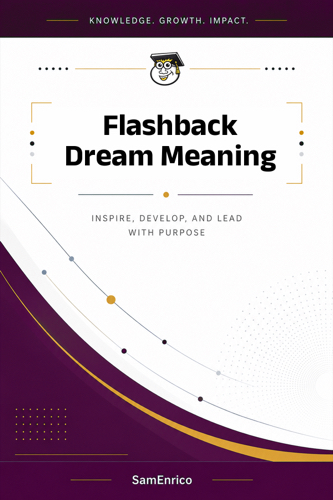
Non-FictionSelf-HelpFlashback Management
Flashback Dream Meaning eBook
Distinguish between memory replays and symbolic dr
by Meador Kisha
Distinguish between memory replays and symbolic dreams.
Formats
Free sample
Chapter 1: The Verbatim Trap...--–- You wake up with your heart hammering against your ribs. The dream is already slipping away like water through your fingers, but one thing remains: the feeling that what you just witnessed was real. Not symbolic. Not metaphorical. Real.
The problem is, you have no idea if that feeling is trustworthy. You lie there in the dark, staring at the ceiling, and the question loops through your exhausted mind: Was that a memory or a message?This book is built to answer that question. But before we can distinguish between memory replays and symbolic dreams, we have to understand the first category in depth: the memory replay itself. Most people have never heard of this phenomenon, let alone learned to recognize it. We have been trained by pop psychology and dream dictionaries to treat every dream image as a symbol waiting to be decoded.
That assumption is wrong—and it is causing millions of people to waste years searching for hidden meanings in dreams that are nothing more than their brain's backup drive running a routine file-save operation.This chapter introduces the neurobiology of memory replay, the concept of "day residue," and the single most important distinction you will learn in this book: verbatim versus gist. By the end of this chapter, you will never look at a boring or repetitive dream the same way again. You will know when a dream is just your brain filing paperwork—and when it is time to dig deeper.The 3 AM Confusion That Started Everything Let us begin with a story. A woman we will call Sarah came to my research colleague's practice complaining of a recurring dream. Every night for three weeks, she dreamed of spreadsheets.
Not frightening spreadsheets. Not symbolic spreadsheets. Just spreadsheets—columns of numbers, formulas, cells that she could not quite read. She would wake up frustrated, convinced that her subconscious was trying to tell her something about her career, her finances, her life purpose. She had spent hundreds of dollars on dream interpretation books and online courses, trying to decode the hidden meaning of the numbers.The truth was far simpler.
Sarah was an accountant in the middle of tax season. She had been working twelve-hour days staring at spreadsheets. Her brain was doing exactly what healthy brains do during sleep: replaying the day's sensory experiences to consolidate them into long-term memory. There was no hidden message. There was no prophecy.
There was only the hippocampus doing its job.This is what I call The Verbatim Trap: the mistaken belief that every detail of every dream carries symbolic weight. The Verbatim Trap keeps you searching for meaning where none exists. It turns a healthy neurological process into a source of anxiety and self-doubt. And it is entirely avoidable once you understand how memory replays work.Sarah's case is not unusual. In fact, it is the norm.
Research using functional neuroimaging and polysomnography has shown that a significant percentage of dream content—estimates range from 30 to 50 percent—consists of literal, low-emotion replays of recent waking experiences. These are not messages from the unconscious. They are not glimpses of the future. They are not visits from deceased relatives. They are the brain's backup system, running on autopilot.The tragedy is that Sarah spent three weeks convinced she was missing something profound.
She was not missing anything. She was just not recognizing a memory replay when she saw one.The Hippocampus: Your Brain's Built-In Replay Machine To understand memory replays, you need to understand a small, seahorse-shaped structure deep in your brain called the hippocampus. The hippocampus is the brain's central filing system. Its job is to take the chaotic stream of sensory information you experience during waking hours and convert it into stable, long-term memories that can be stored across the cortex.Here is what most people do not know: the hippocampus does most of its work while you sleep.During the day, your hippocampus is busy recording. Every sight, sound, smell, touch, and taste that your brain deems potentially important gets tagged and temporarily stored.
But temporary storage is not enough. For a memory to last, the hippocampus must "replay" that experience to the rest of the brain, strengthening the neural connections that encode it.This replay happens during slow-wave sleep and sharp-wave ripples. A sharp-wave ripple is exactly what it sounds like: a sudden burst of electrical activity in the hippocampus that lasts only 50 to 100 milliseconds. During that tiny window, the hippocampus fires in the exact same pattern it fired when you were having the original experience—but at ten to twenty times the normal speed.Imagine watching a movie at 20x speed. You would not understand the dialogue or follow the plot, but you would see the same sequence of images compressed into seconds.
That is what the hippocampus does with your memories. It replays them at high speed, again and again, throughout the night.Researchers have known about sharp-wave ripples for decades, but only recently have they been able to demonstrate that these ripples correspond directly to waking experiences. In a landmark study, scientists recorded the neural activity of rats as they ran through a maze. Later, during sleep, the same neural sequences fired in the same order—but compressed. The rats were literally dreaming of running the maze.
When the researchers disrupted those sharp-wave ripples, the rats forgot how to navigate the maze the next day.The implications are clear: memory replays are not optional. They are essential for learning, memory, and survival. Without them, you would wake up each morning having forgotten most of what happened the day before.But here is the crucial point for our purposes: these replays often become conscious experiences. You do not just dream about spreadsheets because you worked on spreadsheets. You dream about spreadsheets because your hippocampus is replaying the neural firing pattern that occurred while you were looking at spreadsheets.
The content of the dream is literal because the neural pattern is literal.The Day Residue Phenomenon Sigmund Freud was the first to notice that dreams often incorporate fragments of the previous day's experiences. He called this day residue. Freud believed that day residue served as raw material that the dream-work transformed into symbolic content. He was half right. Day residue does appear in dreams.
But Freud was wrong about what happens to it.Modern neuroscience has shown that much day residue appears in dreams without any transformation at all. It is not disguised. It is not symbolic. It is simply replayed.Think about your own dreams. Have you ever dreamed of:A conversation you actually had earlier that day?A television show you watched before bed?A meal you ate, a road you drove, or an email you wrote?A song that was stuck in your head?A task you repeated over and over, like folding laundry or answering emails?These are all examples of day residue appearing as literal replay.
They are not secret messages. They are your hippocampus doing its job.The strength of day residue depends on several factors. Repetition is the most powerful. If you do the same thing over and over during the day—if you are…
This is the end of the free sample. Get the eBook to keep going. Buy now
About this book
Details
- Author
- Meador Kisha
- Publisher
- SamEnrico
- Language
- English
- Genre
- Non-Fiction, Self-Help, Flashback Management
- Released
- 2026-06-11
- Pages (approx.)
- 155
- Available as
- eBook, Audiobook

Read better in the ZLOADR app
Your eBooks on your phone or tablet. Sign in with your SamEnrico account and start reading.
More by Meador Kisha
 Conversation Starters for WidowsMeador Kisha$11.99
 Secular Forgiveness GuideMeador Kisha$11.99
 MBSR for Dental AnxietyMeador Kisha$11.99
 Quantum Pioneers: The Nobel Laureates Who Shattered Cosmic BoundariesMeador Kisha$11.99
 How to Produce a BatteriserMeador Kisha$11.99
 Bank Account for Stripe AtlasMeador Kisha$12.99
 How to Start a Bedsteads Made of Wood Business (Beginners Guide)Meador Kisha$11.99
 Human Resource AssistantMeador Kisha$11.99
You may also like
 Hong Kong Handover 1997Dunn Johnnie$11.99
 Zumba For Postnatal Recovery CourseNeal Christian$11.99
 Zumba for BeginnersLadner Nikia$11.99
 YouTube Comment Mining GuideHumes Pandora$12.99
 Worry Box MeditationCarlin Rudy$11.99
 Workplace Stress MeditationNguyen Lynn$11.99
 Workplace Stress and Sleep RepairHawley Ivory$11.99
 Workplace Perfectionism CureDelaney Jeffry$11.99
 Workplace Injustice Anger GuideWallen Isabelle$11.99
 Work Addiction and Burnout LinkGreenwood Ester$11.99
 Women in Yoga and WellnessBeattie Galina$11.99
 Women in Stand Up ComedyChun Evangeline$11.99