
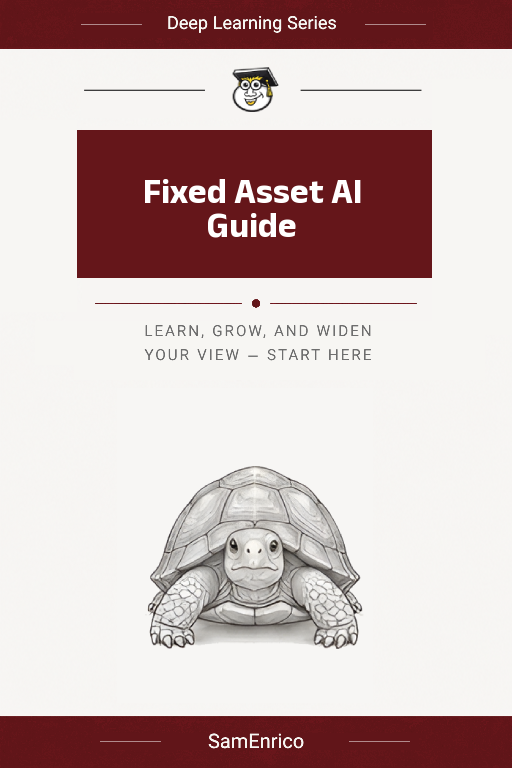
Non-FictionBusiness BriefAutomation Guide
Fixed Asset AI Guide eBook
Manage fixed assets and depreciation with AI. Sche
Manage fixed assets and depreciation with AI. Schedule automation for small business.
Formats
Free sample
Chapter 1: The Ghost in the Ledger--–- The email arrived on a Tuesday afternoon, three weeks before taxes were due. Maya Chen, owner of Green Cycle Landscaping & Snow Removal, opened it while holding a cup of coffee that had gone cold two hours earlier. Her accountant’s message was brief, professional, and devastating:“Maya, I’ve reviewed your fixed asset schedule. You’re claiming depreciation on two snowplows that you sold in 2022. You’re also missing three mowers that you definitely own.
We need to fix this before filing, or the IRS will treat the overclaimed depreciation as an error — and possibly fraud if we don’t correct it proactively. Please call me.”Maya stared at the screen. She remembered selling those plows. She remembered the cash changing hands, the buyer’s firm handshake, the relief of clearing space in the garage. But she had never told her spreadsheet.
And the spreadsheet, in turn, had never told her accountant.For seven years, Maya had managed her fixed assets the same way her father had managed his — a yellow legal pad, then Excel, then a shared Google Sheet that three different employees had edited over time. Somewhere along the way, the plows became ghosts. They existed on paper but not in reality. Meanwhile, three zero-turn mowers — each worth over $8,000 — had become zombies. They were very real, very expensive, and very absent from any depreciation schedule.Maya calculated the damage quickly: over 4,000inoverstateddeductionsfortheghostplows(whichshewouldnowhavetorepay,plusinterest)andover4,000 in overstated deductions for the ghost plows (which she would now have to repay, plus interest) and over 4,000inoverstateddeductionsfortheghostplows(whichshewouldnowhavetorepay,plusinterest)andover11,000 in missed deductions for the zombie mowers (which she would never get back for those tax years).
The total hit to her cash flow: nearly $15,000. That was the cost of a new truck. That was the cost of her daughter’s braces twice over. That was the cost of a spreadsheet that had quietly, patiently, been lying to her for years.The Ghost Asset Epidemic Maya’s story is not an outlier. It is the rule.Across the United States, small and medium-sized businesses are bleeding cash through two identical-sounding but fundamentally different problems: ghost assets and zombie assets.
Understanding the difference is the first step toward stopping the bleeding.Ghost assets are items still listed on your depreciation schedule that no longer physically exist. You sold them. You threw them out. They were stolen. They were cannibalized for parts.
But no one ever told the spreadsheet. The result is that you continue to claim depreciation deductions for assets that are legally dead. When the IRS catches this — and they catch it routinely during audits — you must repay the overclaimed depreciation, plus interest, plus potential penalties for negligence. Ghost assets are a tax time bomb with a long fuse.Zombie assets are the mirror image. These are items that physically exist — sitting in your warehouse, your garage, your field — but have no record in your fixed asset register.
You bought them with cash. You received them as a trade-in. You built them from spare parts. But no one ever added them to the spreadsheet. The result is that you fail to claim depreciation deductions you are legally entitled to.
Unlike ghost assets, which hurt you through repayment, zombie assets hurt you through omission. You simply leave money on the table, year after year, until the asset finally breaks and you throw away something you never bothered to depreciate.Maya had both. The plows were ghosts. The mowers were zombies. Together, they cost her $15,000 in a single tax season — money that could have bought new equipment, paid a bonus, or simply stayed in her pocket.The Scale of the Problem If Maya’s story feels personal, the data makes it universal.
According to a 2024 survey of small business owners, 43% admit to struggling with manual fixed asset tracking. Among businesses with more than 50 assets, that number jumps to 61%. The most common pain points are consistent across industries:Lost receipts. You bought a used skid steer for $14,000 cash at an auction. The receipt is in a drawer somewhere.
Or the truck. Or maybe you threw it away. Without the receipt, you cannot prove the purchase date, the cost basis, or the asset’s existence for tax purposes.Missing disposal dates. You sold the old pickup to your nephew for $2,000. He paid you in cash and drove it away.
You never recorded the sale. Three years later, the pickup is still on your depreciation schedule, generating deductions you are not entitled to claim. The IRS calls this “retirement without removal.” Your accountant calls it a problem.Version control chaos. Your asset spreadsheet lives on a shared drive. The office manager updated it last year.
The warehouse manager updated it six months ago. The bookkeeper has her own copy. Three different files, three different realities, none of them matching the physical inventory in your building.Manual data entry errors. Someone typed “12/31/2024” as the purchase date for a machine bought on “01/15/2023.” That one-character typo shifted the entire depreciation schedule by a year, changed the mid-quarter convention, and potentially disqualified the asset for Section 179 expensing. No one noticed until the audit.The cost of these errors is not abstract.
The American Institute of CPAs estimates that the average small business overpays or underpays its taxes by over $5,000 annually due to fixed asset mistakes alone. That figure excludes the soft costs: staff hours spent hunting for receipts, reconciling spreadsheets, and explaining discrepancies to accountants.The Spreadsheet of Doom Let me show you the enemy. It looks harmless. It lives on your computer. You might even feel a small sense of pride when you open it — look at all those rows, all those columns, all that careful data entry.The spreadsheet of doom has three telltale characteristics:First, it is shared.
Multiple people have edit access. Some have view-only access. No one remembers who added the last row. The file is email-attachment old. Every time someone saves a new version, a small angel loses its wings, and a small error is born.
“Fixed_Assets_FINAL_v2.xlsx” is not a file name. It is a cry for help.Second, it is incomplete. Look at any spreadsheet used by a real small business for more than six months. You will find missing acquisition dates. Blank “disposal date” columns.
Useful lives that were guessed rather than calculated. Cost basis entries that say “approx” or “per Joe.” The spreadsheet started with good intentions — a weekend project, a template downloaded from the internet — but reality outran it.Third, it is disconnected. The spreadsheet does not talk to your accounting software. It does not receive updates from your bank feed. It does not know when you buy a new asset because you paid with a credit card.
The asset information lives in one system (the spreadsheet), while the purchase information lives in another system (the bank), and the tax information lives in a third system (your accountant’s software). When these systems drift apart — and they always drift apart — no one notices until someone reconciles them manually, usually under deadline pressure, usually while crying.Maya’s spreadsheet had all three characteristics. It was shared among four employees, each with…
This is the end of the free sample. Get the eBook to keep going. Buy now
About this book
Details
- Author
- Cardenas Johnie
- Publisher
- SamEnrico
- Language
- English
- Genre
- Non-Fiction, Business Brief, Automation Guide
- Released
- 2026-05-29
- Pages (approx.)
- 136
- Available as
- eBook, Audiobook

Read better in the ZLOADR app
Your eBooks on your phone or tablet. Sign in with your SamEnrico account and start reading.
More by Cardenas Johnie
 Insurance and Liability OutlookCardenas Johnie$11.99
 Office Chair Meditation CourseCardenas Johnie$11.99
 The Prolonged Grief Treatment GuideCardenas Johnie$11.99
 Legal Creative Problem SolvingCardenas Johnie$11.99
 The Blue Zone Herbal TeasCardenas Johnie$11.99
 The Sword and the Rose: Love and Blood in the Baltic CrusadesCardenas Johnie$11.99
 Category Insights ExecutiveCardenas Johnie$11.99
 Understanding Stickler SyndromeCardenas Johnie$17.99
 Dynamic Discounting GuideCardenas Johnie$12.99
 How to Become a Pipe-and-tank FabricatorCardenas Johnie$11.99
You may also like
 Hong Kong Handover 1997Dunn Johnnie$11.99
 Zumba For Postnatal Recovery CourseNeal Christian$11.99
 Zumba for BeginnersLadner Nikia$11.99
 YouTube Comment Mining GuideHumes Pandora$12.99
 Worry Box MeditationCarlin Rudy$11.99
 Workplace Stress MeditationNguyen Lynn$11.99
 Workplace Stress and Sleep RepairHawley Ivory$11.99
 Workplace Perfectionism CureDelaney Jeffry$11.99
 Workplace Injustice Anger GuideWallen Isabelle$11.99
 Work Addiction and Burnout LinkGreenwood Ester$11.99
 Women in Yoga and WellnessBeattie Galina$11.99
 Women in Stand Up ComedyChun Evangeline$11.99