
Non-FictionBusiness BriefDigital Services
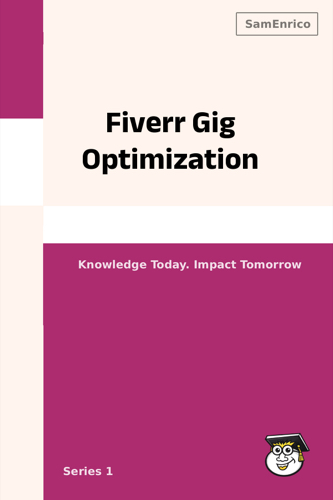
Fiverr Gig Optimization eBook
Create high converting gig packages that rank and
Create high converting gig packages that rank and attract buyers quickly.
Formats
Free sample
Chapter 1: The Click Illusion–- Most Fiverr sellers wake up every morning and check two things: their inbox and their impressions count. They obsess over keywords, rewrite their descriptions a dozen times, and watch You Tube videos about "secret SEO hacks." They believe, with religious certainty, that if they can just stuff the right words into their gig title, the algorithm will reward them with page-one placement. This is the great lie of the Fiverr marketplace. And it is costing you orders right now.Let me tell you about a seller we will call Sarah. Sarah is a graphic designer from Manchester.
She spent three months perfecting her "minimalist logo design" gig. She researched keywords obsessively. She put "minimalist," "modern," "professional," "fast delivery," "unlimited revisions," and "best value" all into her title and description. She did everything the outdated You Tube gurus told her to do. Her gig was a keyword masterpiece.
And after three months, she had received exactly 47 impressions and two orders—both from friends.Across town, another seller—let us call him Marcus—published a gig with a title that barely contained three keywords. He did not stuff anything. His description was short, almost too short by traditional standards. But within two weeks, his gig was on page one for his category. He was getting 200 impressions per day and converting 8% of those clicks into orders.What did Marcus know that Sarah did not?Marcus understood something that 95% of Fiverr sellers never figure out: the algorithm does not read your gig.
The algorithm watches your buyers.This single distinction separates the sellers who struggle for months from those who achieve page-one rank within weeks. Fiverr’s primary goal is not to find the gig with the most keywords. Fiverr’s primary goal is to keep buyers on the platform by ensuring every purchase is a satisfying experience. The algorithm is not a librarian matching keywords to search queries. The algorithm is a matchmaker trying to predict which gig will make the buyer happiest.And happiness, as it turns out, is revealed through behavior—not text.The Death of Keyword Stuffing (And What Replaced It)Between 2015 and 2020, Fiverr operated on a relatively simple search algorithm.
If your gig contained the words a buyer typed into the search bar, and if you had a decent number of reviews, you would rank reasonably well. This created an era of "keyword arms races." Sellers would cram their titles with every possible variation: "I will design a logo, brand identity, business card, letterhead, social media kit, vector, print, digital, modern, classic, vintage, 3D, flat, geometric, abstract..." You have seen these gigs. They are unreadable. They are ugly. And they no longer work.In 2021 and through subsequent updates culminating in 2025, Fiverr completely rewrote its ranking logic.
The current algorithm (as of 2026) operates on what industry analysts call a "satisfaction-prediction model." Instead of simply matching keywords, the algorithm analyzes dozens of behavioral signals to predict whether a buyer will be satisfied with a particular seller.Here is the crucial distinction: The algorithm does not know if your work is good. The algorithm knows if buyers act like your work is good.This is not semantics. It is the entire ballgame.Consider two hypothetical gigs. Gig A has a perfectly optimized description with every keyword imaginable. Gig B has a mediocre description with basic keywords.
But Gig B has a click-through rate (CTR) of 12%, while Gig A has a CTR of 3%. Which one ranks higher? Gig B, every single time. The algorithm interprets a high CTR as a signal that Gig B’s title and thumbnail are appealing to buyers. And appealing titles and thumbnails predict satisfaction, because buyers are more likely to be happy with something they chose voluntarily.The same logic applies to conversion rates.
If 100 people click on your gig and 10 of them order, you have a 10% conversion rate. If 100 people click on a competitor’s gig and 3 of them order, you will outrank them—even if their description is "better" and their keywords are "more optimized." The algorithm does not care about your adjectives. It cares about what buyers actually do.The Three Behavioral Signals That Actually Control Your Rank Through extensive analysis of Fiverr’s ranking patterns and interviews with Top Rated Sellers, three behavioral signals emerge as the dominant factors in the algorithm’s satisfaction-prediction model. These are not the only signals—Chapter 10 will introduce you to the full Four Pillars of ranking, including response rates and private feedback. But these three are the foundation upon which everything else is built.Signal One: Click-Through Rate (CTR)Your click-through rate is the percentage of people who see your gig in search results and actually click on it.
This is the algorithm’s first test. If your gig appears 1,000 times in search results and 50 people click, your CTR is 5%. If your competitor appears 1,000 times and 120 people click, their CTR is 12%.The algorithm interprets a low CTR as a clear signal: "This gig is not appealing to buyers." It does not matter why. Maybe your thumbnail is ugly. Maybe your title is confusing.
Maybe your price looks wrong. The algorithm does not diagnose the problem. It simply shows your gig less frequently until you fix whatever is causing buyers to scroll past.This is why the thumbnail and title are more important than your description. Your description only matters after someone clicks. Your thumbnail and title determine whether anyone clicks at all.Signal Two: Conversion Rate (CVR)Once a buyer clicks on your gig, the algorithm watches to see if they order.
Your conversion rate is the percentage of clicks that result in an order. If 100 people click on your gig and 10 order, your CVR is 10%. If 100 people click on your competitor’s gig and 25 order, their CVR is 25%.The algorithm interprets a high CVR as a signal that your gig page—the description, the packages, the FAQs, the video—is persuasive and trustworthy. Buyers feel safe ordering from you. The algorithm wants more of that.Here is the painful truth that most sellers never accept: A low conversion rate will kill your ranking even if you have a high click-through rate.
You can have the most clickable thumbnail in your category, but if buyers arrive on your gig page and then leave without ordering, the algorithm will conclude that you are a disappointment. And you will be demoted.Signal Three: Save-to-Favorites Ratio This is the signal that most sellers overlook entirely. When a buyer saves your gig to their favorites, they are signaling high intent. They are not just browsing. They are bookmarking you for future consideration.
The algorithm tracks this ratio closely. A gig with a high save rate—even from buyers who do not order immediately—is seen as valuable. The algorithm will continue to show that gig prominently because it has demonstrated the ability to generate interest.Savvy sellers learn to design their gig pages to encourage saves. A well-structured FAQ, a compelling portfolio, and a clear explanation of process all contribute to a buyer thinking, "I am not ready to order right this second, but I want to remember this seller."The Velocity of Trust: Why Your First 10 Views Are Everything…
This is the end of the free sample. Get the eBook to keep going. Buy now
About this book
Details
- Author
- Prince Mignon
- Publisher
- SamEnrico
- Language
- English
- Genre
- Non-Fiction, Business Brief, Digital Services
- Released
- 2026-06-10
- Pages (approx.)
- 154
- Available as
- eBook, Audiobook

Read better in the ZLOADR app
Your eBooks on your phone or tablet. Sign in with your SamEnrico account and start reading.
More by Prince Mignon
 The Lion Breath ExercisePrince Mignon$11.99
 Verbal Abuse Internalized Messages CoursePrince Mignon$11.99
 Tactical Breath for PresentersPrince Mignon$11.99
 The Geo Arbitrage Business Model GuidePrince Mignon$11.99
 The Lion of Abyssinia: Emperor Tewodros II and the Birth of Modern EthiopiaPrince Mignon$11.99
 Understanding Lower Limb Anomaly Ureteral ObstructionPrince Mignon$17.99
 How to Become a Lap Cutter-truer OperatorPrince Mignon$11.99
 Ecommerce Seller LLC Foreign OwnerPrince Mignon$12.99
 Crowdfunding Behavior ReportPrince Mignon$12.99
 Forensic OdontologyPrince Mignon$11.99
You may also like
 Hong Kong Handover 1997Dunn Johnnie$11.99
 Zumba For Postnatal Recovery CourseNeal Christian$11.99
 Zumba for BeginnersLadner Nikia$11.99
 YouTube Comment Mining GuideHumes Pandora$12.99
 Worry Box MeditationCarlin Rudy$11.99
 Workplace Stress MeditationNguyen Lynn$11.99
 Workplace Stress and Sleep RepairHawley Ivory$11.99
 Workplace Perfectionism CureDelaney Jeffry$11.99
 Workplace Injustice Anger GuideWallen Isabelle$11.99
 Work Addiction and Burnout LinkGreenwood Ester$11.99
 Women in Yoga and WellnessBeattie Galina$11.99
 Women in Stand Up ComedyChun Evangeline$11.99