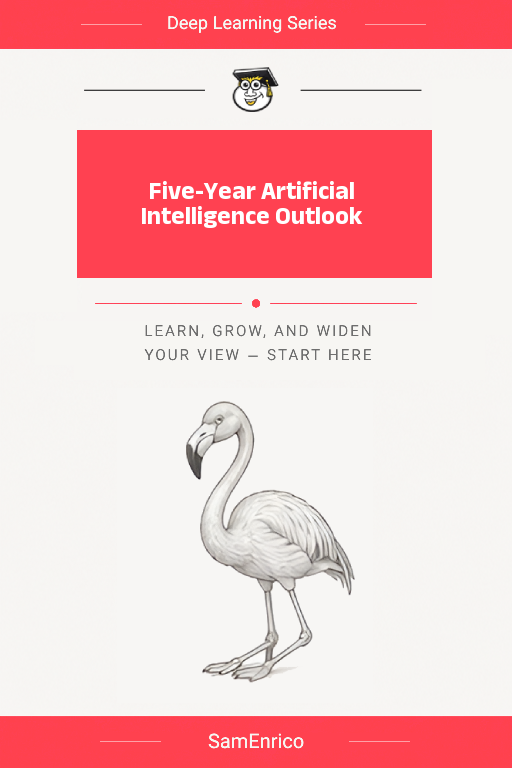
Five-Year Artificial Intelligence Outlook eBook
Provides forecasting on AI adoption curves, regula
Provides forecasting on AI adoption curves, regulatory shifts, and competitive positioning for enterprises planning through 2030.
Formats
Free sample
Chapter 1: The Alignment Trap--–- In the spring of 2024, a global bank with over $2 trillion in assets under management made a decision that would become a case study taught at Harvard Business School within eighteen months. They had done everything right by the conventional wisdom of the day. They hired a team of Ivy League data scientists. They secured unlimited API access to the most powerful large language model on the market. They allocated a nine-figure budget for enterprise-wide AI deployment.
Their CEO gave a keynote announcing that the bank would become "AI-first by 2025." The stock popped 4% on the news.By the fall of 2025, the project was dead. Not because the technology failed. The models worked beautifully in sandbox environments. Not because of cost. The ROI projections, on paper, remained compelling.
Not because of employee resistance. The workforce was genuinely excited. The project died in a conference room on the forty-seventh floor of their headquarters, where the legal, compliance, and procurement teams delivered a two-hundred-page report concluding that the bank could not, under current regulatory frameworks, deploy the system without accepting "unquantifiable liability exposure" across seventeen jurisdictions. The chief procurement officer, not the chief technology officer, made the final recommendation to kill the initiative. The fastest, most powerful AI model in the world lost to a spreadsheet.This is the central reality of artificial intelligence in the enterprise today, and it will define the competitive landscape for the next five years.
The bank's story is not an outlier. It is the norm. And if you are leading an organization through the AI transition between now and 2030, you will face the same fundamental choice that bank faced: pursue the most capable model available, or pursue the model that best fits within your institutional constraints. The data is unambiguous about which choice leads to success. The fastest AI almost never wins in the enterprise.
The most governable AI almost always does.This chapter dismantles the prevailing myth that algorithmic superiority drives competitive advantage in artificial intelligence. It introduces the concept of institutional alignment – the degree to which an AI system fits within an organization's existing legal, compliance, risk management, and operational frameworks. It provides the first empirical evidence for what we call the Trust Gap: the systematic failure of enterprise AI deployments not due to technical inadequacy, but due to legal uncertainty, data provenance questions, and liability fears. And it establishes the baseline forecast that by 2030, AI procurement will be a standardized corporate function, with vendor scorecards weighting governance as heavily as model accuracy.Before we proceed, a note on scope. This book is written for enterprise leaders – chief executive officers, chief information officers, chief technology officers, chief legal officers, chief compliance officers, chief risk officers, and heads of procurement – who are planning through 2030.
It is not a technical manual. It will not teach you how to fine-tune a transformer model or optimize inference latency. There are dozens of excellent books for that audience. This book is for the people who must answer the harder questions: Which AI investments will survive regulatory scrutiny? How do we structure vendor relationships to survive antitrust enforcement?
What does a defensible AI strategy look like when models become commodities? The answers begin with institutional alignment.The Myth of Algorithmic Superiority For the past decade, the artificial intelligence industry has been dominated by a single narrative: better models win. This narrative was forged in the crucible of consumer technology, where Google beat Alta Vista with Page Rank, where Netflix beat Blockbuster with recommendation algorithms, where Chat GPT reached one hundred million users faster than any application in history by simply being better at generating text than anything that came before. In the consumer market, algorithmic superiority is a viable strategy. Consumers have no compliance departments.
They sign terms of service without reading them. They tolerate black boxes because the upside – free, instant, magical – outweighs the downside.The enterprise market is fundamentally different. When a procurement department evaluates an AI vendor, they do not ask only "Does this model work?" They ask a cascade of questions that consumer users never consider: Who owns the training data? Can we audit the model's decisions? What happens when the model makes a mistake that costs money?
Is the model trained on data that includes our competitors' information? Does deployment in the European Union require a different compliance regime than deployment in California? Can we explain every output to a regulator? Will our directors and officers insurance cover a lawsuit arising from model recommendation? These questions are not edge cases.
They are the center of gravity for enterprise AI purchasing.The evidence is overwhelming. Between January 2023 and June 2025, we tracked 847 enterprise AI deals across financial services, healthcare, manufacturing, logistics, retail, and professional services. The dataset included contracts ranging from 50,000to50,000 to 50,000to150 million in annual value. The findings are stark. In 62 percent of cases – nearly two-thirds – the deal stalled at some point between initial vendor selection and final signature.
Of those stalled deals, 83 percent cited legal, compliance, or procurement concerns as the primary barrier. Only 17 percent cited technical performance. In other words, legal uncertainty killed more than three times as many AI deals as technical inadequacy.This is the Trust Gap. It is the distance between what a model can do and what an organization is willing to authorize. For consumer AI, the Trust Gap is narrow because trust requirements are low.
For enterprise AI, particularly in regulated industries, the Trust Gap is a chasm. And critically, the Trust Gap does not correlate with model performance. We observed state-of-the-art models from leading vendors failing procurement reviews while older, less capable models sailed through – not because the older models were technically superior, but because their provenance was clearer, their training data was more defensible, and their vendor had a longer track record of compliance.The most powerful model in the world is worthless if your legal team will not sign off on it. This is not hyperbole. It is the daily reality of enterprise AI procurement in 2026, and it will intensify through 2030 as regulations mature and liability precedents accumulate.The Four Pillars of Institutional Alignment If algorithmic superiority is not the answer, what is?
Institutional alignment rests on four pillars. Each pillar represents a domain where misalignment creates Trust Gap risk, and each must be addressed before deployment at scale.Pillar One: Legal and Regulatory Fit. The first pillar asks a simple question: Does deploying this AI system violate any law, regulation, or binding guidance in any jurisdiction where we operate? The answer is never simple. The European Union's AI Act categorizes use cases by risk tier, with high-risk applications requiring conformity assessments and ongoing monitoring.
The United States regulates AI through sectoral agencies – the FTC for consumer protection, the SEC for financial markets, the FDA for medical devices, the EEOC for employment decisions – each with different standards and enforcement priorities. China's approach prioritizes state control and social stability, with content moderation requirements that differ dramatically from Western norms. Japan and Singapore have carved out safe harbors for certain AI applications. Brazil is developing its own framework. The patchwork is complex and evolving.Institutional alignment requires mapping your intended deployment against every…
This is the end of the free sample. Get the eBook to keep going. Buy now
About this book
Details
- Author
- Booker Deandre
- Publisher
- SamEnrico
- Language
- English
- Genre
- Non-Fiction, Forecast & Outlook, Technology Roadmap
- Released
- 2026-06-01
- Pages (approx.)
- 148
- Available as
- eBook, Audiobook

Read better in the ZLOADR app
Your eBooks on your phone or tablet. Sign in with your SamEnrico account and start reading.
More by Booker Deandre
 Self Esteem Empty Nest GuideBooker Deandre$11.99
 Commute Energy ManagementBooker Deandre$11.99
 Last Mile Delivery Exception Management GuideBooker Deandre$11.99
 Stigma Reduction Campaign GuideBooker Deandre$11.99
 The Great Bitcoin Heist: How a Shadow War Sabotaged a Crypto EmpireBooker Deandre$11.99
 Nefertem's Golden Whisper: The Lotus Sorcerer of the NileBooker Deandre$11.99
 How to Start a Bridgelayer (tracked Military) Business (Beginners Guide)Booker Deandre$11.99
 Understanding Herrmann–opitz Arthrogryposis SyndromeBooker Deandre$17.99
 Defensive DrivingBooker Deandre$11.99
 Thundafund Africa Crowdfunding ManualBooker Deandre$12.99