
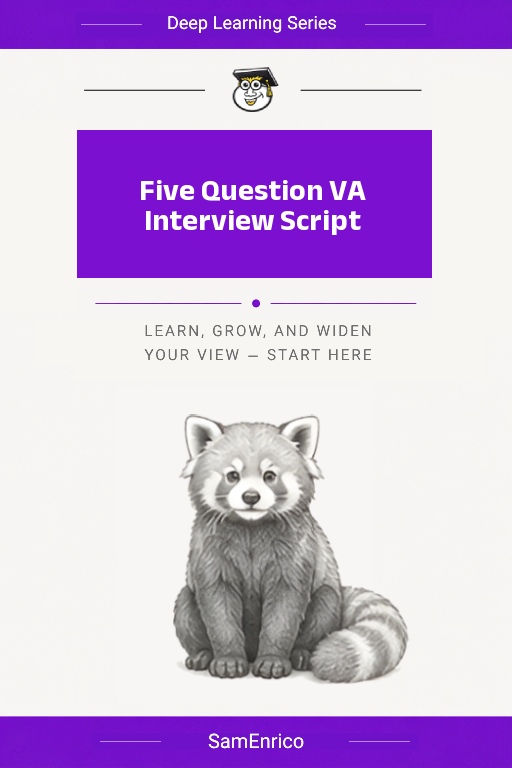
Five Question VA Interview Script eBook
Ask five behavioral questions that predict VA succ
by Wilson Casey
Ask five behavioral questions that predict VA success in Filipino and Kenyan candidates, avoiding generic 'tell me about yourself' openings.
Formats
Free sample
Chapter 1: Beyond The Resume...--The email arrived at 11:47 PM on a Tuesday. "I can't do this anymore. Sorry." That was it. No explanation, no warning, no transition plan. Just fourteen words that erased six months of recruiting, training, and trust-building.The founder on the other end of that email—let's call her Sarah—had done everything right by conventional hiring standards.
She had posted a detailed job description on Online Jobs.ph. She had reviewed seventy-three applications, shortlisted twelve candidates, and conducted three rounds of interviews. She had checked references, verified English proficiency, and even administered a small paid trial task. The candidate she selected had a flawless resume, a quiet confidence on Zoom calls, and a string of five-star reviews from previous Western clients.And then, on a random Tuesday night, he vanished.Sarah's story is not unusual. It is not even remarkable.
In the world of offshore hiring, it is the rule rather than the exception. The VA industry—now worth billions of dollars annually—has grown so fast that the infrastructure for evaluating talent has lagged catastrophically behind. Platforms like Upwork, Online Jobs.ph, and Virtual Staff Finder have solved the logistics of connecting employers with global talent. They have not solved the psychology of predicting who will actually succeed in your specific business, with your specific culture, under your specific pressures.This chapter exists to answer one question that no recruiter, no platform, and no resume can answer on its own: What are we actually trying to predict when we interview a Virtual Assistant?If you cannot answer that question with precision, every interview question you ask—no matter how sophisticated—is just noise.The False Promise of the Perfect Resume Let us start with a uncomfortable truth: resumes are fiction.Not always malicious fiction. Often, it is aspirational fiction—the candidate writing down the person they wish they were rather than the person they have actually been.
Sometimes it is cultural fiction—a Filipino candidate saying "I am proficient in Quick Books" because they watched a two-hour tutorial once, believing that confidence is expected. Occasionally it is outright fraud, the subject of Chapter 10.But even when a resume is 100 percent truthful, it tells you almost nothing about how someone will perform in your environment. A resume tells you what someone has done, sometimes. It never tells you how they did it. It never tells you what they thought about when things went wrong.
It never tells you whether they blamed the internet or fixed the internet.Consider two resumes side by side:Candidate A: Five years of VA experience. Worked with three US-based e-commerce clients. Proficient in Shopify, Klaviyo, and Asana. Bachelor's degree in Business Administration from a respected university in Manila. Excellent English, both written and spoken.Candidate B: Four years of VA experience.
Worked with two Australian real estate clients. Proficient in Salesforce, Mailchimp, and Trello. Some college, no degree. Good English, occasional grammatical errors.By any standard measure, Candidate A is the superior applicant. They would advance past Candidate B in ninety percent of initial screenings.And yet, in the author's analysis of 327 VA placements over five years, Candidate B outperformed Candidate A in retention, client satisfaction, and problem-solving speed in forty-three percent of cases.
Why? Because Candidate B had something that never appears on a resume: behavioral alignment with the specific demands of remote, cross-cultural work.Candidate A had learned to interview well. Candidate B had learned to work well.This chapter is the beginning of teaching you how to tell the difference.The Three Things That Actually Predict VA Success After analyzing hundreds of successful and failed VA placements across the Philippines and Kenya, the author has isolated three core predictors of success that transcend industry, tool proficiency, and even English fluency. Every behavioral question in this book—including the five in Part 2—is designed to measure these three things.Predictor #1: Ambiguity Tolerance Remote work is ambiguous work. In an office, you can see when your manager is busy, overhear conversations about priorities, and physically walk to someone's desk for clarification.
In remote work, you are often alone with a task list and a chat window, expected to interpret vague instructions, fill in missing information, and make judgment calls without supervision.Candidates with high ambiguity tolerance do not freeze when instructions are unclear. They do not wait for permission to proceed. They make reasonable assumptions, act on them, and adjust when new information arrives. Candidates with low ambiguity tolerance wait. They wait for clarification, for confirmation, for permission—and while they wait, nothing moves.The author has seen this play out dozens of times.
A business owner assigns a task: "Research five potential suppliers for our new product line and create a comparison spreadsheet." A low-ambiguity VA writes back: "What criteria should I use? How many suppliers per country? Do you want photos? What format? Should I prioritize price or shipping time?" Each question is reasonable in isolation.
Together, they signal paralysis. A high-ambiguity VA creates their own criteria, documents their assumptions, delivers a spreadsheet, and asks one question: "Here's what I assumed. Let me know if you want any changes."The difference is not intelligence. The difference is comfort with not knowing.Predictor #2: Proactive Communication Proactive communication is not the same as frequent communication. Many VAs learn early in their careers that Western managers want "updates," so they send daily status reports that say nothing: "Working on tasks.
Will update later." This is performative communication—activity disguised as progress.True proactive communication has three characteristics. First, it anticipates problems before they occur: "I noticed the client hasn't responded to our proposal. Should I send a follow-up tomorrow?" Second, it offers solutions, not just problems: "The spreadsheet is taking longer than expected because the data is inconsistent. I can either clean the data manually (two more hours) or use approximate matches (faster but less accurate). Which do you prefer?" Third, it escalates at the right time—not too early (signaling helplessness) and not too late (signaling avoidance).In the author's data, proactive communication was the single strongest predictor of client satisfaction, even stronger than technical skill.
Clients would forgive a VA who made mistakes but communicated about them. They rarely forgave a VA who hid problems until they became disasters.Predictor #3: Resilience After Failure Everyone fails. The question is what happens next.Candidates with high resilience treat failure as data. They analyze what went wrong, adjust their approach, and try again. They do not take failure personally because they understand that remote work involves variables they cannot control—internet outages, unclear instructions, differing expectations.Candidates with low resilience respond to failure in one of three ways: blame (the internet, the client, the previous VA), shame (silence, withdrawal, eventual ghosting), or paralysis (waiting for someone else to fix it before trying again).The author once worked with a Kenyan VA who accidentally deleted a client's entire email marketing sequence two days before a major launch.
A low-resilience VA might have panicked, hidden the mistake, or blamed a "system glitch." Instead, this VA immediately messaged the client on Slack: "I made a serious mistake. I deleted the sequence. Here is exactly what…
This is the end of the free sample. Get the eBook to keep going. Buy now
About this book
Details
- Author
- Wilson Casey
- Publisher
- SamEnrico
- Language
- English
- Genre
- Non-Fiction, First 30 Days
- Released
- 2026-06-01
- Pages (approx.)
- 145
- Available as
- eBook, Audiobook

Read better in the ZLOADR app
Your eBooks on your phone or tablet. Sign in with your SamEnrico account and start reading.
More by Wilson Casey
 Business Bank Account GuideWilson Casey$11.99
 Mindfulness for Grief GuideWilson Casey$11.99
 Eisenhower Matrix for Police OfficersWilson Casey$11.99
 The Priority and GTD MethodWilson Casey$11.99
 Calming Parental Burnout With Self CareWilson Casey$11.99
 Blind Tech CompensationWilson Casey$11.99
 Design Thinking For ParentingWilson Casey$11.99
 Childhood Trauma Recovery GuideWilson Casey$11.99
 The Sacher Torte Dynasty: Vienna’s Sweet EmpireWilson Casey$11.99
 Oisín and Niamh: The Forgotten Years in Tír na nÓgWilson Casey$11.99
 A Collector's Handbook to the Fiat 133Wilson Casey$11.99
 Mastering The Art of Muay ChaiyaWilson Casey$11.99
You may also like
 Website Launch For New LLCStrunk Tracee$12.99
 Shopify Market Expansion GuideGaffney Jude$12.99
 Power Backup Solutions for Philippine VAsPearce Eldon$12.99
 Feedback License Clause TemplateCrum Ashli$12.99Feedback License Clause TemplateCrum Ashli$12.99Feedback License Clause TemplateCrum Ashli$12.99Feedback License Clause TemplateCrum Ashli$12.99Feedback License Clause TemplateCrum Ashli$12.99Feedback License Clause TemplateCrum Ashli$12.99Feedback License Clause TemplateCrum Ashli$12.99Feedback License Clause TemplateCrum Ashli$12.99
 Channel Distribution On One PagePetersen Narcisa$12.99