
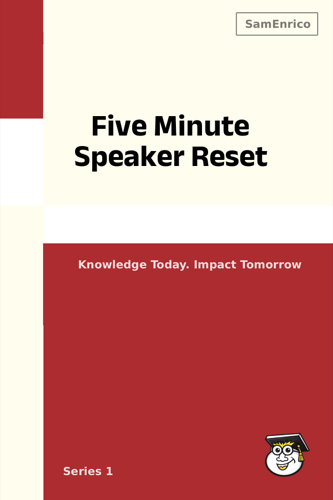
Non-FictionMental WealthQuick Reset
Five Minute Speaker Reset eBook
Use a rapid protocol when you're called on unexpec
Use a rapid protocol when you're called on unexpectedly.
Formats
Free sample
Chapter 1: The 3-Phase Lie--You have probably heard some version of this lie before. Maybe it came from a well-meaning mentor, a confident TED speaker, or a Linked In influencer with perfect lighting and a podcast. The lie sounds like this: “Great impromptu speakers are just more confident than everyone else. They trust themselves. They’ve practiced enough that they don’t need a structure.
They simply speak from the heart.”That is not just wrong. It is dangerously wrong.The truth—the uncomfortable, counterintuitive, liberating truth—is that the people who sound brilliant when caught off guard are not relying on confidence, charisma, or natural talent. They are relying on something far more mundane and far more available to you. They are relying on a hidden protocol. A sequence of steps so automatic and so practiced that it looks like instinct from the outside.
But it is not instinct. It is architecture.This entire book exists to give you that architecture. But before we build anything, we need to tear down the myth that has been paralyzing you.The Myth of the Natural Impromptu Speaker Let me describe a scene. You are in a weekly staff meeting. Twenty-three people on Zoom, plus eight in the room.
You have been quietly listening for forty-five minutes, relieved that no one has asked you anything. Your coffee is getting cold. You are mentally drafting an email about something else. Then the meeting leader—let’s call her Diane—turns her head directly toward you and says, “Before we move on, I’d love to hear your take on this. What do you think we should do about the client escalation?”Your stomach drops.
Your face warms. Your mind, which was full of words three seconds ago, is now full of static. You hear yourself say something. You are not sure what. The words feel disconnected from your intention.
You use the word “actually” twice. You mention something that happened three months ago that no one remembers. You end with “So yeah, that’s my thought.” And then Diane nods and moves on, and you spend the rest of the meeting replaying your answer, finding new ways to hate it.Here is what you tell yourself afterward: “I’m just not good on my feet. Some people are. I’m not.”That story you are telling yourself is the lie.The research on impromptu speaking is remarkably consistent.
When cognitive psychologists study people who perform well under spontaneous speaking pressure, they find almost no correlation with measures of natural charisma, extraversion, or even verbal fluency. What they find instead is a very specific kind of preparedness—not preparation of content, but preparation of process. The people who succeed have, often without realizing it, built a mental checklist that runs automatically when the spotlight finds them.The people who fail have not. It is that simple. And the difference between those two groups can be measured in minutes.
Specifically, five minutes.The 5-Minute Lie (and Why It’s Actually True)You might be looking at the title of this book and thinking: Five minutes? That’s a long time to stand there in silence while everyone waits for me to speak.That is a reasonable concern. Let me clarify immediately.The “five minutes” in Five Minute Speaker Reset is not five minutes of speaking. It is five minutes of total time from the moment the question is asked to the moment you finish your answer. That includes thinking time, structuring time, and delivery time.
In practice, for most unexpected questions, you will speak for somewhere between sixty and ninety seconds. The other three and a half minutes are silence—silence that you control, silence that you use to run the protocol you are about to learn.Yes, you read that correctly. You are allowed to be silent. In fact, the most charismatic speakers in the world are more comfortable with silence than the average person. They know something that anxious speakers do not: a two-second pause feels like an eternity to the person speaking and like a natural breath to the audience.
You are always feeling your pauses more acutely than anyone else in the room.So the five minutes break down like this:Minutes 1–2 (Calm): You regulate your physiology and read the room. This happens entirely in silence. No one knows you are doing it.Minutes 2–4 (Capture): You structure your message using a two-part system (Anchor + PREP) that you will learn in Chapter 5. Most of this also happens in silence, though you may use a brief bridging phrase (Chapter 4) to buy a few extra seconds.Minutes 4–5 (Connect): You deliver your answer using vocal and body techniques (Chapter 7) that make you look calm even if you are not.That is the architecture. And before you worry that three and a half minutes of silence will feel awkward, let me tell you about the two-second rule that changes everything.The Two-Second Rule That Changes Everything Here is a simple experiment you can run right now, wherever you are reading this.
Ask yourself a question—any question. Something like, “What did I have for breakfast yesterday?” Now answer it aloud. Notice how quickly you started speaking. For most people, it is almost instantaneous. That speed is the enemy.Now ask yourself another question.
“What is one thing I would change about my job if I had no fear of consequences?” This time, before you answer, count to two in your head. One-one-thousand, two-one-thousand. Then answer.What did you notice? Most people notice two things. First, the two-second pause felt much longer than it actually was.
Second, the answer that came after the pause was clearer, more direct, and more confident than the first answer. That is not a coincidence.The human brain, under social pressure, wants to fill silence with words. Any words. This is a survival mechanism left over from tribal times—silence in a group could mean danger. So your brain throws language at the problem, hoping something will stick.
That is why you say “um” and “like” and “actually” and “I guess.” Those are not signs of stupidity. They are signs of a brain that is trying to protect you by making noise.The two-second rule is your countermeasure. When you force yourself to pause for two full seconds before speaking, you give your prefrontal cortex—the planning part of your brain—just enough time to catch up with your amygdala, the panic center. Two seconds is the difference between a rambling answer and a structured one.Throughout this book, you will see the two-second rule appear again and again. It is the smallest habit that produces the largest return.Why Speed Beats Perfection (The 70 Percent Principle)One of the most common reasons people freeze when called on unexpectedly is perfectionism.
Not laziness, not lack of intelligence, not introversion. Perfectionism. The quiet, internal demand that your answer be good—complete, thoughtful, nuanced, well-supported, and ideally a little witty.That demand is the enemy of ever speaking at all.Let me introduce you to something I call the 70 Percent Principle. It comes from research on decision-making under time pressure, particularly in fields like emergency medicine and air…
This is the end of the free sample. Get the eBook to keep going. Buy now
About this book
Details
- Author
- Stubbs Arlyne
- Publisher
- SamEnrico
- Language
- English
- Genre
- Non-Fiction, Mental Wealth, Quick Reset
- Released
- 2026-06-06
- Pages (approx.)
- 120
- Available as
- eBook, Audiobook

Read better in the ZLOADR app
Your eBooks on your phone or tablet. Sign in with your SamEnrico account and start reading.
More by Stubbs Arlyne
 Spouse Grief Exercise TherapyStubbs Arlyne$11.99
 Upwork Niche Domination PlanStubbs Arlyne$11.99
 Sudden Key Departure Customer Retention GuideStubbs Arlyne$11.99
 Cannabis Use Disorder WorkplaceStubbs Arlyne$11.99
 Delayed Sleep Phase GuideStubbs Arlyne$11.99
 The Relapse Prevention Field GuideStubbs Arlyne$11.99
 The Magnesium Brain ProtectionStubbs Arlyne$11.99
 Tiamat's Last Stand: The Titan of ChaosStubbs Arlyne$11.99
 FTC Merger Litigation ReviewStubbs Arlyne$11.99
 The Maestro and the Mogul: How Ravi Shankar Redefined Global Music ContractsStubbs Arlyne$11.99
 How to Start a Crop Preparation for Primary Market (cleaning, Trimming, Grading, Etc.) Business (BegStubbs Arlyne$11.99
 The Complete Guide to Weight WatchersStubbs Arlyne$11.99
You may also like
 Hong Kong Handover 1997Dunn Johnnie$11.99
 Zumba For Postnatal Recovery CourseNeal Christian$11.99
 Zumba for BeginnersLadner Nikia$11.99
 YouTube Comment Mining GuideHumes Pandora$12.99
 Worry Box MeditationCarlin Rudy$11.99
 Workplace Stress MeditationNguyen Lynn$11.99
 Workplace Stress and Sleep RepairHawley Ivory$11.99
 Workplace Perfectionism CureDelaney Jeffry$11.99
 Workplace Injustice Anger GuideWallen Isabelle$11.99
 Work Addiction and Burnout LinkGreenwood Ester$11.99
 Women in Yoga and WellnessBeattie Galina$11.99
 Women in Stand Up ComedyChun Evangeline$11.99