
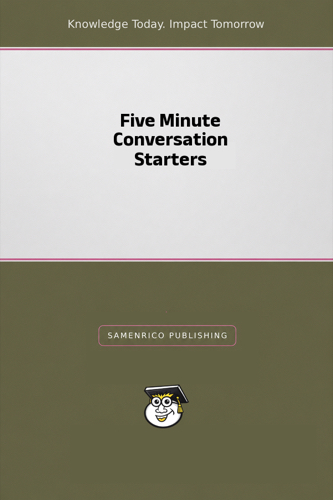
Non-FictionSelf-HelpSocial Skills
Five Minute Conversation Starters eBook
Provides quick openers for brief interactions like
Provides quick openers for brief interactions like elevators and queues.
Formats
Free sample
Chapter 1: The Queue Code--–- The fluorescent lights of the DMV hummed overhead, casting a sickly glow on forty-seven strangers who had one thing in common: they all wanted to be anywhere else. Sarah had been standing in line for eleven minutes. Her phone was at four percent battery. The woman behind her was sighing with the rhythm of a metronome. The man in front kept checking his watch as if sheer willpower could make the line move faster.
And then something unexpected happened. The man turned around, looked Sarah in the eye, and said, “If this line gets any slower, I’m going to start measuring it in geological time.” Sarah laughed. Not a polite, forced laugh, but a real one. And just like that, the next fifteen minutes became bearable. They talked about bad government websites, the art of the fake smile, and whether anyone actually enjoys signing their name on a digital screen.
When they finally reached the front, they waved goodbye like old friends. Sarah never got his name. But she remembered, for the rest of the day, that a stranger had turned a miserable wait into a shared moment of humanity.This book is about how to be that person.Welcome to the first of twelve chapters that will transform the way you navigate the small windows of opportunity that appear in your daily life—the elevator ride, the coffee line, the waiting room, the queue. These are not interruptions to your day. They are invitations.
And most of us, without realizing it, have been declining those invitations for years.The Standing Still Paradox There is something uniquely uncomfortable about waiting in a line. Psychologists call it the “standing still in public” paradox, though that term is my own synthesis of research from environmental psychology and social anxiety studies. Here is the paradox in simple terms: when we are moving through public space—walking down a sidewalk, navigating a grocery store aisle, crossing a lobby—we feel invisible and safe. Our motion grants us a kind of social immunity. But the moment we stop moving, we become visible.
We are suddenly aware that others can see us, that we are occupying space, that we are, in the words of one study participant, “a person standing around for no obvious reason except that someone else told me to.”This visibility triggers a low-grade anxiety response. Our heart rate increases slightly. Our palms may moisten. We reach for our phones—not because we need to check email, but because the phone is a shield. It signals to others: “I am occupied.
Do not approach me.” It also signals to ourselves: “I am not just standing here like an idiot. I am doing something.”The cruel irony is that everyone in the queue is feeling the same thing. Everyone is slightly anxious. Everyone is pretending to be busy. Everyone is waiting for someone else to break the silence.
And almost no one does.I want you to sit with that for a moment. In a typical American city, on an average weekday, there are millions of people standing in lines—at coffee shops, pharmacies, post offices, airport security, grocery stores, bank tellers, food trucks, concert venues, and restrooms. Millions of people. And the vast majority of them will never speak to the person standing two feet away. They will stand in silence, staring at phones or into the middle distance, feeling the weight of the unspoken, and then they will walk away having missed an opportunity that cost them nothing to take.This chapter is the cure.Why Queues Are Different from Every Other Social Space Before we get into specific techniques, we need to understand why waiting in line is a unique social environment—different from an elevator, different from a coffee shop, different from a party.The Queue is a Temporary Community.
In an elevator, you are together for thirty seconds, and then you scatter in different directions. In a waiting room, you are together for an unknown duration, but you are seated, often in chairs that face away from each other. In a queue, however, you are standing. You are oriented in the same direction. You are moving together at the same slow pace.
You are, for a brief period, a small tribe of reluctant pilgrims on the same journey to the same destination—the front of the line. This shared orientation creates a subtle bond. You are not strangers who happen to be near each other. You are comrades in inconvenience.The Queue Has a Built-In Timer. One of the reasons brief interactions feel safer than long ones is that everyone knows when they will end.
In a queue, the end is visible. You can see the counter. You can count the people ahead of you. This knowledge lowers the stakes dramatically. If you say something awkward, you will be at the front of the line in four minutes, and you will never see these people again.
This is liberating. The worst-case scenario is not actually that bad.The Queue Amplifies Boredom. Boredom is an uncomfortable state. The human brain craves stimulation. When you are standing in a line with nothing to do (because you have already checked Instagram, read the headlines, and watched two minutes of a Tik Tok video about how to fold a fitted sheet), your brain becomes desperate for input.
This desperation makes people more receptive to conversation than they would be in almost any other setting. The person next to you is not just tolerating the possibility of you speaking. They may actually want you to speak. They just do not want to be the one to start.The Queue Has Clear Green and Red Light Signals. Unlike a crowded bar or a busy street, a queue offers relatively unambiguous cues about who is open to conversation and who is not.
We will spend significant time on this later in the chapter, but for now, understand this: the queue is a social environment with rules. Learn the rules, and you stop guessing. You start knowing.The First Three Seconds Before we discuss what to say, we need to discuss when to say it.Every queue-based interaction has a critical window. I call it The First Three Seconds—the period immediately after you stop moving and settle into your place in line. This window is the difference between a natural, easy conversation and a forced, awkward one.Here is why the window matters.
When you first join a queue, you are in motion. You are walking toward the end of the line, scanning for where to stop, adjusting your trajectory, perhaps shifting a bag or a coffee cup from one hand to the other. During these few seconds of motion, you are not yet “in the line.” You are arriving. And then you stop. In that moment of stopping, there is a brief vacuum.
You are not yet settled. You have not yet pulled out your phone. You have not yet established your “waiting posture.” This is the moment when social walls are lowest. This is when you can say something without it feeling like an interruption.If you wait longer…
This is the end of the free sample. Get the eBook to keep going. Buy now
About this book
Details
- Author
- Maestas Marquita
- Publisher
- SamEnrico
- Language
- English
- Genre
- Non-Fiction, Self-Help, Social Skills
- Released
- 2026-06-08
- Pages (approx.)
- 145
- Available as
- eBook, Audiobook

Read better in the ZLOADR app
Your eBooks on your phone or tablet. Sign in with your SamEnrico account and start reading.
More by Maestas Marquita
 Childcare Subsidy ComplianceMaestas Marquita$11.99
 The New Car GenerationMaestas Marquita$11.99
 Mindful Elevator RideMaestas Marquita$11.99
 Active Listening for Mental Health First AidMaestas Marquita$11.99
 Morning Routine for Shift WorkersMaestas Marquita$11.99
 Networking for Customer ServiceMaestas Marquita$11.99
 Deep Work Remote GuideMaestas Marquita$11.99
 The Krays and the Birth of Criminal Profiling: How London's Most Notorious Brothers Changed Forensic PsychologyMaestas Marquita$11.99
 The Bone Breakers and the Healers: Medieval Football's Forgotten Medical WarriorsMaestas Marquita$11.99
 Service Providers Guide to Herb Wreaths & CraftsMaestas Marquita$11.99
 How to Produce Wall and CeilingMaestas Marquita$11.99
 How to Produce Lens and Filter Adapter RingsMaestas Marquita$11.99
You may also like
 Hong Kong Handover 1997Dunn Johnnie$11.99
 Zumba For Postnatal Recovery CourseNeal Christian$11.99
 Zumba for BeginnersLadner Nikia$11.99
 YouTube Comment Mining GuideHumes Pandora$12.99
 Worry Box MeditationCarlin Rudy$11.99
 Workplace Stress MeditationNguyen Lynn$11.99
 Workplace Stress and Sleep RepairHawley Ivory$11.99
 Workplace Perfectionism CureDelaney Jeffry$11.99
 Workplace Injustice Anger GuideWallen Isabelle$11.99
 Work Addiction and Burnout LinkGreenwood Ester$11.99
 Women in Yoga and WellnessBeattie Galina$11.99
 Women in Stand Up ComedyChun Evangeline$11.99