
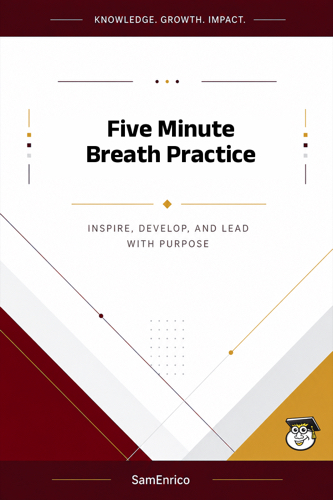
Five Minute Breath Practice eBook
Accessible daily breathing for beginners.
Accessible daily breathing for beginners.
Formats
Free sample
Chapter 1: The Quiet Epidemic--–- The morning began like any other. At 6:47 AM, the alarm shattered the silence. A 35-year-old marketing director named Sarah reached for her phone, scrolled through emails before her eyes fully focused, and stumbled toward the coffee maker. Her mouth was dry. Her jaw ached.
Her brain felt wrapped in cotton. She had slept eight hours—eight full hours—yet exhaustion clung to her like wet clothing.She told herself this was normal. Everyone was tired. Everyone needed caffeine to function. Everyone woke up with a stuffy nose and a sore throat from breathing through their mouth all night.But here is the truth Sarah did not know: she was not suffering from a lack of sleep.
She was suffering from a lack of correct breathing.This is not Sarah's fault. It is not your fault either. Over the past century, humans have quietly, collectively, forgotten how to breathe. And that forgetting has become a quiet epidemic—one that manifests as anxiety, fatigue, brain fog, high blood pressure, sleep apnea, and a dozen other modern ailments we have learned to accept as normal.They are not normal. They are symptoms.
And the root cause is simpler than you think.The 25,000 Breath Problem Every day, you take approximately 25,000 breaths. That is 25,000 opportunities to either fuel your body or slowly drain it. For the vast majority of modern adults, those 25,000 breaths are dysfunctional—too fast, too shallow, taken through the mouth instead of the nose, and driven by the wrong muscles.Let that sink in. You are breathing incorrectly tens of thousands of times per day.The data is startling. Chronic over-breathing—a condition called hyperventilation syndrome—affects an estimated one in ten people, yet most have never heard of it.
They simply feel "anxious" or "tired" or "foggy" and assume that is their baseline. The average resting breath rate in pre-industrial societies was four to six breaths per minute. Today, it is twelve to twenty. That is not progress. That is dysfunction.And here is the most humbling fact of all: humans are the only mammals on Earth with chronic breathing problems.
A newborn baby breathes correctly—diaphragmatically, nasally, slowly. So does a dog. So does a horse. So does every wild animal. Only humans, with our stressed, sedentary, indoor, processed-food lifestyles, have managed to break the most fundamental biological process.But here is the good news: if you learned to breathe poorly, you can learn to breathe well again.
And you do not need an hour a day or a retreat in the mountains. You need five minutes. Five minutes and your nose.The Ancient Skull That Changed Everything In 2019, journalist James Nestor published a book called Breath that would fundamentally change how we understand human respiration. In it, he described a visit to a collection of ancient skulls housed at a university. The skulls were hundreds—sometimes thousands—of years old.
And they all had something in common: wide palates, straight teeth, fully developed sinuses, and spacious airways.Then Nestor looked at modern skulls. The difference was shocking. Modern skulls have narrow palates, crowded and crooked teeth, recessed jaws, and constricted nasal passages. The human face has literally shrunk over the past few centuries. And with that shrinkage came a collapse of the airway.What caused this dramatic change?
Three culprits, working in concert.First, soft processed foods. When humans stopped chewing tough, fibrous, unprocessed foods, their jaw muscles weakened. Those muscles provide the structure that pulls the face forward and wide. Without that resistance training, the face grew narrower and longer.Second, indoor living. For most of human history, we lived outdoors, breathing fresh, moving air.
Today, we live in sealed boxes filled with dust, dander, mold, and volatile chemicals. Our immune systems responded with inflammation. Our nasal passages swelled. We started breathing through our mouths to compensate.Third, chronic stress. Modern life is a low-grade, never-ending emergency.
The sympathetic nervous system—the "fight or flight" response—was designed for short bursts of survival, not a constant hum of anxiety. But that is exactly what we have created: a perpetual state of low-level alertness that drives shallow, rapid, chest-based breathing.These three forces—soft food, indoor air, chronic stress—have rewired the human breath in less than ten generations. And we are paying the price.The Symptoms You Think Are Normal Let us be specific. Here is a list of common complaints. Read each one and ask yourself: have I experienced this in the past month?Waking up tired after seven or eight hours of sleep Dry mouth or sore throat in the morning Snoring (or being told you snore)Feeling anxious for no identifiable reason Brain fog or difficulty concentrating Frequent sighing or yawning (which is actually a sign of over-breathing)Feeling short of breath during mild exertion Cold hands and feet (poor circulation)High blood pressure Chronic nasal congestion Teeth grinding or jaw pain If you checked even two or three of these, your breathing is likely dysfunctional.
And here is the crucial insight: these are not separate problems. They are all downstream effects of a single root cause. Fix the breath, and many of these symptoms will improve or disappear entirely.The mechanism is surprisingly straightforward. When you breathe through your mouth or breathe too rapidly, you "blow off" excess carbon dioxide. That might sound good—after all, we are taught that CO2 is waste.
But that is only half the truth. Carbon dioxide is also a potent vasodilator. It tells your blood vessels to open up, allowing oxygen to reach your tissues. When your CO2 levels drop too low, your blood vessels constrict. Your hands and feet get cold.
Your brain receives less oxygen. Your heart has to work harder. And your entire nervous system shifts toward anxiety and alertness.You feel breathless—not because you lack oxygen, but because your CO2 is too low to release the oxygen you already have. It is a paradox that confounds most doctors and nearly all patients. The solution is not to breathe more.
The solution is to breathe better. Less air, but higher quality air, delivered through the nose, driven by the diaphragm, at a slower rate.The 30-Second Test That Changed My Life Before we go any further, I want you to take a simple test. It takes thirty seconds. It requires no equipment. And it will give you a baseline measurement that we will revisit at the end of this book.This is called the Body Oxygen Level Test, or BOLT score.
It was developed by Russian physiologist Konstantin Buteyko and popularized by Patrick Mc Keown in The Oxygen Advantage. It is not a maximum breath hold. Do not push yourself to the point of struggle. We are measuring something much more subtle.Here is what you do:First, sit quietly for a few minutes. Do not take any deep breaths beforehand.
Just breathe normally through your nose.Second, take a normal, relaxed exhale. Not a forced exhale. Not a deep exhale. Just let the air leave your lungs naturally.Third, pinch your nose gently to seal it shut. Start a stopwatch or count silently in your head.Fourth, hold your breath.…
This is the end of the free sample. Get the eBook to keep going. Buy now
About this book
Details
- Author
- Sipes Stefania
- Publisher
- SamEnrico
- Language
- English
- Genre
- Non-Fiction, Self-Help, Short
- Released
- 2026-06-11
- Pages (approx.)
- 130
- Available as
- eBook, Audiobook

Read better in the ZLOADR app
Your eBooks on your phone or tablet. Sign in with your SamEnrico account and start reading.
More by Sipes Stefania
 Lactose Free Calcium Sources GuideSipes Stefania$11.99
 Elderly Power Training WorkoutSipes Stefania$11.99
 Postpartum Hemorrhoid Relief GuideSipes Stefania$11.99
 TM and ConsciousnessSipes Stefania$11.99
 The Mindful Pause MBSRSipes Stefania$11.99
 War Correspondent StressSipes Stefania$11.99
 Bipolar Therapy GuideSipes Stefania$11.99
 Rheumatoid Arthritis Flare TriggersSipes Stefania$11.99
 The Mamluk Blitz: Egypt’s Slave Warriors Conquer the Holy LandSipes Stefania$11.99
 The Last Gold Rush: How a Single Bank Collapse Triggered a Global PanicSipes Stefania$11.99
 How to Become a Aquatic PerformerSipes Stefania$11.99
 Innovation Leadership in PracticeSipes Stefania$11.99
You may also like
 Hong Kong Handover 1997Dunn Johnnie$11.99
 Zumba For Postnatal Recovery CourseNeal Christian$11.99
 Zumba for BeginnersLadner Nikia$11.99
 YouTube Comment Mining GuideHumes Pandora$12.99
 Worry Box MeditationCarlin Rudy$11.99
 Workplace Stress MeditationNguyen Lynn$11.99
 Workplace Stress and Sleep RepairHawley Ivory$11.99
 Workplace Perfectionism CureDelaney Jeffry$11.99
 Workplace Injustice Anger GuideWallen Isabelle$11.99
 Work Addiction and Burnout LinkGreenwood Ester$11.99
 Women in Yoga and WellnessBeattie Galina$11.99
 Women in Stand Up ComedyChun Evangeline$11.99