
Non-FictionSelf-HelpFitness TrackingHealth
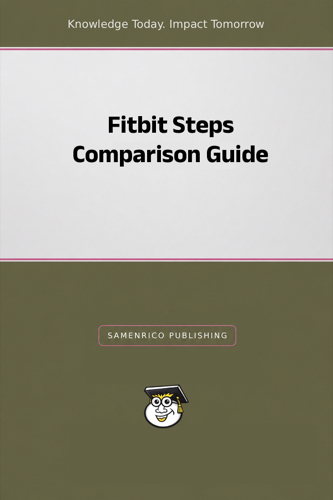
Fitbit Steps Comparison Guide eBook
Stop comparing daily step counts and sleep scores
Stop comparing daily step counts and sleep scores with social connections.
Formats
Free sample
Chapter 1: The Comparison Machine--–- Three years ago, I woke up at 3:17 a.m. for no reason I could name. No nightmare. No barking dog. No urgent need to use the bathroom.
Just the sudden, electric jolt of consciousness that arrives like an uninvited guest. I lay there in the dark, staring at the ceiling, waiting for sleep to reclaim me. It didn't. Instead, my hand reached for my phone on the nightstand—a motion so automatic, so unconscious, that I didn't even realize I was doing it until the screen glowed in my face. I wasn't checking the time.
I wasn't answering a message. I was opening the Fitbit app. And not to see my own sleep data. I wanted to see how my friend Sarah had slept.The number appeared: 87. A sleep score of 87.
Deep sleep: 1 hour, 47 minutes. REM: 2 hours, 12 minutes. Restoration: excellent.I looked at my own score: 62.My jaw tightened. My chest felt hot. A voice in my head—quick, sharp, unfair—whispered: She always sleeps better than you.
She's probably dreaming peacefully right now while you're lying here like an idiot at 3 a.m. I felt something close to resentment toward a person I genuinely loved. All because of two numbers on a screen.I did not go back to sleep that night.The next morning, over coffee, I texted Sarah: "Wow, 87 sleep score! What's your secret?" She replied: "Honestly? I was exhausted.
I fell asleep on the couch at 8 p.m. and didn't move until 6 a.m. Not sure that's healthy but I'll take it." Her answer was reasonable, even humble. It didn't matter. The damage was already done.
I had spent twenty minutes comparing my broken night to her apparently perfect one, and I felt smaller for it.That moment—that stupid, 3 a.m., phone-glowing, score-comparing moment—is why this book exists. Because I know I am not alone. And because what happened to me is not a personal failure. It is a design feature.The Invisible Arena Here is what most people don't realize about their wearable devices. You bought your Fitbit, Apple Watch, or Oura ring for noble reasons.
You wanted to move more. Sleep better. Stress less. You wanted data to help you understand your own body. That was the promise.
That was the transaction: you wear the device, it collects the numbers, you make better choices. Simple.But somewhere along the way, something changed. A software update added a "Friends" tab. A notification appeared: "See how you compare to Sarah!" A weekly email arrived: "You ranked 4th in steps this week. Beat 3rd place by 500 steps to move up!" The device that was supposed to be your personal wellness companion became a social arena.
And you didn't ask for it.This chapter is called "The Comparison Machine" because that is exactly what these devices have become. Not pedometers. Not sleep trackers. Not health tools. Machines engineered to generate comparison—endless, involuntary, emotionally charged comparison—because comparison keeps you opening the app.
And opening the app is how these companies make money.I want you to sit with that for a moment. The same device that tells you how many steps you took today is also, quietly, systematically, encouraging you to feel inadequate relative to your friends. Not because the company hates you. Because inadequacy is profitable. A satisfied user checks their stats once a day.
An anxious user checks eleven times.The Psychology We Can't Escape Before we blame the technology entirely, we have to understand the raw material it's working with: the human brain's ancient, relentless drive to compare.Let's go back about 200,000 years. You are living in a small tribe on the African savanna. Your survival depends on knowing where you stand relative to others. Who is faster at spotting predators? Who is better at finding water?
Who has more social influence? Your brain evolved a mechanism called social comparison theory—first formally described by psychologist Leon Festinger in 1954—which argues that humans have an innate drive to evaluate themselves by comparing to others when objective standards are unavailable.Here is what that means in practice. In the absence of a clear, universal, objective measure of "am I doing okay?", your brain automatically looks sideways. It finds someone similar to you—a peer, a friend, a colleague—and asks: How am I doing compared to them? If you are doing better, you feel relief, pride, or superiority.
If you are doing worse, you feel shame, anxiety, or motivation to improve.This system worked beautifully on the savanna. If you noticed that your hunting partner brought back more meat than you, the resulting discomfort motivated you to try harder. If you noticed that your neighbor's hut was larger, you might improve your own building skills. Comparison was a functional, adaptive tool for survival and progress.But here is the catch. The savanna comparison system had built-in brakes.
You only compared to a handful of people—maybe fifty or sixty in your entire tribe. You could see their actual lives, not curated highlights. And most importantly, the comparison was not constant. You compared when you happened to notice something, not on a screen, not at 3 a.m., not hundreds of times per day.Now contrast that with your Fitbit.Every time you open the app, you see a leaderboard of everyone in your social circle who has synced their device today. That is not a handful of people.
That could be dozens. Each of them has a step count. Each of them has a sleep score. Each of them has moved more or rested better or performed some metric slightly above or below you. And here is the cruel math: on any given day, roughly half of them will be above you.
That is how averages work. But your brain does not see averages. Your brain sees threats.Upward and Downward: The Two Faces of Comparison Psychologists distinguish between two types of social comparison, and understanding this distinction is the single most important concept in this entire book.Upward comparison happens when you compare yourself to someone you perceive as better than you on a given dimension. You see your friend's 15,000 steps. You see your 8,000 steps.
You look up. That is upward comparison. The emotional result is typically negative: envy, inadequacy, shame, or frustrated ambition. Sometimes upward comparison motivates you to try harder. More often, it discourages you.
And crucially, with wearables, upward comparison is endless. There is always someone with more steps. Always someone with a higher sleep score. Always someone who ran faster, rested longer, woke up earlier. You cannot "win" upward comparison because the ceiling does not exist.Downward comparison happens when you compare yourself to someone you perceive as worse than you.
You see your friend's 4,000 steps. You see your 8,000 steps. You look down. The emotional result is typically positive: relief, pride, or a smug sense of superiority. Downward comparison feels good in the moment.
But here is the problem: it is fragile. The moment someone below you overtakes you—which they will, because step counts fluctuate—that relief evaporates and is replaced by the sting of upward comparison. Worse, downward comparison trains your brain to seek…
This is the end of the free sample. Get the eBook to keep going. Buy now
About this book
Details
- Author
- Hayward Stefani
- Publisher
- SamEnrico
- Language
- English
- Genre
- Non-Fiction, Self-Help, Fitness Tracking, Health
- Released
- 2026-06-09
- Pages (approx.)
- 138
- Available as
- eBook, Audiobook

Read better in the ZLOADR app
Your eBooks on your phone or tablet. Sign in with your SamEnrico account and start reading.
More by Hayward Stefani
 Sioux Hemp Farming CoHayward Stefani$11.99Sioux Hemp Farming CoHayward Stefani$11.99
 Judds Mama He's CrazyHayward Stefani$11.99
 Assertiveness in Customer ServiceHayward Stefani$11.99
 The Ayurvedic Spice Cabinet GuideHayward Stefani$11.99
 Blood Moon Over the Silk Road: The Lost Caravans of the Celestial NomadsHayward Stefani$11.99
 SkydivingHayward Stefani$11.99
 Rate Cap Insurance for LoansHayward Stefani$12.99
 Cost Reimbursement ContractsHayward Stefani$12.99
 Understanding Short Stature Mental Retardation Eye AnomaliesHayward Stefani$17.99
 How to Become a Dust-mill OperatorHayward Stefani$11.99
You may also like
 Hong Kong Handover 1997Dunn Johnnie$11.99
 Zumba For Postnatal Recovery CourseNeal Christian$11.99
 Zumba for BeginnersLadner Nikia$11.99
 YouTube Comment Mining GuideHumes Pandora$12.99
 Worry Box MeditationCarlin Rudy$11.99
 Workplace Stress MeditationNguyen Lynn$11.99
 Workplace Stress and Sleep RepairHawley Ivory$11.99
 Workplace Perfectionism CureDelaney Jeffry$11.99
 Workplace Injustice Anger GuideWallen Isabelle$11.99
 Work Addiction and Burnout LinkGreenwood Ester$11.99
 Women in Yoga and WellnessBeattie Galina$11.99
 Women in Stand Up ComedyChun Evangeline$11.99