
Non-FictionSelf-HelpFitness Tracking
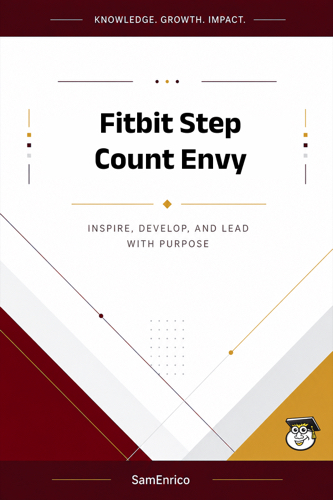
Fitbit Step Count Envy eBook
Analyzes how daily activity tracking becomes a sou
Analyzes how daily activity tracking becomes a source of inadequacy.
Formats
Free sample
Chapter 1: The 8:47 AM Shame Spiral--–- You wake up feeling fine. Not great, not terrible. Just fine. The kind of fine where you don’t think about your body at all for the first thirty seconds of consciousness. Then you remember.
You reach for your phone.The screen glows. Your wrist—bare because you charged the tracker overnight—feels strangely light. The app opens before you’ve fully blinked. And there it is. Your step count: 0.
Your friend Bethany’s step count, posted to the leaderboard at 6:12 AM: 3,247. She has already walked her dog, made a green smoothie, and posted a sunrise selfie. You have not yet peed. The day is forty-seven minutes old, and you are already losing.This is the 8:47 AM Shame Spiral. If you own a fitness tracker—and roughly one in five American adults now does, with over 80 million wearables sold globally in the last five years alone—you know this feeling intimately.
It is not jealousy, exactly. It is not guilt, exactly. It is something worse. It is the quiet, gnawing sense that you have somehow failed before you have even begun. Your body is still warm from sleep, and already it has been weighed, measured, and found wanting.This book is about that feeling.
Not about how to get more steps. Not about how to beat Bethany. Not about how to close your rings more consistently or finally win that workplace challenge. This book is about why that feeling exists, who profits from it, and how to make it stop.Let us start with a confession: I have been Bethany. I have also been the person crying over 9,987 steps at 11:47 PM.
I have strapped my tracker to my dog. I have paced my apartment in the dark like a caged animal. I have felt genuine, burning resentment toward a friend for the crime of… walking. And I have wondered, in my more honest moments, whether any of this has anything to do with health at all.It does not. It never did.The Invention of a Number Before we can understand step count envy, we must understand the number that causes it: 10,000.
Where did it come from? If you are like most tracker users, you assume it came from science. Perhaps a Japanese public health study. Perhaps the World Health Organization. Perhaps the American Heart Association.
Surely, you think, a number this universal, this embedded in every fitness app, every smartwatch, every corporate wellness challenge, must have a rigorous evidentiary foundation.It does not.The 10,000-step goal was invented in 1965 by a Japanese company called Yamasa Corporation, which manufactured a pedometer named the Manpo-kei. In Japanese, man means 10,000, po means step, and kei means meter or gauge. Manpo-kei translates literally to “10,000-step meter.” The number was chosen for one reason and one reason only: it looked good on packaging. The character for 10,000 in Japanese resembles a person walking. It was memorable.
It was round. It was easy to say. And it sold pedometers.No clinical trial supported it. No longitudinal study had shown that 10,000 steps was the threshold for any meaningful health outcome. The company simply needed a number, and 10,000 was it.For decades, the Manpo-kei remained a modest success in Japan.
Then, in the 1990s and early 2000s, as the global fitness industry exploded, the 10,000-step goal was exported to the West. It appeared in magazine articles, then in early digital pedometers, then in the first Fitbits. By the time the i Phone and Apple Watch arrived, 10,000 steps had become an unquestioned article of faith. It was no longer a marketing slogan. It was The Truth.The scientific community, for its part, has spent the last twenty years trying to catch up—and largely failing to validate the number.
A major 2019 study published in JAMA Internal Medicine followed nearly 17,000 older women and found that the risk of premature death leveled off at around 7,500 steps per day. Walking more than that provided no additional longevity benefit. A 2020 study in The Lancet found that the health benefits of walking plateaued at roughly 8,000 steps for adults under sixty and 6,000 for adults over sixty. Another study found that for people with chronic conditions like diabetes or heart disease, 5,000 steps was often the optimal target—with higher step counts associated with increased injury risk and no additional disease reduction.The scientific consensus, such as it is, can be summarized in one uncomfortable sentence: No major health organization recommends 10,000 steps as a universal goal. The American Heart Association talks about “at least 150 minutes of moderate activity per week.” The World Health Organization says the same.
Neither mentions 10,000 steps. The number lives in your tracker not because doctors endorse it, but because a Japanese marketing executive in the 1960s thought it sounded nice.Let that land. You have been feeling inadequate—sometimes daily, sometimes acutely—because of a jingle.The Shift from Feeling to Data The 10,000-step lie is only half the story. The other half is the technological shift that turned a vague wellness aspiration into a quantifiable, shareable, endlessly comparable metric. That shift is called the gamification of health, and it has changed the way millions of people relate to their own bodies.Before fitness trackers, movement was felt.
You went for a walk, and you knew it was a good walk because your mood improved, your muscles loosened, your mind quieted. You did yard work, and you knew it was sufficient because you were tired afterward. You played with your kids, and you knew it counted because you were out of breath and smiling. The feedback loop was internal, subjective, and forgiving. A short walk was still a walk.
A slow day was still a day.Fitness trackers replaced that internal feedback loop with an external one. Instead of asking “Do I feel good?” you ask “What does the number say?” Instead of noticing your energy levels, you notice your step count. Instead of stopping when your body is tired, you stop when the tracker says you have “earned” the right to rest.This substitution seems benign—even helpful—until you examine what is lost. The human body is not a pedometer. It does not experience movement in discrete, countable units.
A day spent caring for a sick child involves thousands of small, exhausting movements that a wrist-worn accelerometer will never register as “steps.” A day spent at a physically demanding job—construction, nursing, retail—may produce 15,000 steps, but those steps come at a cost that the tracker cannot measure: joint pain, fatigue, cortisol elevation. A day spent recovering from illness or injury may produce 500 steps, and yet those 500 steps may be a heroic achievement for that body on that day.The tracker sees none of this. It sees only the number. And the number, because it is stripped of all context, inevitably invites comparison. You compare today’s number to yesterday’s.
You compare your number to Bethany’s. You compare your number to the 10,000-step phantom goal. And in almost every comparison, you lose.This is not an accident. It is a design feature.The Paradox of Motivation Here is the central paradox of the fitness tracker: People buy them to feel more motivated, but the trackers systematically…
This is the end of the free sample. Get the eBook to keep going. Buy now
About this book
Details
- Author
- Calabrese Augustine
- Publisher
- SamEnrico
- Language
- English
- Genre
- Non-Fiction, Self-Help, Fitness Tracking
- Released
- 2026-06-08
- Pages (approx.)
- 158
- Available as
- eBook, Audiobook

Read better in the ZLOADR app
Your eBooks on your phone or tablet. Sign in with your SamEnrico account and start reading.
More by Calabrese Augustine
 Hoffa Disappearance Podcast Investigative GuideCalabrese Augustine$11.99
 Reading People Body Language GuideCalabrese Augustine$11.99
 Housing Market StressCalabrese Augustine$11.99
 Remote Work Week PlanningCalabrese Augustine$11.99
 Goal Framework ResearchCalabrese Augustine$11.99
 Recovering From Being Fired GuideCalabrese Augustine$11.99
 Stimulus Control GuideCalabrese Augustine$11.99
 The Battle of the Java Sea: The Pacific's Forgotten Cataclysm (1942)Calabrese Augustine$11.99
 The Iron Poet: Brunel and the Birth of Modern EngineeringCalabrese Augustine$11.99
 How to Produce Textile Machinery PartsCalabrese Augustine$11.99
 AI for Bad Debt Provision CalculationCalabrese Augustine$12.99
 UAE VAT on Financial ServicesCalabrese Augustine$12.99
You may also like
 Hong Kong Handover 1997Dunn Johnnie$11.99
 Zumba For Postnatal Recovery CourseNeal Christian$11.99
 Zumba for BeginnersLadner Nikia$11.99
 YouTube Comment Mining GuideHumes Pandora$12.99
 Worry Box MeditationCarlin Rudy$11.99
 Workplace Stress MeditationNguyen Lynn$11.99
 Workplace Stress and Sleep RepairHawley Ivory$11.99
 Workplace Perfectionism CureDelaney Jeffry$11.99
 Workplace Injustice Anger GuideWallen Isabelle$11.99
 Work Addiction and Burnout LinkGreenwood Ester$11.99
 Women in Yoga and WellnessBeattie Galina$11.99
 Women in Stand Up ComedyChun Evangeline$11.99