
Non-FictionHealth & WellnessAdvanced Fitbit
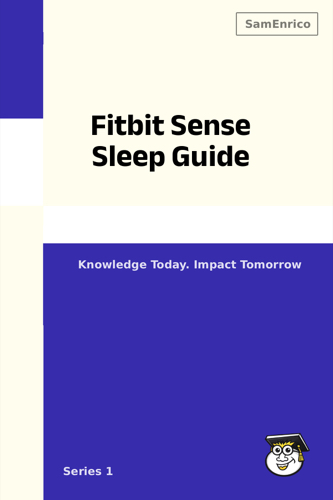
Fitbit Sense Sleep Guide eBook
Track sleep stages, skin temperature, and nightly
by Tapp Ariel
Track sleep stages, skin temperature, and nightly SpO2 with EDA sensor.
Formats
Free sample
Chapter 1: The Baseline Lie--–- You have been lied to about your sleep. Not by a person, not by a conspiracy, but by the very idea that sleep is a simple, binary state—either you are "asleep" or you are "awake." The fitness industry, the wellness influencers, and even many doctors have treated sleep as a single dimension: duration. Get eight hours. Case closed. But the Fitbit Sense exists because eight hours of stressed, oxygen-deprived, temperature-spiking sleep is not recovery.
It is a prison sentence for your nervous system.This book is not a manual. You will not find instructions on how to change a clock face or sync Bluetooth in these pages—those belong in the drawer with the warranty card. Instead, this is a field guide to your own physiology. The Sense is a laboratory on your wrist, capable of measuring five distinct biological signals during sleep: movement, heart rate, heart rate variability, skin temperature, blood oxygen, and electrodermal activity. Six signals that, when read together, tell a story more accurate than any sleep diary you have ever kept.But there is a problem.
A dangerous problem that every Fitbit Sense owner faces within the first week of ownership. You wake up, bleary-eyed, and tap the screen. The Sleep Score appears: 72. Or 68. Or, God forbid, 45.
Your heart sinks. You failed. You slept poorly. You are broken.That number is a lie. Not because the sensor is wrong, but because you have no baseline.The Tyranny of the Absolute Number Let me tell you about Sarah.
Sarah is a 34-year-old emergency room nurse who works rotating shifts. She bought a Fitbit Sense because she noticed she was making medication errors during night shifts—a dangerous sign of cognitive fatigue. On her first night of tracking, her Sense reported a Sleep Score of 58. The app labeled it "Fair" and suggested she needed more Deep sleep. Sarah panicked.
She bought blackout curtains, melatonin, and a weighted blanket. She tried everything. Her score stayed in the 50s and 60s.Three weeks later, Sarah almost quit her job. She believed her body was fundamentally broken.Then she discovered something accidental. She forgot to wear her Sense for a week.
When she put it back on, she checked her 30-day average: 61. Her "bad" nights were 58. Her "good" nights were 64. She had been comparing herself to a hypothetical "perfect 100" that does not exist. Her baseline was 61.
A score of 58 was not failure; it was a normal 3-point variation.This is the Baseline Lie. Every number your Sense shows you—Sleep Score, Stress Management Score, HRV, breathing rate, skin temperature deviation—is meaningless without a personal baseline. The device does not know you yet. It does not know that you have a naturally high resting heart rate because you are a long-distance runner. It does not know that your skin runs cold because you have poor circulation.
It does not know that your EDA spikes at 3 AM because your neighbor's cat yowls outside your window every night.For the first five to seven nights, the Sense is not measuring you. It is measuring a stranger who happens to have your wrist. The algorithm needs time to learn what "normal" looks like for your unique biology.The Science of Allostatic Load To understand why baselines matter, you need to understand the concept of allostatic load. This is the physiological term for the wear and tear on your body caused by repeated exposure to stress. Imagine your nervous system as a rubber band.
Every time you encounter a stressor—a deadline, a argument, a loud noise, a late meal—you stretch the band. In a healthy system, the band snaps back to its original shape when the stressor passes. That is allostasis: stability through change.But chronic stress—the kind that comes from bad sleep, financial worry, relationship conflict, or shift work—prevents the band from snapping back. It stays stretched. Over months and years, the rubber loses elasticity.
That is allostatic load. It is the reason why stressed people get sick more often, age faster, and die younger.The Fitbit Sense measures allostatic load indirectly through three primary channels:Heart Rate Variability (HRV): The variation in time between heartbeats. High HRV (more variation) means your nervous system is flexible—it can switch between "fight or flight" (sympathetic) and "rest and digest" (parasympathetic) easily. Low HRV (less variation) means your system is stuck in one gear, usually sympathetic. Chronically low HRV is a marker of high allostatic load.Electrodermal Activity (EDA): The measure of sweat gland activity on your skin.
Your sweat glands are controlled exclusively by the sympathetic nervous system. When you are stressed, even unconsciously, your palms sweat microscopically. The Sense detects this as EDA spikes. During sleep, EDA spikes indicate that your body is reacting to something—a dream, a noise, a breathing interruption—as if it were a threat.Skin Temperature: Your body temperature follows a circadian rhythm, dropping at night to initiate sleep and rising in the morning to wake you. Deviations from your personal baseline—especially sustained increases—can indicate inflammation, infection, or hormonal shifts.
These are all forms of allostatic load.These three metrics, combined with movement and blood oxygen, create a fingerprint of your nightly recovery. But fingerprints are useless without a reference print. Your baseline is your reference.The Five to Seven Night Rule Here is the single most important instruction in this entire book: Do not interpret any sleep data until you have completed five to seven consecutive nights of wear.Not four nights. Not "most nights." Five to seven consecutive, full-night sleeps with the Sense worn correctly (we will cover placement in Chapter 2). Why five to seven?
Because sleep is not stable night to night. You might have a great Monday, a terrible Tuesday, an average Wednesday, a great Thursday, and a terrible Friday. One night tells you nothing. Three nights give you a hint. Five to seven nights give you a statistically meaningful average.During this baseline period, you will do three things:Wear the Sense every night without changing your normal routine.
Do not buy new pillows. Do not start meditating. Do not go to bed earlier. Act as if the watch is not there. You are collecting natural data, not intervention data.Ignore every score.
When you wake up and see a Sleep Score of 45, tell yourself: "That is not a judgment. That is a data point." When you see a Stress Management Score of 28, say: "That is not my grade. That is a baseline reading." You are a scientist collecting observations, not a student receiving report cards.Record nothing except the numbers. Do not keep a sleep diary yet. Do not log your mood.
Do not track what you ate. In Week 1, you want pure, unadulterated physiological data without your conscious biases. The moment you start logging "I felt tired today," you introduce interpretation. Save that for Week 2.On the morning of Day 8, open the Fitbit app and navigate to the 7-day trend view. Look at each metric:Sleep Score: What is the average?
What is the range (lowest to highest)?HRV: What is the average in milliseconds? What is the lowest night? The highest?Resting…
This is the end of the free sample. Get the eBook to keep going. Buy now
About this book
Details
- Author
- Tapp Ariel
- Publisher
- SamEnrico
- Language
- English
- Genre
- Non-Fiction, Health & Wellness, Advanced Fitbit
- Released
- 2026-06-09
- Pages (approx.)
- 129
- Available as
- eBook, Audiobook

Read better in the ZLOADR app
Your eBooks on your phone or tablet. Sign in with your SamEnrico account and start reading.
More by Tapp Ariel
 The Walking Mindfulness WorkbookTapp Ariel$11.99
 Assertiveness In School Meetings CourseTapp Ariel$11.99
 ABCDE For Project ManagementTapp Ariel$11.99
 The Black Dahlia Autopsy Report GuideTapp Ariel$11.99
 Stitching the Cosmos: The Hidden Fashion of the StarsTapp Ariel$11.99
 How to Become a Ornamental-metal-worker ApprenticeTapp Ariel$11.99
 Online Degree Programs TurkeyTapp Ariel$12.99
 Philippines Remote Success StoriesTapp Ariel$12.99
 Mail ClerkTapp Ariel$11.99
 Understanding RhabdomyolysisTapp Ariel$17.99
You may also like
 Hong Kong Handover 1997Dunn Johnnie$11.99
 Zumba For Postnatal Recovery CourseNeal Christian$11.99
 Zumba for BeginnersLadner Nikia$11.99
 YouTube Comment Mining GuideHumes Pandora$12.99
 Worry Box MeditationCarlin Rudy$11.99
 Workplace Stress MeditationNguyen Lynn$11.99
 Workplace Stress and Sleep RepairHawley Ivory$11.99
 Workplace Perfectionism CureDelaney Jeffry$11.99
 Workplace Injustice Anger GuideWallen Isabelle$11.99
 Work Addiction and Burnout LinkGreenwood Ester$11.99
 Women in Yoga and WellnessBeattie Galina$11.99
 Women in Stand Up ComedyChun Evangeline$11.99