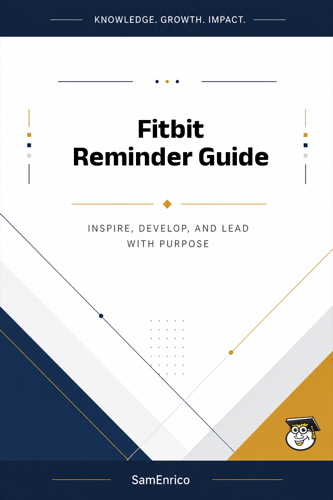
Free sample
Chapter 1: The 2 AM Rule--–- Sarah’s alarm clock read 2:00 AM, though she wasn’t awake to see it. Her Fitbit, strapped silently to her wrist, vibrated gently—a reminder she had set months ago for a nighttime bathroom break during a brief obsession with “optimized hydration.” She slept through it, as she had every night for the last ninety days. The device, ever faithful, would try again at 2:15 AM. It would not forget. It could not forget.
Unlike Sarah.This is the central irony of modern health technology: we buy sophisticated devices to track our bodies, then promptly forget they exist. According to internal data leaked from major wearables manufacturers, approximately 30% of fitness trackers are abandoned within six months, and over 50% within one year. The reason isn’t product failure—it’s memory failure. Not the Fitbit’s memory. Yours.The Forgetting Curve That’s Ruining Your Health Let me introduce you to a concept that will change how you think about every health goal you’ve ever set.
It’s called the forgetting curve, and it was first described by German psychologist Hermann Ebbinghaus in 1885. Here’s what he discovered: within one hour of learning new information, humans forget approximately 50% of it. Within 24 hours, we forget 70%. Within a week, unless we deliberately review the material, we retain barely 10% of what we originally learned.This isn’t a character flaw. It’s not laziness, stupidity, or a lack of willpower.
It’s how your brain is wired.Your brain evolved to prioritize survival threats (tiger in the bushes) and immediate rewards (ripe fruit on the tree), not abstract future goals (“I should walk 250 steps every hour to reduce my cardiovascular risk by 17% over the next decade”). Your hippocampus, the memory center of your brain, treats your 10 AM stand reminder the same way it treats the license plate of the car you parked behind yesterday: irrelevant, transient, forgettable.Sarah, our recurring protagonist throughout this book, learned this lesson the hard way. A 42-year-old marketing director with two children and a calendar that resembles a game of Tetris, Sarah bought her Fitbit Charge 6 with genuine enthusiasm. She set up reminders to move. She tracked her sleep.
She even posted a photo of her step count on social media. For three weeks, she was unstoppable.Then life happened.A client presentation ran long. Her daughter spiked a fever. She forgot to charge the Fitbit for two days. By week six, the device was still on her wrist, but she had stopped looking at the app.
By week ten, she ignored the “Reminders to Move” because she was in back-to-back meetings. By week twelve, she didn’t even feel the vibration anymore—her brain had learned to filter it out as irrelevant noise.Sarah’s story is not unusual. It is, in fact, the default outcome for most fitness tracker owners. But here’s the good news: the same forgetting curve that sabotages your intentions can be reverse-engineered to work in your favor. You just need to stop relying on your memory and start relying on something that never forgets.That something is your Fitbit.Decision Fatigue: Why You Quit Before You Start There’s a second psychological force working against you, and it’s even more insidious than the forgetting curve.
It’s called decision fatigue, and it explains why the healthiest version of you exists at 7 AM and the unhealthiest version emerges around 3 PM.Decision fatigue is the deterioration of your ability to make good choices after making many choices. Researchers have documented this phenomenon across dozens of settings: judges give harsher sentences as the day progresses, shoppers make worse purchasing decisions in the afternoon, and yes—people choose stairs less often and elevators more often after a long day of decisions.Every day, you wake up with a finite reservoir of willpower. Every choice you make—what to wear, which email to answer first, whether to have coffee or tea, how to respond to a difficult client—draws from that reservoir. By the time your Fitbit buzzes at 10 AM to remind you to stand, you’ve already made perhaps fifty small decisions. By 2 PM, you’ve made hundreds.
By 8 PM, your willpower reservoir is essentially empty.This is why you eat the cookie. This is why you skip the evening walk. This is why you tell yourself “I’ll start fresh tomorrow.” You’re not weak. You’re exhausted.The solution is not to build more willpower—that’s a fool’s errand. The solution is to eliminate decisions entirely.
And that’s precisely what a properly configured Fitbit does. When your watch vibrates at 10 AM, and you’ve trained yourself to stand up immediately without thinking, you’ve removed a decision. You’ve automated a behavior. You’ve conserved willpower for the things that actually matter.Introducing The Buzz Bridge: The Psychological Engine of This Book Every habit operates on a simple loop: cue → routine → reward. Charles Duhigg popularized this framework in The Power of Habit, and it’s been validated by decades of behavioral psychology research.
The cue triggers the behavior. The behavior produces the behavior. The reward reinforces the cue, making it stronger next time.Here’s where most people go wrong: they try to change the routine (the behavior itself) without understanding the cue. You tell yourself “I will walk more today,” but you haven’t established a reliable cue that triggers walking. You’re relying on memory and willpower—both of which fail you, as we’ve already established.Your Fitbit provides the perfect cue: a vibration on your wrist.
But a vibration is just a vibration unless it becomes what I call The Buzz Bridge—a conditioned stimulus that automatically triggers a desired behavior without conscious thought.You’ve already experienced the Buzz Bridge in other contexts. When your phone buzzes with a text message, do you consciously decide to look at it? Probably not. Your hand reaches for the phone before your conscious brain has even processed the vibration. That’s classical conditioning in action, the very same phenomenon Ivan Pavlov documented when he trained dogs to salivate at the sound of a bell.Pavlov’s dogs didn’t think, “Ah, I hear a bell, and that bell has historically preceded food, so I shall now produce saliva in anticipation of nourishment.” They just salivated.
The cue bypassed conscious thought entirely and triggered a physiological response directly.Your Fitbit can do the same thing for standing, walking, drinking water, breathing deeply, and going to bed on time. But only if you build the Buzz Bridge correctly. And that requires three things:A consistent cue – The same vibration pattern at the same time(s) every day An immediate routine – You perform the desired behavior within seconds of the vibration A satisfying reward – You feel good about performing the behavior (we’ll build this in later chapters)This chapter focuses on the first element: establishing the cue. Subsequent chapters will teach you how to chain multiple cues together, how to pair vibrations with environmental triggers, and how to maintain the Buzz Bridge long after the novelty has worn off.The 2 AM Metaphor: Why Your Fitbit Never Forgets…
This is the end of the free sample. Get the eBook to keep going. Buy now
About this book
Details
- Author
- Jasper Faustino
- Publisher
- SamEnrico
- Language
- English
- Genre
- Non-Fiction, Self-Help / Fitness
- Released
- 2026-06-06
- Pages (approx.)
- 160
- Available as
- eBook, Audiobook

Read better in the ZLOADR app
Your eBooks on your phone or tablet. Sign in with your SamEnrico account and start reading.
More by Jasper Faustino
 The Public HumiliationJasper Faustino$11.99
 Multitasking Myth Recovery GuideJasper Faustino$11.99
 Parent Death and DivorceJasper Faustino$11.99
 CrossFit JournalingJasper Faustino$11.99
 Romantic Relationship EQ GuideJasper Faustino$11.99
 The Quit Smoking Sleep ProtocolJasper Faustino$11.99
 Child Loss And Divorce RiskJasper Faustino$11.99
 Law School RecallJasper Faustino$11.99
 The Varangian Guard: Byzantium's Viking EliteJasper Faustino$11.99
 The Great Pacific Garbage Patch: A Plastic Ocean OdysseyJasper Faustino$11.99
 The Silent Assault: Swimming's Greatest Espionage FeatsJasper Faustino$11.99
 How to Start a Plastic Headgear (other Than Hard Hats) Made of Plastic Business (Beginners Guide)Jasper Faustino$11.99