
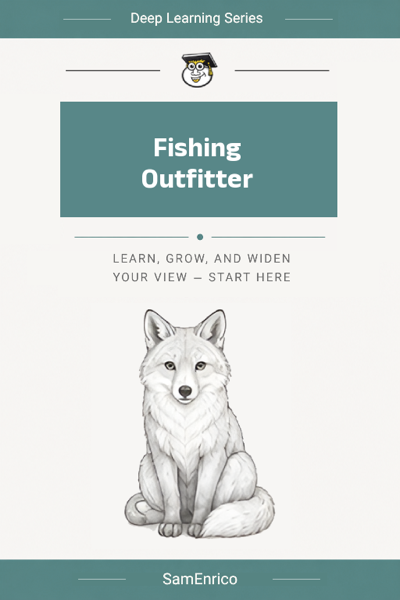
Non-FictionInformativeEducational
Fishing Outfitter eBook
A Coursebook on Fishing Outfitter
by Weaver Marie
A Coursebook on Fishing Outfitter
Formats
Free sample
Chapter 1: The Skunk That Saved Me--– I learned to build a business not on the days I landed fifty fish, but on the day I caught nothing and still had to pay my guides.The rain started at 4:00 AM, the kind of cold, sideways drizzle that doesn't just wet you but finds its way into your bones. I was twenty-seven years old, three years into running a fly-fishing guide service on Montana's Madison River, and I was already broke. Not metaphorically broke. Not "cash-flow negative" broke. I mean I had $412 in my personal checking account, a boat payment due in five days, and two guides expecting paychecks for a week of trips that had just been cancelled because the river blew out from snowmelt.I sat in my truck that morning, windshield fogged, coffee cold, and did something I had never done before.
I opened my laptop, navigated to the Small Business Administration's website, and looked up the word "bankruptcy."Chapter 7. Chapter 11. Chapter 13.I didn't know what any of them meant. I just knew I was running out of chapters.That morning, I made a decision that had nothing to do with fishing. I decided to stop being a guide who happened to run a business and start being a business owner who happened to guide.
Three years later, that business was doing seven figures annually. Five years after that, I sold it to my head guide for a price that let me retire at thirty-five.This book is not about how to catch more fish. There are already three thousand books on that subject, and most of them are written by people who have never had to make payroll during mud season. This book is about how to build a fishing outfitter that outlasts you—without losing your soul, your shirt, or your family.And it starts with understanding the single greatest lie in the outdoor industry.The Great Lie: "Do What You Love and the Money Will Follow"Every aspiring outfitter has heard this phrase. It is usually delivered by someone who has never run a small business, often at a cocktail party, always with a glass of wine in hand.
It is complete nonsense.Doing what you love is a prerequisite, not a strategy. The money does not follow. The money must be hunted, trapped, skinned, and tanned. And if you don't know how to do that, what you love will destroy you.I have watched this happen more times than I can count. A talented guide—let's call him Dave—decides to start his own outfit.
Dave can read water better than anyone I know. He can tie a fly that looks so real the fish probably file taxes on it. He has a truck, a drift boat, and twenty years of experience.Dave opens for business. He prices his trips at $400 per day because that's what everyone else charges. He prints business cards with a beautiful cutthroat trout on them.
He tells all his fishing buddies. They promise to book trips. Some of them do.Six months later, Dave is sleeping on his mother's couch.What happened? Dave did what he loved. He fished.
He guided. He was excellent at the water. But he had no idea how much it actually cost to run a boat per trip (fuel, insurance, amortization, maintenance). He had no marketing system beyond "tell your friends." He had no cancellation policy. He had no idea that his "profit" of 200pertripwasactuallyalossof200 per trip was actually a loss of 200pertripwasactuallyalossof50 when he accounted for vehicle depreciation and his own unpaid labor.Dave loved fishing.
Fishing did not love him back.The Two Wolves: Sportsman vs. Retailer Every outfitter has two wolves living inside them. The first wolf is the Sportsman. This wolf loves the sound of a reel screaming. It can name every hatch on every river within two hundred miles.
It believes that fishing is a spiritual practice, that the best clients become friends, and that money is somehow vulgar to discuss.The second wolf is the Retailer. This wolf loves inventory turns, profit margins, and the quiet satisfaction of a fully booked calendar. It knows that without cash flow, there are no trips. It understands that "exposure" does not pay for boat insurance. It is not ashamed to ask for a deposit.Most outfitters starve the Retailer and feed the Sportsman.
They feel guilty about marketing. They hesitate to raise prices. They give away trips to friends "just this once." They convince themselves that if they are good enough on the water, the business will somehow take care of itself.It will not.The outfitters who survive—who actually thrive—learn to feed both wolves. They understand that the Sportsman provides the why and the Retailer provides the how. Without the Sportsman, you are just a merchant selling access to water you don't love.
Without the Retailer, you are just a hobbyist with expensive gear and a bankruptcy filing.The rest of this chapter is about learning to hear both wolves—and to know which one to listen to when.The Case Study That Changed Everything: Leigh Perkins and Orvis In 1965, the Orvis company was dying. Founded in 1856 as a fly-fishing tackle manufacturer, Orvis had spent a century building a reputation for quality. But by the mid-1960s, the company was losing money, losing customers, and losing relevance. Big-box stores were selling cheaper rods. Mail-order catalogs were eating their lunch.
The brand was, in the words of one industry analyst, "a museum piece with a fishing problem."Then Leigh Perkins bought the company.Perkins was not a career fisherman. He was a businessman who happened to love the outdoors. And he did something that every outfitter in this book needs to study carefully. He did not try to compete on price. He did not try to match the big-box stores on selection.
Instead, he doubled down on authenticity—but not the fuzzy, sentimental kind. He doubled down on the economics of authenticity.Here is what Perkins actually did:First, he raised prices. Not a little. A lot. Orvis rods became some of the most expensive on the market.
Industry insiders called him crazy. They said no one would pay that much for a fishing rod when they could get a "good enough" rod at a discount store.Perkins understood something they didn't. He understood that price is not just a number—it is a signal. A high price signals quality, exclusivity, and commitment. It attracts a different kind of customer: one who values expertise, who is willing to pay for service, who is not shopping on price alone.Second, he built a community, not a customer list.
Perkins started the Orvis schools—fly-fishing courses taught by experts. He published a catalog that was half product listings and half storytelling. He wrote letters to customers that read like letters from a friend, not a corporation.Third, he aligned his business with conservation. Orvis became one of the first companies to donate a percentage of sales to habitat restoration. Not because it was nice.
Because it was smart. Conservation-minded customers became loyal customers. And loyal customers are dramatically more profitable than one-time buyers.The result?…
This is the end of the free sample. Get the eBook to keep going. Buy now
About this book
Details
- Author
- Weaver Marie
- Publisher
- SamEnrico
- Language
- English
- Genre
- Non-Fiction, Informative, Educational
- Released
- 2026-05-11
- Pages (approx.)
- 142
- Available as
- eBook, Audiobook

Read better in the ZLOADR app
Your eBooks on your phone or tablet. Sign in with your SamEnrico account and start reading.
More by Weaver Marie
 Low Carb For Type 1 DiabetesWeaver Marie$11.99
 Genetic Testing for Mental HealthWeaver Marie$11.99
 Core Belief Work Self Worth GuideWeaver Marie$11.99
 Cash Flow Planning For Business Plans GuideWeaver Marie$11.99
 Abolition of Samurai Class HandbookWeaver Marie$11.99
 Anansi's Shadow Network: The Spider’s Web of DeceptionWeaver Marie$11.99
 The Phantom Broadcast: The Secret War of Radio LibertyWeaver Marie$11.99
 Understanding Gianotti-crosti SyndromeWeaver Marie$17.99
 How to Start a Broadwoven Fabric Mills BusinessWeaver Marie$11.99
 B Corp Export GuideWeaver Marie$12.99
 Ingvar Kamprad Cash Frugality WorkbookWeaver Marie$12.99
You may also like
 Hong Kong Handover 1997Dunn Johnnie$11.99
 Zumba For Postnatal Recovery CourseNeal Christian$11.99
 Zumba for BeginnersLadner Nikia$11.99
 YouTube Comment Mining GuideHumes Pandora$12.99
 Worry Box MeditationCarlin Rudy$11.99
 Workplace Stress MeditationNguyen Lynn$11.99
 Workplace Stress and Sleep RepairHawley Ivory$11.99
 Workplace Perfectionism CureDelaney Jeffry$11.99
 Workplace Injustice Anger GuideWallen Isabelle$11.99
 Work Addiction and Burnout LinkGreenwood Ester$11.99
 Women in Yoga and WellnessBeattie Galina$11.99
 Women in Stand Up ComedyChun Evangeline$11.99