
Non-FictionHealth & WellnessSeafood
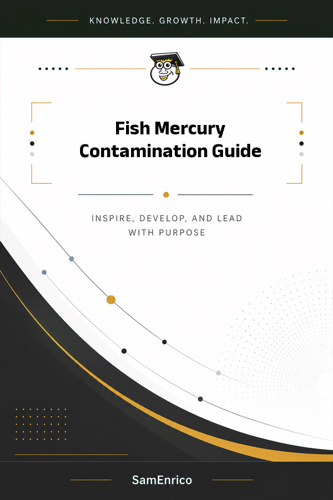
Fish Mercury Contamination Guide eBook
Teaches choosing low-mercury seafood and limiting
Teaches choosing low-mercury seafood and limiting tuna for pregnant women.
Formats
Free sample
Chapter 1: The Silent Passenger–- It arrives uninvited, hidden inside a meal you thought was healthy. You don’t see it. You don’t taste it. You don’t smell it. And by the time you might suspect its presence, it has already completed a remarkable and terrifying journey—from the ocean, into a fish, onto your plate, through your gut, across the most selective barrier in the human body, and finally into the quiet, rapidly developing world of your unborn child.This silent passenger is methylmercury, and understanding how it travels, where it comes from, and what it does once it arrives is the single most important step toward making safe seafood choices during pregnancy.
This chapter is not designed to alarm you. It is designed to arm you with knowledge. Because here is the truth that confuses even doctors and nutritionists: the very same fish that carry this neurotoxin also carry some of the most powerful brain-building nutrients known to science. You cannot simply fear all fish. You cannot simply trust all fish.
You must learn to distinguish, and that distinction begins with the chemistry of a poison that behaves like no other.The Metamorphosis of Mercury To understand methylmercury, you must first understand its origin story. Mercury is a naturally occurring element found in the Earth’s crust, but human activity has dramatically accelerated its release into the environment. Coal-fired power plants are the largest single source, accounting for approximately 65 percent of anthropogenic mercury emissions globally, according to the United Nations Environment Programme. When coal burns, the mercury trapped inside—present in trace amounts in virtually all coal seams—is released as elemental mercury vapor. That vapor rises into the atmosphere, where it can travel thousands of miles on prevailing winds.
It then falls back to Earth in rain and snow, landing in rivers, lakes, and oceans.Once mercury enters aquatic environments, a critical transformation occurs. In the oxygen-deprived sediments at the bottom of bodies of water, certain anaerobic bacteria—mostly sulfate-reducing bacteria—convert inorganic mercury into methylmercury through a process called methylation. This is the chemical metamorphosis that changes everything. Inorganic mercury is toxic but does not easily enter the food chain or cross biological barriers. Methylmercury is a different beast entirely.
It is the form that bioaccumulates, that biomagnifies, and that slips through the placenta as if the door were held open for it.The chemistry is straightforward but revealing. Methylmercury has the chemical formula CH₃Hg⁺, meaning a single carbon atom bonded to three hydrogen atoms (a methyl group) attached to a mercury atom with a positive charge. This structure makes it both lipid-soluble (able to cross cell membranes) and protein-binding (able to attach to amino acids). This dual personality is what makes methylmercury so effective at infiltrating the human body and, more critically, the fetal brain.The Arithmetic of Biomagnification Here is where the numbers become sobering. Methylmercury is absorbed by phytoplankton and algae at the base of the marine food web.
A single algal cell contains an almost immeasurable amount—measured in parts per quadrillion. But algae multiply by the billions, and the tiny crustaceans called zooplankton graze on them continuously. Each zooplankton consumes thousands of algal cells, and with each meal, mercury accumulates. The concentration ratio from water to phytoplankton is approximately 1,000 to 1. From phytoplankton to zooplankton, another 10 to 1.
From zooplankton to small fish like herring and anchovies, another 5 to 1.This process is called biomagnification, and it follows a relentless arithmetic progression. Each step up the food chain multiplies the mercury concentration by a factor of three to ten. Small fish eat zooplankton. Medium fish eat small fish. Large predatory fish eat medium fish.
And at the top of the aquatic food chain, fish like tuna, swordfish, shark, and king mackerel have been accumulating mercury for years or decades.Consider the actual numbers. According to FDA testing data, a wild salmon contains approximately 0.022 parts per million of mercury on average. A sardine contains approximately 0.013 parts per million. A skipjack tuna (the species most commonly canned as “light tuna”) contains approximately 0.12 parts per million—about six times higher than salmon. An albacore tuna (canned as “white tuna”) contains approximately 0.35 parts per million—about sixteen times higher than salmon.
A swordfish contains approximately 0.98 parts per million—about forty-five times higher than salmon. And a bigeye tuna (the deep-red flesh used in high-end sushi) can exceed 1.2 parts per million—more than fifty times higher than salmon.These numbers are not abstract. When a pregnant woman eats a six-ounce serving of swordfish, she consumes approximately 166 micrograms of methylmercury. When she eats a six-ounce serving of salmon, she consumes approximately 3.4 micrograms. The swordfish meal delivers nearly fifty times more mercury.
That is biomagnification in action, and it is the single most important scientific concept driving every recommendation in this book.The Trojan Horse at the Placenta Now we arrive at the most critical passage in this chapter, because it explains why the placenta—which protects the fetus from so many toxins and pathogens—fails spectacularly against methylmercury.Approximately 95 percent of ingested methylmercury is absorbed from the human digestive tract into the bloodstream. Once in circulation, it binds tightly to the amino acid cysteine, forming a complex called cysteine-methylmercury. This complex is structurally almost identical to methionine, an essential amino acid that the human body cannot synthesize and must obtain from food. Methionine is critical for fetal growth; it is one of the building blocks of proteins and serves as the precursor for other essential molecules.The placenta is equipped with specialized transport proteins called neutral amino acid transporters, specifically the system L transporters. Their biological function is to recognize methionine and other neutral amino acids in the mother’s blood and actively shuttle them across the placental barrier into the fetal circulation.
Without these transporters, the fetus would starve for essential amino acids. They are the gatekeepers of fetal nutrition.But these transporters are not intelligent. They do not discriminate based on intent or safety. They recognize shape, and the cysteine-methylmercury complex is shaped almost exactly like methionine. The transporters pick it up and deliver it directly to the baby, often with even greater efficiency than they deliver the real nutrient.
Research published in the journal Toxicological Sciences has shown that fetal cord blood mercury levels are typically 1.5 to 2 times higher than maternal blood levels. The placenta is not a barrier against mercury. It is an amplifier.Once in the fetal bloodstream, the same trick repeats at the blood-brain barrier, which is structurally similar to the placental barrier. The same neutral amino acid transporters carry the cysteine-methylmercury complex from the fetal blood into the developing brain. The mercury is now exactly where it causes the most damage—inside the organ that is growing faster and more complexly than any other part of the fetal body.The cruel irony is overwhelming.
The same transport system that evolved over hundreds of millions of years to nourish the fetal brain has been hijacked by an industrial pollutant. The baby receives mercury in the same delivery system that brings essential nutrients. This is not a failure of the placenta. It is a success of chemistry—the chemistry of a molecule that…
This is the end of the free sample. Get the eBook to keep going. Buy now
About this book
Details
- Author
- Strunk Tracee
- Publisher
- SamEnrico
- Language
- English
- Genre
- Non-Fiction, Health & Wellness, Seafood
- Released
- 2026-06-10
- Pages (approx.)
- 114
- Available as
- eBook, Audiobook

Read better in the ZLOADR app
Your eBooks on your phone or tablet. Sign in with your SamEnrico account and start reading.
More by Strunk Tracee
 Moving and Children's DreamsStrunk Tracee$11.99
 FODMAP And Gas Reduction GuideStrunk Tracee$11.99
 Bipolar in MenStrunk Tracee$11.99
 Electronics Off Gassing PreventionStrunk Tracee$11.99
 Transcendental Meditation for MusiciansStrunk Tracee$11.99
 Sam Sheppard Physical EvidenceStrunk Tracee$11.99
 Arthritis Surgical OptionsStrunk Tracee$11.99
 Hedge Fund Manager StressStrunk Tracee$11.99
 The Starlight Seekers: New Zealand’s Quest for Cosmic DiscoveryStrunk Tracee$11.99
 The Forgotten Architect of the Bomb: How a Polish Genius Shaped the Atomic AgeStrunk Tracee$11.99
 Pandamonium: The Great San Diego Zoo BreakoutStrunk Tracee$11.99
 Keyword Research for Paid MediaStrunk Tracee$11.99
You may also like
 Hong Kong Handover 1997Dunn Johnnie$11.99
 Zumba For Postnatal Recovery CourseNeal Christian$11.99
 Zumba for BeginnersLadner Nikia$11.99
 YouTube Comment Mining GuideHumes Pandora$12.99
 Worry Box MeditationCarlin Rudy$11.99
 Workplace Stress MeditationNguyen Lynn$11.99
 Workplace Stress and Sleep RepairHawley Ivory$11.99
 Workplace Perfectionism CureDelaney Jeffry$11.99
 Workplace Injustice Anger GuideWallen Isabelle$11.99
 Work Addiction and Burnout LinkGreenwood Ester$11.99
 Women in Yoga and WellnessBeattie Galina$11.99
 Women in Stand Up ComedyChun Evangeline$11.99