
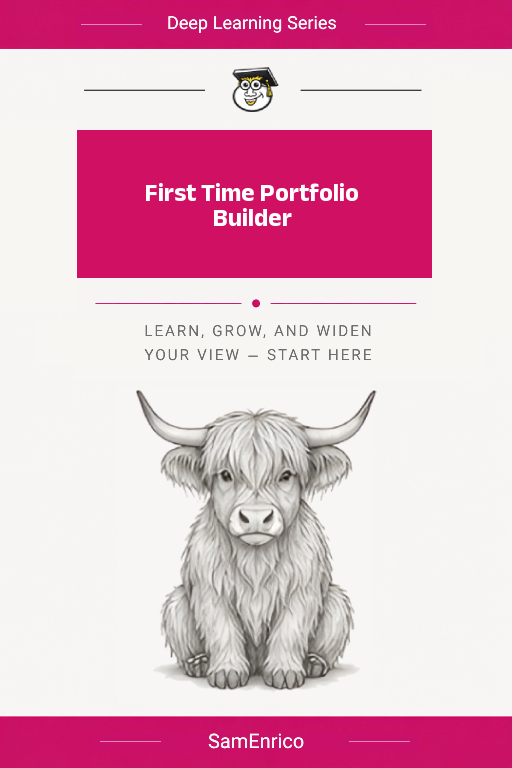
Non-FictionZero-to-One CreatorConfidence Workbook
First Time Portfolio Builder eBook
Navigate the anxiety of creating your first profes
by Eaton Blake
Navigate the anxiety of creating your first professional portfolio. This workbook includes confidence-building exercises, project generators, and rejection-proof presentation templates.
Formats
Free sample
Chapter 1: The Already-Done Inventory--–- You are not starting from zero. You are starting from a pile of evidence you have been taught not to see.Let me say that again, because your inner critic is already screaming a rebuttal: You have work. You just don’t recognize it as work.This chapter exists to fix that recognition problem. By the time you finish reading these pages and completing the exercises, you will have identified between five and ten legitimate portfolio pieces. You will not have created anything new.
You will simply have opened your eyes to what has been sitting in front of you for months or years.And that shift – from “I have nothing” to “I have more than I realized” – is the single most important move you will make in this entire book. Everything else builds on this foundation.The Lie You Have Been Told About “Real Work”Here is a quiet cultural lie that has cost millions of people their confidence: Real work happens inside formal structures with titles, paychecks, and deliverables approved by someone above you.This lie is taught in schools (your homework doesn’t count until it’s graded), reinforced in entry-level job listings (“2–3 years of experience required”), and weaponized by imposter syndrome (“That doesn’t belong in a portfolio – it was just a favor for a friend”).Let me be explicit about what counts as portfolio-worthy material according to the people who actually hire and review portfolios (not the ones selling you courses):Class projects – especially ones where you solved an ambiguous problem Volunteer work – flyers, spreadsheets, event coordination, social media posts Fixing something for a friend – a resume rewrite, a website glitch, a confusing instruction manual Personal experiments – a blog you started and abandoned, a meal you planned and executed, a room you rearranged for better flow Failed attempts – projects that taught you something valuable even though they didn’t “succeed”Process documentation – notes, sketches, drafts, emails showing how you think Compliments you have received – if someone praised a specific thing you did, that thing belongs in your inventory The only requirement is that you did something. Not that you got paid. Not that you had a title. Not that it was perfect.The Anxiety Mapping Exercise: Name the Fear Before It Names You Before we dig into your inventory, we need to address the elephant in the room: the fear that got you to pick up this book in the first place.
Most portfolio paralysis is not about a lack of material. It is about a fear of exposure.Take out a piece of paper or open a new note. Answer these three questions as honestly as you can. There is no wrong answer.Question 1: What is the worst thing that could happen if you shared your portfolio right now?Be specific. Do not write “people will judge me.” Write what the judgment sounds like.
For example: “They will say my work looks amateur.” “They will think I don’t belong in this field.” “They will compare me to someone younger and better.”Question 2: Where did this fear come from?Trace it back. Was there a specific criticism you received? A comparison someone made? A rejection letter that stung? A voice from childhood that told you not to be seen?
Name the source. Not to blame it – to understand it.Question 3: What would you need to believe to feel calm about sharing your work?For example: “That everyone starts somewhere.” “That showing process is as valuable as showing polish.” “That the right people will see potential, not perfection.”Keep this paper. You will return to it in Chapter 3 when we build your pre-portfolio ritual. For now, you have simply named the opponent. That is the first step to disarming it.The “Already Done” Inventory: Your Hidden Portfolio Now we get to the core of this chapter.
The Already Done Inventory is a systematic method for surfacing work you have already completed but have not categorized as “portfolio material.”Set a timer for 20 minutes. Work through the following six categories one by one. Do not judge. Do not edit. Do not say “that’s too small” or “that doesn’t count.” Just write.Category 1: Formal projects with clear deliverables These are the easiest to spot.
List any project where someone asked you to produce something specific with a deadline. Examples:A presentation you built for work or school A report you wrote A spreadsheet you designed An event you planned A product you built (physical or digital)A lesson you taught Even if you hated the project. Even if it was boring. Even if you barely passed. Write it down.Category 2: Informal fixes and problem-solving This is where most people miss their best work.
List any time someone asked for your help and you solved something. Examples:You fixed a friend’s resume You debugged a parent’s computer You organized a shared drive that was chaos You rewrote confusing instructions You mediated a disagreement You figured out a faster way to do a repetitive task These show resourcefulness, empathy, and practical intelligence – three things hiring managers would kill to see in a portfolio.Category 3: Compliments you have received Go through your email, text messages, and memory. Any time someone said something specific about your work, write down what they praised. Examples:“That email was so clear.”“You saved us so much time.”“I love how you explained that.”“You’re the only one who could have fixed that.”The compliment itself is not the portfolio piece. The thing you did that earned the compliment is the piece.
Write down the action, not just the praise.Category 4: Personal experiments and learning projects List any time you tried something just to see if you could do it. Examples:You taught yourself a software tool You followed a tutorial and built something You redesigned a bad menu at a local restaurant (even if you never showed them)You wrote a sample of the kind of work you want to do You recorded yourself practicing a skill These show initiative, curiosity, and self-directed learning – traits that often matter more than formal experience.Category 5: Failures that taught you something This category is non-negotiable. List at least two things you tried that did not work out the way you hoped. Examples:A project that was rejected A plan that fell apart A skill you tried to learn and struggled with A pitch that got no response Here is the secret: failures become valuable portfolio material when you can articulate what you learned. A failed project with a thoughtful reflection is often more impressive than a flawless project with no reflection.Category 6: Things you organized, improved, or maintained This is the invisible infrastructure work that keeps families, teams, and communities running.
Examples:You created a shared calendar system You maintained a household budget You kept a group chat on track You archived old files You labeled a storage system Do not dismiss these as “not real work.” Organization and maintenance skills transfer directly to project management, operations, and administrative roles.The Documentation Step: From Invisible to Visible You have a list. Now you need to turn that list into…
This is the end of the free sample. Get the eBook to keep going. Buy now
About this book
Details
- Author
- Eaton Blake
- Publisher
- SamEnrico
- Language
- English
- Genre
- Non-Fiction, Zero-to-One Creator, Confidence Workbook
- Released
- 2026-06-01
- Pages (approx.)
- 126
- Available as
- eBook, Audiobook

Read better in the ZLOADR app
Your eBooks on your phone or tablet. Sign in with your SamEnrico account and start reading.
More by Eaton Blake
 NVC for Social WorkersEaton Blake$11.99
 Wandering Attention FixEaton Blake$11.99
 Proofreading for Persuasion GuideEaton Blake$11.99
 Maternal Anger UnpackedEaton Blake$11.99
 Wise Old Man Dream FigureEaton Blake$11.99
 Folate Pregnancy Nutrition GuideEaton Blake$11.99
 Young Adult Cancer SurvivorEaton Blake$11.99
 Elijah Wood RingEaton Blake$11.99
 Crossed Arms Deception ClueEaton Blake$11.99
 Eclipsed by Shadows: The Forgotten Rivalry of Plato and IsocratesEaton Blake$11.99
 The Golden Quill of Timbuktu: Ahmed Baba and the Legacy of African ScholarshipEaton Blake$11.99
 Ragnarök in the Sands: Odin’s Quest for the Egyptian Sun DiskEaton Blake$11.99
You may also like
 Hong Kong Handover 1997Dunn Johnnie$11.99
 Zumba For Postnatal Recovery CourseNeal Christian$11.99
 Zumba for BeginnersLadner Nikia$11.99
 YouTube Comment Mining GuideHumes Pandora$12.99
 Worry Box MeditationCarlin Rudy$11.99
 Workplace Stress MeditationNguyen Lynn$11.99
 Workplace Stress and Sleep RepairHawley Ivory$11.99
 Workplace Perfectionism CureDelaney Jeffry$11.99
 Workplace Injustice Anger GuideWallen Isabelle$11.99
 Work Addiction and Burnout LinkGreenwood Ester$11.99
 Women in Yoga and WellnessBeattie Galina$11.99
 Women in Stand Up ComedyChun Evangeline$11.99