
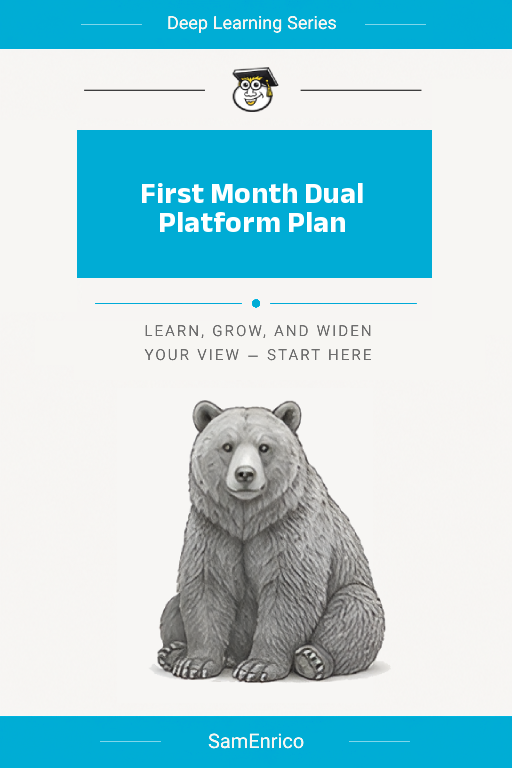
Non-FictionFirst 30 DaysDual PlatformClient Acquisition
First Month Dual Platform Plan eBook
Apply to projects on Upwork and Fiverr simultaneou
Apply to projects on Upwork and Fiverr simultaneously for 30 days to find your fastest-paying channel.
Formats
Free sample
Chapter 1: The Tiger's Teeth...--Most freelancers discover the truth too late. They spend months—sometimes years—building a profile on a single platform, collecting five-star reviews, climbing the algorithm's favor, and convincing themselves they have built a stable business. Then one morning they wake up to an email: "Your account has been suspended." Or: "We have updated our fee structure." Or, most terrifying of all: silence—their messages simply stop sending because an algorithm change has buried them on page fifty of search results.This is not a cautionary tale. This is the new normal of the Tiger Economy.The term "Tiger Economy" was originally used to describe the rapid, volatile growth of certain Asian markets in the late twentieth century—economies that grew ferociously fast but could also turn and bite investors without warning. Today, the same metaphor applies to freelancing platforms.
Upwork and Fiverr are tigers. They are powerful, hungry, and capable of providing extraordinary opportunities. But they are also wild. They do not owe you loyalty. They will change their rules overnight, and you will have no recourse.
The only freelancers who survive are those who refuse to build their homes on a single riverbank.This book exists because of a painful truth buried inside the data of failed freelancers. According to internal metrics shared by platform veterans, approximately forty percent of new freelancers on Upwork never win their first project. On Fiverr, the numbers are worse: less than twenty percent of new gigs ever receive an order. But here is the detail that the platforms do not advertise: among freelancers who simultaneously maintain active profiles on both Upwork and Fiverr, the success rate in the first ninety days jumps to nearly sixty-five percent. The reason is not mysterious.
Diversification works. When one platform's algorithm suppresses you, the other platform's clients can still find you. When Upwork introduces a new bidding fee, Fiverr's flat commission structure remains predictable. The dual-platform freelancer is not smarter or more talented. They are simply playing a different game.The Tiger has teeth.
This chapter teaches you to see them, respect them, and build a strategy that works regardless of which direction the Tiger turns.The Illusion of Platform Loyalty Every freelancing platform wants you to believe that loyalty is rewarded. Upwork has its "Top Rated" and "Expert-Vetted" badges. Fiverr has its "Level One," "Level Two," and "Pro Seller" tiers. These badges create a sense of progression, a ladder to climb. They are not meaningless—they do confer algorithm benefits and client trust.
But they are also cages. The moment you believe that your career lives inside one platform's badge system, you have surrendered control of your income to a company that does not know your name.Consider what happened on Upwork in 2023 when the platform introduced "Connects" bidding for virtually all jobs. Freelancers who had previously applied to dozens of jobs per week for free suddenly faced a new cost structure. Many had to reduce their application volume by seventy percent. Their income dropped accordingly.
There was no warning. There was no grandfathering. There was simply a new rule, and thousands of freelancers woke up poorer.Consider what happened on Fiverr in 2022 when the platform changed its search algorithm to prioritize "promoted gigs." Freelancers who had spent years building organic search rankings suddenly found themselves buried beneath paid listings. Their only option was to pay for promotion themselves, compressing their already thin margins. Again, no warning.
Again, no recourse.These are not anomalies. These are the natural behavior of for-profit marketplaces. Upwork and Fiverr are publicly traded companies with shareholders. Their primary obligation is to maximize shareholder value, not to protect your income. When you build your entire freelancing business on a single platform, you are building on rented land.
The landlord can change the rent at any time.The dual-platform freelancer understands this. They use Upwork and Fiverr as channels, not as homes. They maintain profiles on both platforms not because they enjoy the extra work, but because they refuse to be vulnerable to a single algorithm change. When Upwork raises its fees, the dual-platform freelancer shifts volume to Fiverr. When Fiverr changes its search algorithm, the dual-platform freelancer increases their Upwork bidding.
The Tiger still bites, but it bites a diversified portfolio, not a single point of failure.The Psychological Divide: Bidders Versus Shoppers To succeed in the Dual-Platform Sprint, you must understand a fundamental psychological distinction that most freelancers never consciously recognize. Upwork clients and Fiverr clients are not the same species of buyer. They arrive at their respective platforms with different mental models, different expectations, and different decision-making processes.Upwork clients are bidders. They have a problem. They post a job description, often with a budget range or an hourly rate.
Then they sit back and wait for proposals to arrive. Their mindset is similar to a hiring manager reviewing resumes. They are comparison shopping. They will read ten, twenty, or fifty proposals before making a decision. They are looking for the best combination of price, experience, and communication style.
They value detailed proposals, relevant samples, and evidence of past success. They are slow to decide but, once committed, tend to be loyal to freelancers who perform well.The Upwork client is asking: "Which of these people is most likely to solve my problem correctly?" They are risk-averse. They have been burned before by freelancers who overpromised and underdelivered. They want to see that you understand their specific situation. Generic proposals are deleted instantly.Fiverr clients are shoppers.
They have a problem, but they do not post a job description. Instead, they type a keyword into a search bar—"logo design," "article writing," "virtual assistant"—and browse the results like they are scrolling through Amazon. They compare gig images, prices, delivery times, and reviews. Their mindset is transactional. They want to click a button, pay with a credit card, and receive a finished product.
They value speed, visual appeal, and social proof. They decide quickly, often in under sixty seconds, but they have lower loyalty because switching to another gig is as easy as another click.The Fiverr client is asking: "Which of these options looks most appealing right now?" They are not conducting a hiring process. They are shopping. They will choose based on the gig image that catches their eye, the price that seems reasonable, and the delivery time that feels fast enough. They rarely read long descriptions.
They almost never click away from the first page of search results.Understanding this psychological divide changes everything about how you present yourself. On Upwork, you are a candidate. Your proposal must look like a cover letter. On Fiverr, you are a product. Your gig must look like a listing.
Many freelancers fail because they treat Upwork like Fiverr (sending short, informal proposals) or treat Fiverr like Upwork (writing long, formal gig descriptions that nobody reads). The Dual-Platform Sprint teaches you to speak both languages fluently.The 30-Day Sprint Mindset The single biggest mistake new freelancers make is treating their first month on a platform as the beginning of a long-term career. They worry about their long-term reputation. They worry about whether a five-dollar job will damage their…
This is the end of the free sample. Get the eBook to keep going. Buy now
About this book
Details
- Author
- Pease Rosaline
- Publisher
- SamEnrico
- Language
- English
- Genre
- Non-Fiction, First 30 Days, Dual Platform, Client Acquisition
- Released
- 2026-05-29
- Pages (approx.)
- 129
- Available as
- eBook, Audiobook

Read better in the ZLOADR app
Your eBooks on your phone or tablet. Sign in with your SamEnrico account and start reading.
More by Pease Rosaline
 Persuasive Sponsorship DeckPease Rosaline$11.99
 Sibling Cancer StoryPease Rosaline$11.99
 Manganese Bone Health GuidePease Rosaline$11.99
 NVC for UX DesignersPease Rosaline$11.99
 Interruption BudgetPease Rosaline$11.99
 The Stress and Celiac LinkPease Rosaline$11.99
 Mandala Dream Symbol GuidePease Rosaline$11.99
 Interview Body Language GuidePease Rosaline$11.99
 Christian Bale MachinistPease Rosaline$11.99
 The Codebreaker's Gambit: Alan Turing's War and LegacyPease Rosaline$11.99
 Timur the Lame: The Bloodstained Conquest of Delhi (1398)Pease Rosaline$11.99
 The Silk and Gold Merchants: How African Traders Built a Global EmpirePease Rosaline$11.99
You may also like
 Hong Kong Handover 1997Dunn Johnnie$11.99
 Zumba For Postnatal Recovery CourseNeal Christian$11.99
 Zumba for BeginnersLadner Nikia$11.99
 YouTube Comment Mining GuideHumes Pandora$12.99
 Worry Box MeditationCarlin Rudy$11.99
 Workplace Stress MeditationNguyen Lynn$11.99
 Workplace Stress and Sleep RepairHawley Ivory$11.99
 Workplace Perfectionism CureDelaney Jeffry$11.99
 Workplace Injustice Anger GuideWallen Isabelle$11.99
 Work Addiction and Burnout LinkGreenwood Ester$11.99
 Women in Yoga and WellnessBeattie Galina$11.99
 Women in Stand Up ComedyChun Evangeline$11.99