
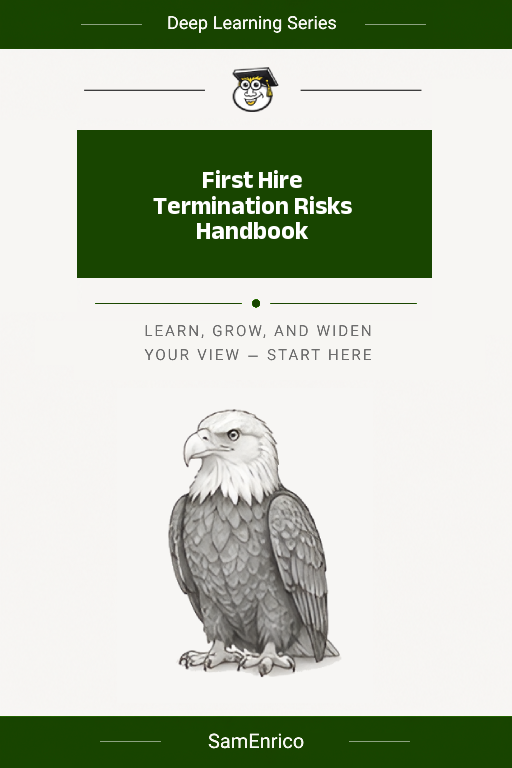
First Hire Termination Risks Handbook eBook
Fire your first employee without lawsuits by avoid
Fire your first employee without lawsuits by avoiding retaliation, discrimination, and contract breach pitfalls.
Formats
Free sample
Chapter 1: The $50,000 Handshake--–- You just fired your first employee. You shook hands, wished them well, and felt a wave of relief wash over you. Three months later, that handshake costs you fifty thousand dollars.This is not a hypothetical nightmare. It happens every single day to founders who believed they were doing everything right. They followed their gut.
They trusted their instincts. And they learned the hard way that in employment law, memory is not evidence, verbal agreements become contracts, and the friend you hired over coffee can become the plaintiff who takes everything you have built.I wrote this book because I have watched too many first-time founders walk into the same legal traps. They hire their first employee with enthusiasm and zero paperwork. They manage with verbal feedback and good intentions. When things go wrong, they fire quickly, hoping to rip off the bandage and move on.
Then the lawsuit arrives, and suddenly they are learning about "wrongful termination" and "retaliation claims" from a lawyer who charges four hundred dollars an hour.The purpose of this chapter—and this entire book—is to ensure that does not happen to you. But before we can build your defenses, we need to understand exactly what you are defending against. And that starts with demolishing the most dangerous myth in American employment law: the belief that "at-will employment" means you can fire anyone, anytime, for any reason, with complete immunity.The Conversation That Changed Everything Let me tell you about Daniel. He founded a small software company in Denver. His first hire was a childhood friend, someone he trusted completely.
There was no employment agreement, no signed handbook acknowledgment, no written performance standards. They were friends. They would figure it out as they went.Eighteen months later, the friendship had frayed. The employee was coming in late, missing deadlines, and arguing with Daniel about direction. Daniel tried to address it verbally.
They had conversations in the kitchen, over text messages, during late nights at the office. Nothing changed.Finally, Daniel had enough. He called his friend into his office and said, "I'm sorry, but this isn't working out. You know I care about you, but I have to let you go."His friend replied, "You can't do this to me. You promised me equity.
You said we were partners."Daniel shrugged it off. They were at-will employees. He could fire anyone for any reason.Six months later, Daniel was served with a lawsuit. His former friend—his first hire—was suing for breach of contract, claiming that Daniel's verbal promises of equity created a binding agreement. He was also suing for discrimination, alleging that Daniel had treated him differently after learning about a medical condition.
And he was suing for retaliation, pointing to a complaint he had made about safety conditions three weeks before his termination.Daniel spent forty-seven thousand dollars on legal fees before the case settled. His friend walked away with thirty thousand dollars and a non-disclosure agreement. Daniel walked away with a permanent mistrust of hiring and a cautionary tale that he now shares with every founder he meets.The tragedy of Daniel's story is that it was entirely preventable. Not because his friend's claims were invalid—some of them may have had merit—but because Daniel had created so much legal exposure through casual statements, undocumented conversations, and a fundamental misunderstanding of at-will employment.What At-Will Employment Actually Means (And Does Not Mean)Let us start with a clear definition. At-will employment is the default employment relationship in forty-nine states.
Montana is the only exception. Under at-will employment, either the employer or the employee can end the employment relationship at any time, for any reason, or for no reason at all, with or without notice.That sounds powerful. It sounds like it gives you, the employer, complete freedom to fire anyone whenever you want.But here is what the definition does not say. It does not say you can fire someone for an illegal reason. It does not say you can fire someone in a way that breaches an implied contract.
It does not say you can fire someone to deprive them of earned benefits. And it does not say you can fire someone in retaliation for engaging in protected activity.Those exceptions are not loopholes. They are not technicalities that clever lawyers use to trap unsuspecting founders. They are fundamental principles of employment law that have been developed over decades of court decisions and legislative action. And they apply to every single at-will employer in the country.Think of at-will employment as a default setting on your computer.
The default setting works fine until you install software that changes it. Implied contracts, discrimination laws, retaliation protections, and public policy exceptions are the software that overrides the default. Once any of those come into play, the at-will setting becomes irrelevant.The Three Legal Traps That Destroy At-Will Protection After analyzing hundreds of wrongful termination cases involving first-time employers, I have identified three categories of legal traps that most commonly undermine at-will employment. These are not obscure legal theories. They are well-established doctrines that have been applied in thousands of cases.
But founders almost never learn about them until they are already named as defendants.Trap One: The Implied Contract An implied contract is exactly what it sounds like—a contract that was never written down and never explicitly stated, but that a court finds was created by the words and actions of the parties.Here is how this destroys at-will employment. You tell your first employee, "You have a future here." You say, "We're like a family." You promise, "As long as you perform, you have a job." None of these statements include the word "contract." None of them mention terms like "just cause" or "termination only for misconduct." But courts have repeatedly found that statements like these create an implied promise that the employee will only be fired for good reason.The logic works like this. The employee hears your statement and reasonably relies on it. They turn down other job offers. They invest time and energy in your company.
They develop skills specific to your business. When you fire them without what they consider a good reason, they feel betrayed. And the legal system gives them a way to act on that feeling.I have reviewed case after case where a founder's casual, well-intentioned words became the centerpiece of a wrongful termination lawsuit. A restaurant owner in Chicago told his sous chef, "You're my right hand. I've got your back." When he fired the sous chef for chronic lateness two years later, the court refused to dismiss the case because a jury might find that statement created an implied contract of job security.The solution is not to become cold or distant with your employees.
The solution is to understand that your words have legal weight, and to structure your communications accordingly.Trap Two: The "Don't Be a Jerk" Rule The covenant of good faith and fair dealing has a fancy legal name, but it boils down to something simple and intuitive: you cannot act in bad faith to deprive an employee of benefits they…
This is the end of the free sample. Get the eBook to keep going. Buy now
About this book
Details
- Author
- Valles Jeannetta
- Publisher
- SamEnrico
- Language
- English
- Genre
- Non-Fiction, Business Brief, Employment Law
- Released
- 2026-05-29
- Pages (approx.)
- 136
- Available as
- eBook, Audiobook

Read better in the ZLOADR app
Your eBooks on your phone or tablet. Sign in with your SamEnrico account and start reading.
More by Valles Jeannetta
 Senior Body Image GuideValles Jeannetta$11.99
 Certification After LayoffValles Jeannetta$11.99
 Fibromyalgia Sleep GuideValles Jeannetta$11.99
 From Stage to MicValles Jeannetta$11.99
 Stress and Mold SensitivityValles Jeannetta$11.99
 Creative Habits for CodersValles Jeannetta$11.99
 Pelvic Floor Physical TherapyValles Jeannetta$11.99
 The Growth Mindset for FinanceValles Jeannetta$11.99
 The Cosmic Symphony: How Voyager 1's Golden Record Connected Humanity to the StarsValles Jeannetta$11.99
 Love on the Track: The Wartime Romance That Revolutionized Sports ScienceValles Jeannetta$11.99
 How to Start a Cotton Opening Business (Beginners Guide)Valles Jeannetta$11.99
 A Collector's Handbook to the Triumph Vitesse FourteenValles Jeannetta$11.99
You may also like
 Franchising Your Local Brand Across Borders Workforce LawsMcmahan Desire$11.99
 Employment Practices LiabilityCorbitt Danyel$11.99
 Remote Termination Compliance ManualWebber Shalon$12.99
 Moonlighting and Second Job Risks WorkbookTalley Burl$12.99
 Independent Contractor Trap GuideSchuler Ardath$12.99
 Independent Contractor Reclassification Risk WorkbookBarlow Emmie$12.99
 Contractor Classification GuideBean Carol$12.99
 At-Will Employment Exceptions HandbookHwang Shayne$12.99
 Joint Employer Liability Risks WorkbookMoll Merissa$12.99
 First Hire Independent Contractor TrapMchenry Carmelita$12.99
 Employee Classification Traps ManualVanover Dominique$12.99
 First Hire Legal Traps Every Owner MissesLeone Olevia$12.99