
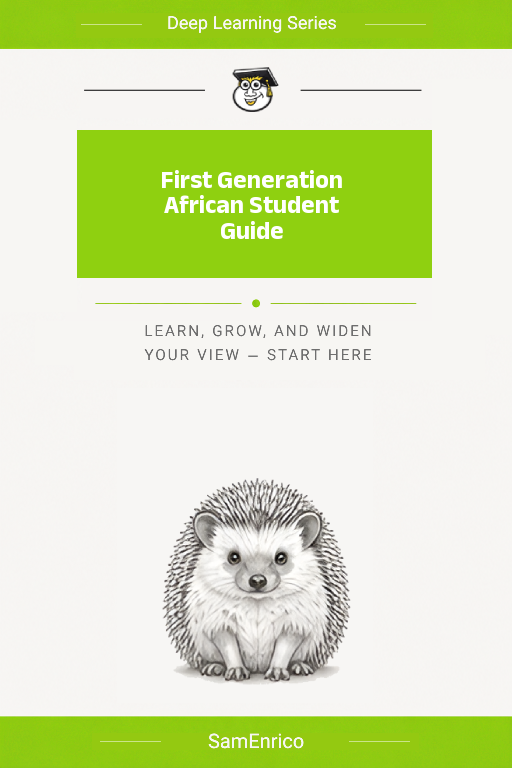
First Generation African Student Guide eBook
Navigate scholarships without family guidance, wit
Navigate scholarships without family guidance, with mentoring resources and application strategies for first-generation African students pursuing degrees abroad.
Formats
Free sample
Chapter 1: The Orphanhood of Information...-- The first time you search for "scholarships for African students," the internet gives you 47 million results. You click the first link. It asks for an application fee you cannot afford. You click the second. The deadline was three months ago.
You click the third. It requires a letter from a "community leader" but you do not know what that means in a Western context. By the eighth click, you close your laptop. The weight in your chest is not just disappointment. It is the quiet, crushing realization that everyone else seems to have a map, and you are walking through a forest with no paths, no landmarks, and no one to call when the sun goes down.This feeling has a name.
It is called the orphanhood of information.You were not born without parents. You were not raised without a village. But when it comes to the specific, peculiar, high-stakes world of international scholarships—of personal statements, recommendation letters, GPA conversions, visa interviews, and conditional offers—you are, effectively, an orphan. No one in your family has done this before. No one in your extended family has a cousin who studied abroad and came back with a binder full of templates.
Your high school teachers are brilliant, underpaid, and overworked, but they have never written a letter for an American university. Your pastor, your uncle, your neighbor who "knows someone who knows someone"—they offer prayers and good intentions, but they cannot tell you the difference between a Fulbright and a Chevening, or why your Second Class Upper might actually be an advantage if you tell the right story.This chapter is not about scholarships. Not yet. This chapter is about the thing that kills more dreams than bad grades or missing documents. It is about the belief that because you lack connections, you lack a chance.
And it is about why that belief is a lie—a comfortable, seductive lie that allows you to stop trying before you have even begun.The Myth of the Connected Student Walk into any university common room in Lagos, Nairobi, Accra, or Johannesburg, and ask a hundred students why they have not applied for a scholarship abroad. Eighty of them will give you some version of the same answer: "You need someone on the inside. You need a godfather. You need family money or family connections."This is the myth of the connected student. And it is devastating not because it is entirely false—connections do help, sometimes, in some places—but because it is mostly false, and the belief in its truth prevents millions of talented, hardworking, brilliant young Africans from even submitting an application.Let us examine the evidence.
Between 2015 and 2025, the Mastercard Foundation Scholars Program alone sent over 40,000 African students to universities around the world. Of those students, approximately 70% were first-generation university students in their families. Approximately 85% had no relatives living outside their home country before they left. Approximately 90% had never flown on an airplane before their departure flight. The majority of these students did not have uncles in Toronto, cousins in London, or family friends in Houston.
They had something else: information, strategy, and the willingness to be outrageously self-reliant.Consider the story of Fatima, a young woman from a rural village in northern Nigeria. Her father was a subsistence farmer. Her mother sold groundnuts at the local market. Fatima had never met anyone who had traveled outside West Africa. She attended a public secondary school without electricity.
She studied for her exams by kerosene lamp. When she first expressed interest in studying abroad, her teacher laughed. Her uncle said it was impossible. Her mother, though supportive, could only offer prayers.Fatima found a scholarship listing on a broken-down computer at an internet café that charged 50 naira per hour. She spent three months learning how to write a personal statement by reading examples she downloaded from a university website in Canada.
She asked her chemistry teacher to write a recommendation letter, then politely—very politely—asked him to rewrite it three times because the first draft was too generic. She applied to twelve scholarships. She was rejected from eleven. The twelfth was the Mastercard Foundation scholarship at the University of British Columbia.Today, Fatima is a Ph D candidate in public health. She has published four papers.
She returns to her village every year and runs a free workshop for young girls, teaching them how to search for scholarships using the same broken-down computer. No uncle. No godfather. No inside connection. Just information, applied with relentless consistency.The myth of the connected student persists because it is comforting.
If success depends on connections, and you have no connections, then failure is not your fault. You are not inadequate; you are simply unlucky. You can stop trying without feeling shame. But the truth is harder and more liberating: success depends primarily on information and strategy. And both can be learned.Information Poverty vs.
Connection Poverty To understand why the myth is so powerful, we must distinguish between two different kinds of lack.Connection poverty is the absence of relationships. You do not know anyone who has done what you want to do. You have no mentor, no relative abroad, no family friend who can open a door. Connection poverty is real, and it hurts. But here is the secret that successful first-generation students discover: connection poverty is often temporary.
It can be solved by information. When you know what to ask, who to ask, and how to ask, you can build connections from scratch.Information poverty is the absence of knowledge. You do not know what scholarships exist, how to apply, what deadlines matter, what essays require, or what visa officers look for. Information poverty is also real. But unlike connection poverty, information poverty can be solved alone.
You do not need an uncle to teach you Boolean search strings. You do not need a godfather to explain the difference between a statement of purpose and a personal statement. You need a reliable internet connection (or even a sporadic one), a willingness to read, and a system for organizing what you learn.Here is the critical insight: information poverty is easier to solve than connection poverty, and solving information poverty often creates connections. When you send a cold email to a professor that demonstrates genuine knowledge of their research, you are solving connection poverty with information. When you show up to a scholarship interview with a coherent narrative about why you want to study public health, you are solving connection poverty with information.
When you help another student from your village find a scholarship you discovered through diligent searching, you are building a network that will sustain you for decades.The students who succeed are not the ones who started with the most connections. They are the ones who refused to let information poverty defeat them.The Google-Fu Method: Finding Scholarships Before They Find You Most students search for scholarships the same way: they wait for someone to post a link on Whats App, Twitter, or a university Facebook group. By the time a scholarship appears on social media, it has already been seen by…
This is the end of the free sample. Get the eBook to keep going. Buy now
About this book
Details
- Author
- Coe Michelina
- Publisher
- SamEnrico
- Language
- English
- Genre
- Non-Fiction, Student's Shortcut
- Released
- 2026-06-01
- Pages (approx.)
- 158
- Available as
- eBook, Audiobook

Read better in the ZLOADR app
Your eBooks on your phone or tablet. Sign in with your SamEnrico account and start reading.
More by Coe Michelina
 Cannabis Use Disorder and Gastrointestinal HealthCoe Michelina$11.99
 Jewelry Purchase IntentCoe Michelina$11.99
 Caregiver Music TherapyCoe Michelina$11.99
 Female Beekeeping HistoryCoe Michelina$11.99
 Melatonin Timing GuideCoe Michelina$11.99
 Bhagwan Art CollectionCoe Michelina$11.99
 Ramadan for Student LifeCoe Michelina$11.99
 Company Follow StrategyCoe Michelina$11.99
 The Fire Within: Edward Jenner and the Conquest of SmallpoxCoe Michelina$11.99
 Merlin's Lost Apprentice: The Forgotten Sage of AvalonCoe Michelina$11.99
 Understanding Muscular DystrophyCoe Michelina$11.99
 How to Start a Amino Resins, Phenolic Resins and Polyurethanes in Primary Forms (wholesale) BusinessCoe Michelina$11.99
You may also like
 Hong Kong Handover 1997Dunn Johnnie$11.99
 Zumba For Postnatal Recovery CourseNeal Christian$11.99
 Zumba for BeginnersLadner Nikia$11.99
 YouTube Comment Mining GuideHumes Pandora$12.99
 Worry Box MeditationCarlin Rudy$11.99
 Workplace Stress MeditationNguyen Lynn$11.99
 Workplace Stress and Sleep RepairHawley Ivory$11.99
 Workplace Perfectionism CureDelaney Jeffry$11.99
 Workplace Injustice Anger GuideWallen Isabelle$11.99
 Work Addiction and Burnout LinkGreenwood Ester$11.99
 Women in Yoga and WellnessBeattie Galina$11.99
 Women in Stand Up ComedyChun Evangeline$11.99