
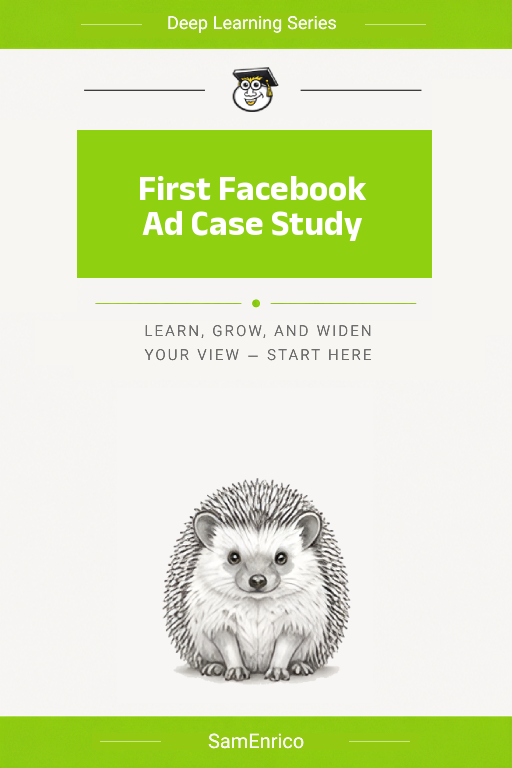
First Facebook Ad Case Study eBook
Follow a real beginner's first campaign from setup
Follow a real beginner's first campaign from setup to results.
Formats
Free sample
Chapter 1: The $500 Paralysis...--It was 11:00 PM on a Sunday when Alex realized something terrifying: three weeks of You Tube tutorials had taught everything except how to click "Publish."The laptop screen glowed in a dark bedroom. A credit card sat next to the trackpad, its plastic edge catching the light like a dare. The candle—Midnight Lavender, hand-poured, soy wax, $30—sat on the desk as a physical reminder of what was at stake. Business was slow. Organic social media was a ghost town.
A friend had said, "Just run a Facebook ad," as if those five words contained a simple instruction manual.They did not.Alex had watched seventeen videos. Seventeen. One expert said "optimize for engagement." Another said "optimize for conversions." A third said "start with traffic." A fourth said "never start with traffic." By the eleventh video, Alex's brain had turned into that GIF of a cartoon character with smoke pouring out of its ears. By the seventeenth, Alex had closed the laptop, made tea, and seriously considered selling everything and becoming a goat farmer.The goat farmer fantasy lasted approximately four minutes.Then Alex reopened the laptop and stared at the blank screen again.This is where most beginners die. Not at the ad auction.
Not at the Pixel setup. Not at the budget decision. They die right here, at 11:00 PM on a Sunday, with a credit card in one hand and a candle in the other, paralyzed by the gap between knowing and doing.The Confession That Opens the Book Let me tell you something about Alex that might surprise you: Alex had already spent money on Facebook ads before. About $200, spread across six months. Boosted posts, mostly.
A few dollars here, a few dollars there. The results were a masterclass in disappointment. Two hundred dollars generated approximately fourteen likes from people in countries Alex had never visited, speaking languages Alex did not speak, none of whom bought a single candle.Those experiments don't count.This is the first real campaign.The distinction matters because boosted posts are to Facebook Ads what a tricycle is to a Formula 1 car. They share the basic concept of wheels and movement, but anyone who confuses the two is in for a painful surprise. Alex learned this the hard way.
The fourteen international likes were a cheap education compared to what some people pay, but an education nonetheless.Now Alex had $500. Real money. Money that could pay for groceries, or fix the squeaky dryer, or go into savings. Money that Alex's spouse (if there was a spouse) or roommate (if there was a roommate) or inner critic (there was definitely an inner critic) would certainly have an opinion about if it disappeared into the digital abyss.The inner critic was already warming up."What if you spend $500 and get zero sales?""What if you accidentally send ads to your competitors?""What if Facebook thinks your candle is a weapon?"That last one was irrational. Alex knew that.
But the irrational fears are often the loudest, aren't they? They don't care about logic. They care about keeping you safe, and "safe" means "not clicking Publish."The You Tube Rabbit Hole and Its Three Contradictory Maps Let me walk you through the specific paralysis that Alex experienced, because I guarantee you have felt something similar.Video Number One: "Facebook Ads for Beginners 2024" by a smiling man in a blue shirt standing in front of a whiteboard. He said: "Start with engagement. Get people to like your page first.
Build trust. Then sell to them later." He drew a funnel on the whiteboard. It looked authoritative.Video Number Two: "How to Make Your First Sale on Facebook" by a serious woman with excellent lighting. She said: "Never start with engagement. That's for people with big budgets.
Start with conversions. Teach the algorithm what you want from Day 1." She did not draw a funnel. She drew a arrow pointing directly to the "Buy Now" button.Video Number Three: "The Only Facebook Ads Strategy You Need" by a man whose thumbnail featured him pointing at a bar graph going up. He said: "Start with traffic. Get people to your website first.
Then retarget them. That's the secret." He had a course. The course was on sale.Three videos. Three strategies. Three experts who all seemed absolutely certain and completely contradictory.This is not a bug in the Facebook Ads educational ecosystem.
This is a feature. The platform changes constantly. What worked six months ago might not work today. What works for a dropshipper with 10,000mightnotworkforacandlemakerwith10,000 might not work for a candle maker with 10,000mightnotworkforacandlemakerwith500. What works for a coach selling 3,000programsmightnotworkforaproductsoldat3,000 programs might not work for a product sold at 3,000programsmightnotworkforaproductsoldat30.The experts are not lying to you.
They are telling you what worked for them, in their context, with their products, their audiences, their budgets, and their risk tolerance. But context is everything, and your context is not their context.Alex needed a framework that worked for a $500 budget, a physical product, and a beginner's tolerance for uncertainty. That framework does not come from You Tube. It comes from understanding one question better than any other.The One Question That Changes Everything Most beginners ask the wrong question first.They ask: "How do I set up a Facebook ad?" Or "What's the best targeting?" Or "How much should I spend?"These are fine questions. They matter.
But they are tactical questions, and tactics without strategy is just guessing.The question Alex needed to answer first was simpler and harder: What does success look like?Not in the abstract. Not "I want to grow my business." Concrete. Measurable. Specific. If you had to choose ONE metric that determines whether this campaign was worth the $500, what would it be?Alex wrote down a list:Likes on the ad Comments from potential customers Shares (organic reach)Website visits (traffic)Add to carts Purchases Email signups Brand awareness (whatever that means)Then Alex crossed off everything except one.Purchases.Only purchases.Not likes.
Not comments. Not shares. Not traffic. Not email signups. Not brand awareness.
If an ad generated 10,000 likes and zero sales, the campaign failed. If an ad generated three sales and nothing else, the campaign succeeded.This is called the One Metric That Matters (OMTM). It is the single most important decision you will make before spending a single dollar on Facebook Ads, and most beginners never make it at all. They optimize for everything, which means they optimize for nothing. They spread their tiny budget across multiple goals and achieve none of them.Alex decided: If an ad doesn't generate a purchase within 7 days, it dies.That was the rule.
That was the commitment. Seven days. One metric. No exceptions.Why This Decision Feels Wrong (But Is Actually Right)When Alex first made this decision, it felt violent. Aggressive.
Impatient. Every expert video had talked about building relationships, nurturing leads, playing the long game. Seven days seemed like a blink.Here is what those experts don't tell you: they have monthly budgets larger than your yearly revenue.A brand spending $100,000 per month on Facebook Ads can afford to play the long game. They can run awareness…
This is the end of the free sample. Get the eBook to keep going. Buy now
About this book
Details
- Author
- Geiger Catherina
- Publisher
- SamEnrico
- Language
- English
- Genre
- Non-Fiction, First 30 Days
- Released
- 2026-05-29
- Pages (approx.)
- 113
- Available as
- eBook, Audiobook

Read better in the ZLOADR app
Your eBooks on your phone or tablet. Sign in with your SamEnrico account and start reading.
More by Geiger Catherina
 Trauma Surgeon Resilience WorkbookGeiger Catherina$11.99
 Middle Manager Self EsteemGeiger Catherina$11.99
 Cope Ahead StrategyGeiger Catherina$11.99
 The Waco Independent ReviewGeiger Catherina$11.99
 The Anapanasati Beginner GuideGeiger Catherina$11.99
 Amun The Hidden OneGeiger Catherina$11.99
 Therapy For BurnoutGeiger Catherina$11.99
 Pressure Suit Failure DrillsGeiger Catherina$11.99
 Cooking Recipe PalaceGeiger Catherina$11.99
 The Iron Titans: How Railroads United a ContinentGeiger Catherina$11.99
 The Silent Guardians: Swiss Precision in the ShadowsGeiger Catherina$11.99
 The Crown and the Kingmaker: How Queen Elizabeth II and Margaret Thatcher Reshaped a NationGeiger Catherina$11.99
You may also like
 Website Launch For New LLCStrunk Tracee$12.99
 Shopify Market Expansion GuideGaffney Jude$12.99
 Power Backup Solutions for Philippine VAsPearce Eldon$12.99
 Feedback License Clause TemplateCrum Ashli$12.99Feedback License Clause TemplateCrum Ashli$12.99Feedback License Clause TemplateCrum Ashli$12.99Feedback License Clause TemplateCrum Ashli$12.99Feedback License Clause TemplateCrum Ashli$12.99Feedback License Clause TemplateCrum Ashli$12.99Feedback License Clause TemplateCrum Ashli$12.99Feedback License Clause TemplateCrum Ashli$12.99
 Channel Distribution On One PagePetersen Narcisa$12.99