
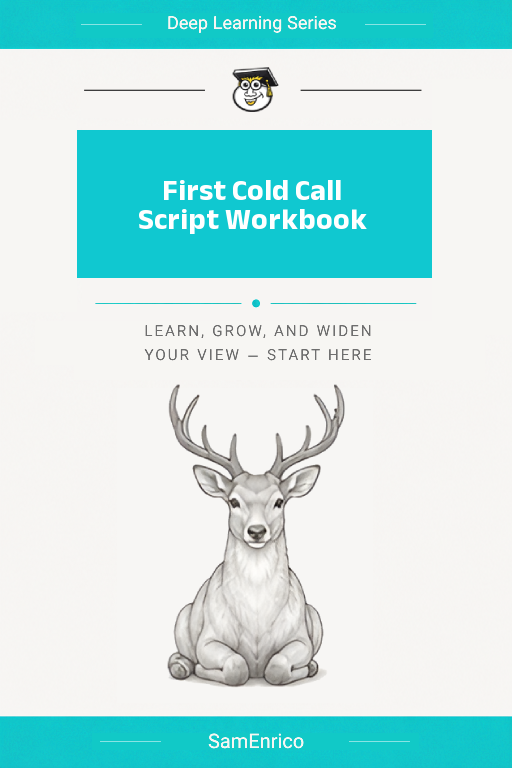
Non-FictionFirst 30 DaysSales TrainingAction Guide
First Cold Call Script Workbook eBook
Write and practice your first five cold call scrip
Write and practice your first five cold call scripts for B2B or B2C sales. Includes objection handlers, voicemail templates, and role-play audio exercises.
Formats
Free sample
Chapter 1: The 10-Second Graveyard--–- The phone feels heavy in your hand. Your finger hovers over the call button. You’ve rehearsed the pitch three times. You know the product works. You believe you can help.
But there’s a knot in your stomach that no amount of preparation seems to dissolve. You press dial. One ring. Two rings. A click.
A voice says, “Hello?” And then you hear yourself say the six words that just killed your chance: “Is this a bad time?”This chapter is called “The 10-Second Graveyard” because that is exactly where most cold calls go to die. Not in minute three, not after the objection, not because the product is wrong. They die in the first ten seconds, buried by a single reflexive question that salespeople have been taught to ask out of politeness. That question—“Is this a bad time?”—is the shovel that digs the grave.Over the next few pages, you are going to learn why those six words are so destructive, what to say instead, and how to turn your opening ten seconds from a liability into your greatest asset. By the time you finish this chapter, you will never open another cold call with a question that invites rejection.
You will have three scripted openers memorized. And you will have recorded yourself enough times that the new habit feels more natural than the old one.Let us begin by understanding exactly what happens in the brain of your prospect during those first ten seconds.The Automatic No Every professional receives cold calls. Executives, managers, buyers, procurement officers—they have all learned a survival mechanism. When an unknown number appears, their brain runs a rapid-fire threat assessment in less than a second. The amygdala, the brain’s fear and pattern-recognition center, flags the call as a potential interruption.
The prospect does not consciously decide to reject you. Their brain decides for them.Here is what that internal monologue sounds like: “Unknown number. Probably a salesperson. I have seventeen emails unread and a meeting in four minutes. I need to end this fast.”This is not personal.
It is not about you. It is a cognitive efficiency hack that every busy person develops. And the moment you say “Is this a bad time?” you give their brain exactly what it wants: permission to say yes and hang up.Let us examine the mechanics of why this question is so damaging. First, it signals low status. You are asking permission to exist in their time.
That is not respectful; it is submissive. Second, it provides an easy exit. The prospect does not have to invent a reason to end the call. You handed them the reason. Third, it frames you as an interruption before you have offered any value.
You have labeled yourself as a nuisance in the first three seconds.Data from 2026 sales engagement platforms shows that calls beginning with “Is this a bad time?” convert to meetings at a rate 40 percent lower than calls that use permission-based openers without the apology. Forty percent. That is not a small difference. That is the difference between a career and a burnout.Consider two versions of the same call. Version A: “Hi Sarah, it’s Mike from Rev Gen.
Is this a bad time?” Sarah’s brain hears: “I am about to waste your time. Please let me off the hook.” Version B: “Hi Sarah, it’s Mike from Rev Gen. Reason for the call is we just helped a company like yours cut reporting time by twelve hours a week. Relevant?” Sarah’s brain hears: “This person has a specific reason. They value my time.
I can answer yes or no without a long conversation.”The difference is not the product. The difference is the frame.Respectful Permission vs. Desperate Permission There is a concept in social psychology called “framing.” The way you present a request determines how it is received. When you ask “Is this a bad time?” you are using what we will call Desperate Permission. You are asking for a favor.
You are assuming the call is an imposition. You are starting from a deficit.Respectful Permission looks completely different. You are not asking for forgiveness. You are stating your purpose and then checking for relevance. The power dynamic shifts.
You are no longer a supplicant. You are a professional with a specific reason for calling, and you respect the prospect enough to be direct.Here is the crucial distinction that most sales training gets wrong: Respectful Permission does not mean asking permission to continue. It means earning attention by demonstrating that you have done your homework and that you value the prospect’s time enough to be brief.Let us compare three openers side by side.Desperate Permission (Do Not Use):“Is this a bad time?”“Do you have a few minutes?”“Sorry to bother you…”“I know you’re busy, but…”Each of these phrases contains an apology or a request for charity. Each one lowers your status. Each one trains the prospect to reject you.Respectful Permission (Use These):“Reason for the call is [specific outcome].
Relevant?”“I’ll be brief. [One sentence of value]. Does that match anything you are working on?”“Two things then I’ll let you go. [Reason]. Worth 30 seconds?”Notice the difference.
You are not asking if you can stay. You are stating that you intend to be brief and then checking if the topic is relevant. The prospect can still say no. But now the no is about the topic, not about you. That is a completely different conversation.The Pattern Interrupt Library Your prospect has answered thousands of cold calls.
They have a script. Their script goes like this: Salesperson says something generic. They say “not interested.” Call ends. Your job in the first ten seconds is not to sell. Your job is to break their script.A pattern interrupt is any unexpected stimulus that forces the brain to pause its automatic processing.
When you say something unexpected, the prospect cannot rely on their default rejection script. They have to actually listen. That pause—even a half-second pause—is your opportunity.Here is your Pattern Interrupt Library. These are five openers that break the automatic rejection loop. They are short, specific, and low-pressure.
They do not ask for permission. They ask for relevance.Opener 1: The Direct Statement“Hey [Name], it’s [You] from [Company]. Reason for the call is [one specific outcome]. Relevant?”This is your workhorse. It works in almost every situation.
The word “relevant” is a pattern interrupt because it is not the word prospects expect. They expect “interested.” “Relevant” is a more neutral, less emotional word. It invites a thinking response rather than a gut reaction.Opener 2: The Referral“[Mutual Contact] suggested I reach out about [topic]. Quick question—are you the right person for that, or should I ask someone else?”This opener works because it leverages social proof and gives the prospect an honorable out. You are not asking them to buy anything.
You are asking if they are the right person. Most people will answer honestly because it costs them nothing.Opener 3: The Two-Question…
This is the end of the free sample. Get the eBook to keep going. Buy now
About this book
Details
- Author
- Duggan Jazmin
- Publisher
- SamEnrico
- Language
- English
- Genre
- Non-Fiction, First 30 Days, Sales Training, Action Guide
- Released
- 2026-06-01
- Pages (approx.)
- 145
- Available as
- eBook, Audiobook

Read better in the ZLOADR app
Your eBooks on your phone or tablet. Sign in with your SamEnrico account and start reading.
More by Duggan Jazmin
 Energy Draining Work HabitsDuggan Jazmin$11.99
 Sleep And Trauma ProcessingDuggan Jazmin$11.99
 The Scream Free Parent Self CareDuggan Jazmin$11.99
 Behavioral Addiction in RetailDuggan Jazmin$11.99
 The Beast of the Labyrinth: Minotaur’s Last StandDuggan Jazmin$11.99
 The Silent Depths: Trieste’s Descent into the MarianasDuggan Jazmin$11.99
 Understanding Hereditary ADuggan Jazmin$17.99
 Alamosite MiningDuggan Jazmin$11.99
 E-Commerce Long Term Outlook 2035Duggan Jazmin$12.99
 How to Start a Hobby in Modeling ShipsDuggan Jazmin$11.99
You may also like
 Hong Kong Handover 1997Dunn Johnnie$11.99
 Zumba For Postnatal Recovery CourseNeal Christian$11.99
 Zumba for BeginnersLadner Nikia$11.99
 YouTube Comment Mining GuideHumes Pandora$12.99
 Worry Box MeditationCarlin Rudy$11.99
 Workplace Stress MeditationNguyen Lynn$11.99
 Workplace Stress and Sleep RepairHawley Ivory$11.99
 Workplace Perfectionism CureDelaney Jeffry$11.99
 Workplace Injustice Anger GuideWallen Isabelle$11.99
 Work Addiction and Burnout LinkGreenwood Ester$11.99
 Women in Yoga and WellnessBeattie Galina$11.99
 Women in Stand Up ComedyChun Evangeline$11.99