
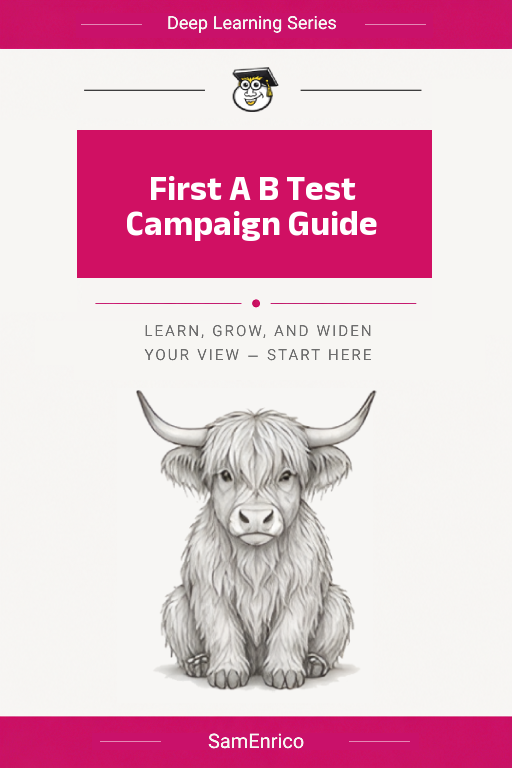
Non-FictionFirst 30 DaysA B Testing
First A B Test Campaign Guide eBook
Test subject lines or send times to improve future
Test subject lines or send times to improve future email performance.
Formats
Free sample
Chapter 1: The Certainty Premium--–- Sarah had just finished her third cup of coffee when she stared at the send button. It was 10:47 on a Tuesday morning. Her email list had grown to 47,000 subscribers over four years. She had a 22% open rate—down from 34% the previous year. Her boss wanted answers.
Her team wanted direction. And Sarah? Sarah wanted to stop guessing.She clicked send.The email went out to everyone. No test. No variant.
Just her gut, a subject line she’d written in sixty seconds, and a send time she’d chosen because someone on Linked In said Tuesday at 10 AM was “the universal best time.”Three hours later, the numbers started coming in. Open rate: 18%. Click-through rate: 2.1%. Unsubscribe rate: 0.8%—higher than usual. Sarah shrugged and said to her assistant, “I guess they just didn’t like this one.”She didn’t know it yet, but that shrug cost her company $47,000 over the next twelve months.Not from that single email.
From the pattern. The habit of guessing. The assumption that “best practices” apply to her audience. The belief that A/B testing was too complicated, too time-consuming, or only for enterprise brands with six-figure marketing budgets.This book exists because Sarah is everywhere. She’s the founder of a $2 million e-commerce brand.
She’s the head of growth at a B2B Saa S company. She’s the solo marketing director at a nonprofit with a tiny budget. And she is leaving money on the table with every email she sends without a test.The Cost of a Single Guess Let’s do the math on Sarah’s Tuesday morning email. She had 47,000 subscribers. Her typical open rate before the decline was 34%.
That would have been 15,980 opens. Instead, she got 18%—8,460 opens. A difference of 7,520 opens.If her typical click-to-open rate was 15%, those lost opens translated to 1,128 lost clicks. With a typical conversion rate of 3% from click to purchase and an average order value of 85,thatsingleemailleftapproximately85, that single email left approximately 85,thatsingleemailleftapproximately2,876 on the table.Now multiply that by fifty-two weeks. By two years.
By the cumulative effect of never knowing what actually works.This is not a hypothetical. Research consistently shows that marketers who run at least one A/B test per week see open rates that are 25-35% higher than those who test monthly or less. More importantly, they see revenue per subscriber that is predictive rather than random. They don’t hope for good results. They manufacture them.The Certainty Premium Defined This book introduces a concept that will appear throughout every chapter that follows: the Certainty Premium.
It is the predictable revenue lift that comes from knowing—not guessing—what your audience responds to.The Certainty Premium has three components:First, there is the Direct Lift. This is the immediate improvement from switching from a losing variable to a winning one. If your control subject line gets a 10% open rate and your challenger gets a 14% open rate, the direct lift is 4 percentage points or a 40% relative improvement. That is real money.Second, there is the Compounding Effect. Unlike a single promotion or a one-time campaign improvement, testing knowledge accumulates.
The subject line formula that wins this month can be applied to next month’s campaigns. The send time that works for your VIP segment can be programmed into your automated flows. The preheader structure that reduces unsubscribes becomes a permanent template. Each test builds on the last.Third, there is the Confidence Dividend. This is the most overlooked component.
When you stop guessing, you stop second-guessing. You stop arguing with colleagues about whether “Free Shipping” or “Free Delivery” will perform better. You stop staying up at night wondering if you sent at the wrong time. You replace anxiety with data. That confidence allows you to move faster, take calculated risks, and scale what works without hesitation.The Anti-Pattern: Why Best Practices Are Worse Than Useless The email marketing industry is drowning in “best practices.” Send on Tuesdays at 10 AM.
Use emojis in subject lines. Personalize with first names. Keep your preheader under 100 characters. Keep your email copy short. Use FOMO.
Use social proof. Use urgency.Here is the uncomfortable truth that most consultants will not tell you: Best practices are averages. And averages are almost always wrong for your specific audience.Consider the “Tuesday at 10 AM” advice. That recommendation comes from aggregate data across thousands of senders. But your audience is not an aggregate.
Your B2B audience might check email at 6:30 AM before their kids wake up. Your e-commerce audience might shop during lunch breaks at 12:30 PM. Your newsletter subscribers might read at 9:00 PM on their phones in bed.When you follow a best practice without testing, you are not optimizing. You are gambling that your audience behaves exactly like the average of everyone else’s audience. That is almost never true.The chapter “Finding Your Audience’s Inbox Habit” (Chapter 7) will show you exactly how to discover your unique audience patterns.
For now, understand this: every minute you spend researching “best practices” is a minute you are not spending learning about your own subscribers.The Privacy Shift That Changed Everything In September 2021, Apple released i OS 15 with Mail Privacy Protection. This feature automatically loads remote content—including tracking pixels—regardless of whether the user opens the email. The result? Open rates became estimates, not counts.Many marketers panicked. They saw open rates spike by 30-50% overnight and assumed their engagement had miraculously improved.
It hadn’t. Apple was simply opening emails in the background.This shift revealed something uncomfortable: most marketers were optimizing for a metric that was never that reliable to begin with. Open rates could be inflated by preview panes, blocked images, and now, automatic pixel firing.The smartest marketers responded not by abandoning testing but by changing what they tested and how they measured success. They shifted focus from opens to clicks. They prioritized Click-to-Open Rate (CTOR)—clicks divided by unique opens—because CTOR tells you whether the people who opened actually engaged with your content.
And they started testing subject lines based on CTOR rather than raw open rates.Chapter 6, “Analyzing Subject Line Results Beyond the Open Rate,” will provide the complete framework for this new analytics reality. But the key takeaway for this chapter is simple: the old ways of guessing are no longer just expensive. They are actively misleading.The Three Traps That Keep Marketers from Testing Before we go further, we need to name the enemy. Not the competition. Not Apple.
Not your ESP’s limitations. The real enemy is the mental models that keep smart people from running tests.Trap One: The Perfectionism Fallacy This is the belief that a test must be perfect to be valuable. That you need a 95% confidence level. That you need a massive sample size. That you need to control for every possible variable.The reality is that an imperfect test is infinitely better than no test.
You do not need a Ph D in statistics to run a useful A/B test. You need a hypothesis, two variants, and a willingness to learn. Chapter 3, “Statistical Significance for the Impatient,” will give you the minimum viable framework—nothing more.Trap Two…
This is the end of the free sample. Get the eBook to keep going. Buy now
About this book
Details
- Author
- Creech Cecila
- Publisher
- SamEnrico
- Language
- English
- Genre
- Non-Fiction, First 30 Days, A B Testing
- Released
- 2026-05-29
- Pages (approx.)
- 125
- Available as
- eBook, Audiobook

Read better in the ZLOADR app
Your eBooks on your phone or tablet. Sign in with your SamEnrico account and start reading.
More by Creech Cecila
 Major Depressive Disorder Explained for Social WorkersCreech Cecila$11.99
 Complete Protein Sources GuideCreech Cecila$11.99
 Anacaona Taíno ChiefCreech Cecila$11.99
 Substance Abuse Prevention CoordinatorCreech Cecila$11.99
 The Resilience PharmacyCreech Cecila$11.99
 Loving Kindness for Addiction CounselingCreech Cecila$11.99
 Daily Review Evening RitualCreech Cecila$11.99
 Purpose in Retirement YearsCreech Cecila$11.99
 The Phantom Trucker: Australia's Highway of HorrorsCreech Cecila$11.99
 The Secret Stitch: How a Medieval Tailor Revolutionized Rugby in the Southern CrossCreech Cecila$11.99
 Service Providers Guide to Portrait & Wedding PhotographyCreech Cecila$11.99
 How to Start a Cork Products (except Cork Life Preservers)(manufacture) Business (Beginners Guide)Creech Cecila$11.99
You may also like
 Hong Kong Handover 1997Dunn Johnnie$11.99
 Zumba For Postnatal Recovery CourseNeal Christian$11.99
 Zumba for BeginnersLadner Nikia$11.99
 YouTube Comment Mining GuideHumes Pandora$12.99
 Worry Box MeditationCarlin Rudy$11.99
 Workplace Stress MeditationNguyen Lynn$11.99
 Workplace Stress and Sleep RepairHawley Ivory$11.99
 Workplace Perfectionism CureDelaney Jeffry$11.99
 Workplace Injustice Anger GuideWallen Isabelle$11.99
 Work Addiction and Burnout LinkGreenwood Ester$11.99
 Women in Yoga and WellnessBeattie Galina$11.99
 Women in Stand Up ComedyChun Evangeline$11.99